Walski’s Note: As a follow-up to his essay New Malaysia: Democracy, Interrupted? that we published yesterday, guest writer Mikhail Hafiz penned this afterword, which in a sense brings us up to speed from the time he wrote the essay was originally written in late 2022. In a way, it provides some closure, but not how you’d usually think about closure. More of an affirmation, that while the details may have changed, where we are in the political spectrum hasn’t changed all that much. As with Mikhail’s other essays, this was originally published as an X/Twitter thread on 9 May 2025.
History says: Don’t hope on this side of the grave. But then, once in a lifetime, The longed-for tidal wave of justice can rise up And hope and history rhyme.
Seamus Heaney (1939-2013)
Seven years ago today, Malaysia experienced a violent political fracturing that reshaped our local political landscape after decades of BN’s uncontested hegemonic dominance, and resulted in the first change of federal government in Malaysian political history.
In the intervening years, however, our beleaguered nation has weathered a political coup that led to the formation of two consecutive morally illegitimate and constitutionally questionable governments, and soldiered through a debilitating global pandemic, amidst the ominous rise of a militant conservative Islamist movement, and worsening racial and religious polarisation, as Malaysia transitions from the ancien régime of hegemonic authoritarianism to a dynamic era of mercenary multipolarity.
Paradigmatically, Malaysia now finds itself in an unenviable predicament: caught between the proverbial rock and hard place, unlikely to return to the bygone days of single-party state dominance, even as the coalition-of-coalitions blueprint remains untested.
Indeed, the crucial issue that may come to dominate GE16, as Malaysia’s tilting ship of state navigates herself through such perilously uncharted waters, is that in an era of pernicious political fragmentation, will our first-past-the-post system still encourage a binary logic?
In other words, will the centre(-right) continue to hold, so as to ensure that it does not fall apart? Or will the “green wave” of Islamist conservatism continue to gain momentum, causing the nation to lurch even further to the right?
If one takes a longue durée approach to Malaysian politics, it is not inconceivable that, given the similarity of our electoral systems, journalist Andrew Marr’s predictions of the UK’s political fortunes could also unfold in our country: “With four or five parties competing in an atmosphere of pessimistic political turbulence, the likelihood is of a sequence of coalitions, failing to produce quick solutions, then collapsing and being replaced by others; a kind of downward spiral of protest, disappointment and political chaos.“
And so, after a turbulent and rancorous interregnum that has seen the appointment of four different prime ministers in as many years, has Malaysia’s very own Velvet Revolution run out of steam, as indicated by its staunchest supporters’ rumblings of discontent?
Has the much vaunted Reformasi movement, (once) embodied by the messianic figure who now helms the unity government, been hampered, hamstrung, and hindered by opportunistic realpolitik in the ostensible pursuit of domestic political stability? Has the exhilarating moment of collective euphoria and exultant joy of that sultry May night – so memorably captured in spontaneous eruptions of rapturous celebrations across the country – given way to creeping dissatisfaction, disenchantment, and despondency?
EPILOGUE:
The incumbent governing coalition is trying to thread an excruciatingly narrow political needle: reiterating its commitment to the reform agenda, whilst seeking to bolster its political legitimacy by courting the support of the Malay-Muslim polity, even as the bellicose and feckless ethnoreligious chauvinist opposition continues to frame the Madani government and its intended reforms as an existential threat to the ethnic majority, instead of functioning as a responsible and reliable check and balance mechanism.
While our long days’ journey into the night, so to speak, remains uncompleted, one remains hopeful that Malaysia will someday take her place among the great nations of the world as “a beacon of light in a disturbed and distracted world”, as envisaged by our founding fathers.
After all, in the words of the English poet Alexander Pope, “hope springs eternal in the human breast”.
So hope for a great sea change, On the far side of revenge. Believe that a further shore Is reachable from here.
Seamus Heaney (1939-2013)
Author’s Note: This thread serves as an afterword to “New Malaysia: Democracy, Interrupted?“, my latest #RediscoveringMalaysia article, in which I chronicle Malaysia’s historic electoral Zeitenwende, and the circumstances that led to this momentous occasion.
(The original main essay, New Malaysia: Democracy, Interrupted? may be read here)
Walski’s Note: Originally published on 17 November 2022 as an X/Twitter thread in four parts, guest writer Mikhail Hafiz‘s essay brilliantly examines the developments in Malaysia’s democratic space. For the sake of continuity and easy reading, it is presented here as a single essay. I have taken some liberty to apply some minor editing (spelling and language), but otherwise, the content presented here is identical to the original threads.
Democracy is the government of the people, by the people, for the people.
Abraham Lincoln (1809-1865)
The battle for contemporary Malaysia remains a tensile, to-and-fro tussle between two concomitantly contesting political pathways: democratic consolidation and authoritarian expansion. Will either ideological trajectory eventually emerge triumphant?
INTRODUCTION
The end of rebellion is liberation, while the end of revolution is the foundation of freedom.
Hannah Arendt (1906-1975)
On 9 May 2018, Malaysia witnessed its very own Velvet Revolution.
This remarkable, precedent-defying electoral Zeitenwende, which has so far registered the highest reading on the Malaysian political Richter scale, was not attained via battle and bloodshed, but through the long queues at polling stations across the nation, where over 12 million Malaysians lined up patiently to cast their ballots on that fateful day.
As political observers watched the cataclysmic collapse of the hegemonic Barisan Nasional (BN) behemoth unfold with a mixture of surprise and schadenfreude, this historic epochal affirmation of political possibility shattered the seemingly immutable political myth of “the eternal yesterday” that Malaysia would be governed by the same consociational coalition until kingdom come, clearly demonstrating that while the past cannot be dismissed or denied, it does not conclusively define the present, nor does it necessarily dictate the future.
For more circumspect Malaysians, however, this watershed moment marked more than the vanquishment of a truculent, kleptocratic ancien régime, and the culmination of a seismic, albeit glacial, decade-long transition from a one-party state system to its two-coalition counterpart. Most importantly, it signalled the sobering and instructive start of a long and arduous task to steer the wayward and listing state vessel that is Malaysia back on her right course, en route to eventual sovereign maturity, in the hope that she can someday take her place among the great nations of the world as “a beacon of light in a disturbed and distracted world”, just as our founding fathers had envisaged, and to do so unencumbered by the undesirable, uncharitable and unsolicited monikers often ascribed to hybrid regimes.
Unfortunately, this narrow window of opportunity was slammed shut by the Sheraton Move, an abhorrent, baleful, calamitous and dastardly political coup de main that subsequently ushered in Malaysia’s ‘Democracy: Interrupted’ era, and saddled our nation with two consecutive mandate-less and manifesto-less governments in 2020. Two years on, this abominable post-election non-sequitur continues to cast a lengthy and ominous shadow over the integrity of our democratic process.
This brazen and odious legislative volte-fa(r)ce is, in retrospect, hardly surprising. Malaysia’s functional relationship with representative democracy, like that of its regional counterparts, while not quite adversarial, has nevertheless been fraught and troubled: expectantly complex, inherently discrepant and frequently problematic.
As Lindsey W. Ford and Ryan Hass of the Brookings Institution perceptively surmise: “Widespread democratization throughout the 1980s and 1990s shifted the complexion of the region away from its illiberal past, ushering in rising hopes of a democratic wave. In recent years, however, democratic backsliding has shifted the political tides in the opposite direction, leading to a resurgence of illiberalism, and in some cases, rising authoritarianism.” (Brookings Institution website)
Michael Vatikiotis, Asia Regional Director of the Centre for Humanitarian Dialogue, a Geneva-based private foundation that facilitates dialogue to resolve armed conflicts, agrees.
In ‘Blood and Silk: Power and Conflict in Modern Southeast Asia‘, his illuminating 2017 literary offering – ambitious and expansive, yet accessible and engaging – which surveys the power structures that define the region, Vatikiotis concludes that:
“If the 1990s was a decade of reform and political transformation in Southeast Asia, then the first two decades of the twenty-first century have seen disappointing dividends.“
“Across the region, respect for human rights, democracy and popular sovereignty has continued to diminish.”
Troublingly, persistent and protracted political polarisation across ethnic, religious and ideological cleavages, along with the wariness or reluctance of most regional leaders to address the consequential risks of authoritarian political influence, only adds to the complex stresses and strains encountered by Indo-Pacific nations.
While democratic erosion precipitated by harsh political conflict is not yet so debilitating for our nation to be threatened by the spectre of democratic dissolution, political violence, or civil war, the warning signs are nevertheless disquieting. This worrying trend is not only confined to Malaysia but rather, part of a larger regional phenomenon, where deepening divisions, frequently fuelled by partisan majoritarian political agendas, are enabling anti-democratic action, and driving democratic regression in key countries throughout the South and Southeast Asia regions. (Carothers & O’Donohue, 2020)
In our understandable haste and eagerness to embrace (and forge) a more benign democratic rule, we may have unintentionally overlooked a crucial axiomatic tenet of political governance: incumbent turnover is a necessary but not a sufficient condition for regime change.
While it may mark the symbolic commencement of a polity’s transition from competitive authoritarian system to functioning democracy, the alternation of power itself does not necessarily result in the substantive process of democratisation.
As Meredith L. Weiss, professor of Political Science at the University of Albany, State University of New York, asserts in her thoughtful and thought-provoking 2020 opus, ‘The Roots of Resilience: Party Machines and Grassroots Politics in Singapore and Malaysia‘: “Real regime change (ie, regime restructuring) requires both alternation of power and a change in linkages and governance. The first of these transformations does not necessarily entail the second.“
In this disjointed, discordant, dysfunctional and (temporarily) derailed epoch of constitutional democracy, the only predictable aspect of contemporary Malaysia’s protean political landscape is its very unpredictability.
As such, the reading of political tea leaves in Malaysia’s ‘Democracy: Interrupted’ era is proving to be an extremely imponderable – if not impossible – endeavour, given the incalculable, volatile and dynamic temperament of our local political environment.
Indeed, any idiosyncratic predictions or temporal projections of intra-party, inter-party and inter-coalition elite machinations by the intellectual intelligentsia have come to resemble a Rorschach test of sorts.
In a 2002 article titled ‘Elections Without Democracy: The Menu of Manipulation‘, Andreas Schedler, Senior Research Fellow at the Central European University Democracy Institute, brings clarity to a common misperception linking suffrage to popular sovereignty:
“The idea of democracy has become so closely identified with elections that we are in danger of forgetting that the modern history of representative elections is a tale of authoritarian manipulation as much as it is a saga of democratic triumphs.
Since the early days of the “third wave” of global democratisation, it has been clear that transitions from authoritarian rule can lead anywhere. Over the past quarter-century, many have led to the establishment of some form of democracy. But many others have not.“
Schedler argues, instead, that “[t]hey have given birth to new forms of authoritarianism that do not fit into our classic categories of one-party, military, or personal dictatorship”, and are categorised as “electoral authoritarian regimes”.
As Harvard University political scientists Steven Levitsky and Daniel Ziblatt incisively observe, in their critically acclaimed and well received 2018 tome ‘How Democracies Die‘, “[t]he tragic paradox of the electoral route to authoritarianism“, while less dramatic in comparison to the military might and coercive forces of a coup d’état but equally destructive, “is that democracy’s assassins use the very institutions of democracy – gradually, subtly, and even legally – to kill it.”
In other words, “[d]emocracy’s primary assailants today are not generals or armed revolutionaries, but rather politicians […] who eviscerate democracy’s substance behind a carefully crafted veneer of legality and constitutionality.” (Levitsky & Ziblatt, 2021)
MALAYSIA: ILLIBERAL DEMOCRACY OR COMPETITIVE AUTHORITARIAN REGIME?
In every age it has been the tyrant, the oppressor and the exploiter who has wrapped himself in the cloak of patriotism, or religion, or both to deceive and overawe the People.”
Eugene V. Debs (1855-1926)
As Marina Ottaway, Middle East Fellow at the Woodrow Wilson Center, astutely observes in her seminal 2003 tome, ‘Democracy Challenged: The Rise of Semi-Authoritarianism‘:
“They (semi-authoritarian regimes) are ambiguous systems that combine rhetorical acceptance of liberal democracy, the existence of some formal democratic institutions, and respect for a limited sphere of civil and political liberties with essentially illiberal or even authoritarian traits.
This ambiguous character, furthermore, is deliberate.“
It is not without reason that Ottaway, a long-time analyst of the formation and transformation of political systems, pointedly highlights the insidious and sinister intent behind this malignant equivocality:
“Semi-authoritarian systems are not imperfect democracies struggling toward improvement and consolidation but regimes determined to maintain the appearance of democracy without exposing themselves to the political risks that free competition entails.“
In a 1999 working paper titled ‘Challenge of Semi-Authoritarianism‘ for the Carnegie Endowment for International Peace, Ottaway and co-author Martha Brill Olcott remark that while “semi-authoritarian regimes continue to go through the motions of a democratic process,” they have also become “masters at stifling electoral competition or at keeping parliaments powerless and judiciary systems cowed“, and “learned to manipulate public opinion“, shrewdly employing a Janus-faced juxtaposition of claiming that “they are committed to popular empowerment and the redistribution of power” on the one hand, and yet, emphasising “the risks of instability they claim are inherent in untrammeled competition and by doing so succeed in deflecting criticisms and reducing internal pressure for democratization” on the other, combining “formal democracy, a modicum of political openness, and fundamental authoritarian tendencies“. The defining characteristic of such regimes is: “the existence and persistence of mechanisms that effectively prevent the transfer of power through elections from the hands of the incumbent leaders or party to a new political elite or political organization.” (Carnegie Endowment for International Peace website)
Accordingly, the aim of this illiberalism, as postulated by American academic and author Christopher R. Browning, the Frank Porter Graham Professor of History Emeritus at the University of North Carolina at Chapel Hill, is a ” ‘managed democracy’ [where the public is shepherded, not sovereign,] unchecked by an independent judiciary and untrammeled by the inconvenience of real democratic accountability that comes through the hazard of electoral defeat and alternating parties in government.“
It is this constant and continual “push-and-pull” of antithetical/contradictory political forces between democratic consolidation and authoritarian expansion that continues to generate an as yet unresolved – and possibly even Gordian knot of unresolvable – ideological tension in hybrid regimes.
More often than not, this tension also galvanises various political actors from opposing sides of the political spectrum to adopt more calcified positions; the resultant rigidity only serves to perpetuate the bruising political stalemate and stultifying ideological impasse.
While much scholarly attention has been focused on incumbent turnover as the principal determinant and prerequisite of democratic consolidation, it is imperative to consider three other salient factors that contribute to authoritarian resilience in Malaysia: illiberal democratic practices (gerrymandering, malapportionment) instituted by successive authoritarian governments; authoritarian innovations employed by new configurations of opposition forces; and authoritarian acculturation of the electorate via personalistic politics.
COMPETITIVE AUTHORITARIANISM IN MALAYSIA
The liberty of a democracy is not safe if the people tolerated the growth of private power to a point where it becomes stronger than the democratic state itself. That in its essence is fascism: ownership of government by an individual, by a group, or any controlling private power.
Franklin D. Roosevelt (1882-1945)
Antidemocracy, executive predominance, and elite rule are basic elements of inverted totalitarianism.
Sheldon S. Wolin (1922-2015)
The examination of competitive authoritarianism in Malaysia can be divided into three phases: genesis, evolution and consolidation.
GENESIS: SOFT AUTHORITARIANISM
How did authoritarianism become so inextricably woven into our political tapestry, and so indelibly enmeshed in our social fabric?
It is only apposite that, in seeking to countenance the vice-like grip which competitive authoritarianism continues to exert over Malaysian sociopolitical consciousness, we return to the idiosyncratic circumstances which led to the transformation of an anti-colonial entity defined by its hostility towards Western European imperial powers to a post-colonial polity predicated on the political ideology of popular sovereignty.
In what can arguably be described as a shortsighted miscalculation, an executional oversight or an executional flaw, democratic implements and procedures that were transplanted wholesale to the newly constituted polity of Malaya were ultimately found to be wanting in terms of efficiency and efficacy, due to the failure of our hastily departing colonisers to inculcate a democratic culture among the local population.
According to the eminent scholar of Malaysian politics Gordon Paul Means, the genesis of Malaysia’s bifurcative political system can be traced back to her singular quest for colonial independence, and damage control exigencies of a retreating British empire in the aftermath of the Second World War:
“Instead of gradual transition to democracy and independence, the British were forced into making piecemeal concessions to one ethnic community after another. Therefore, the introduction of democratic institutions was retarded as the British strove to manage rising ethnic conflict by negotiating directly with the leaders of the main ethnic communities. None questioned whether democracy was congruent with “Asian values,” or doubted that an independent judiciary was needed to protect human rights against the sovereign powers of new governments. As a consequence, the wholesale transplanting of British-style democratic institutions was easily accomplished and received wide popular support.“
“The introduction of elections and representative institutions did not produce widespread popular participation in political affairs. Neither the public nor elites had experience with democracy. The colonial system, even in its most benevolent phases, had been highly authoritarian. Each ethnic community supported leaders from traditional status hierarchies or at the apex of various patron-client networks.“
“For all communities, ‘Asian values‘ meant communal loyalty, distrust of government, and avoidance of individual or collective responsibility for wider public interests. Few could acknowledge or empathize with the claims of ethnic communities other than their own. In this climate, elections and parliamentary government became the basis for the rituals of legitimacy, while the habits and attitudes required for a civic culture and participatory democracy went largely uncultivated.”
This disjuncture enabled the incipient seeds of incremental (or creeping) authoritarianism, which were sown during the Abdul Razak Hussein and Hussein Onn premierships, to be nurtured from the first Mahathir Mohamad administration through the Abdullah Badawi and Najib Razak eras right up to the present day.
A democracy is more than a form of government; it is primarily a mode of associated living, of conjoint communicated experience.
At this point of the discussion, it is imperative to identify the wide range of political controls instituted by successive BN-led, UMNO-dominated governments that restricted scope for criticism and opposition, thereby favouring the ethnic majority ruling elite. The most comprehensive and extensive powers available to the federal government are provided by Article 150 of our Federal Constitution, pertaining to the proclamation of Emergency.
Other legislative forms of political control include the Internal Security Act (1960) which permits detention without trial (repealed in 2012); The Sedition Act (1948) and The Official Secrets Act (1972) that place far-reaching restrictions on political discussion, and issues that the opposition could raise against the government respectively; the Printing Presses and Publications Act (1984) that controls the press and other publications; the Trade Union Act (1959) to prevent the growth of a strong trade-union movement that might fall under the political influence of the opposition; the Universities and University Colleges Act (1971) to prohibit student participation in local politics (later amended); and the Societies Act (1966) relating to the registration of societies.
The distinguished academic Harold Crouch notes that while “[t]he government’s authoritarian powers were ostensibly acquired to maintain political stability and public order“, they were also in reality “used to preserve the position of the ruling coalition and the dominant faction in its dominant party“. As such, “the authoritarian character of the regime was enhanced incrementally“, in response to various domestic political crises, most notably during the 1969 Emergency, the 1975-1977 UMNO crisis, the 1977-1978 Kelantan Emergency, the 1987 Operasi Lalang, the 1988 UMNO split and judicial crisis, and the 1993 confrontation with the Malay rulers.
This continuing evolution of incremental authoritarianism led Ooi Kee Beng, Executive Director of the Penang Institute, to caution in 2001 that “[a]ny euphoria over the phenomenal growth in economic strength and the increase in national pride must however be balanced by an acknowledgement of the damage that has been done to the democratic traditions of the nation.”
Following the resignation of authoritarian strongman Mahathir Mohamad in 2003, his handpicked successor Abdullah Badawi assumed helmsmanship of the nation, promising not only a wide range of political reforms that included the promise of greater accountability, transparency and a thorough overhaul of key national institutions (civil service, judiciary, police force), but also to be a prime minister for all Malaysians.
Appropriating the informal, avuncular sobriquet of “Pak Lah”, Badawi capitalised on his popularity, burnished by his religious credentials and untarnished reputation, in his congenial appeal for Malaysians to “work with me, not for me“.
Malaysian voters responded rapturously by bestowing the largest ever electoral mandate upon BN the following year, with the coalition winning an overwhelming majority of 198 parliamentary seats, and securing 63.9% of the popular vote.
Sadly, many of the promised reforms failed to materialise. While Badawi and BN were lulled into a soporific slumber by confirmation biased faux reassurances emanating from ever distancing and isolating media echo chambers manipulated by their sycophantic supporters, the increasing friction caused by festering grievances of mainly non-Malays and moderate Malays that had been building up over the last few years, further exacerbated by the belligerent rhetoric and weapon-waving antics of a youth leader during UMNO’s annual general assemblies, eventually ruptured the nation’s political tectonic plates, causing an unexpected and unforeseen electoral earthquake in GE12 (2008); it was a sudden and rude awakening that not only revoked the incumbent coalition’s hitherto unchallenged two-thirds majority – thus circumscribing its unfettered ability to amend our Federal Constitution with impunity – but also handed legislative control of five (later four) state governments to the opposition bloc.
In the final analysis, the Badawi administration, according to academician Farish A Noor, was one that was “long on gimmicks and novelties, but short on substance and delivery“.
Following BN’s dismal performance, Badawi was supplanted by Najib Razak in 2009, who came to power promising reform of our nation’s arcane security laws that impede free speech, and affirmative action policies that privilege the Bumiputeras and marginalise the non-Malays and Muslims but fared no better than his immediate predecessor during his nine year tenure.
Not only did BN fail to regain its much-coveted two-thirds majority, but the coalition also lost the popular vote share for the first time in GE13 (2013). As chronicled by Vatikiotis, “when his legitimacy was called into question after revelations that billions of dollars were misused or went missing from a development fund he managed, Najib veered sharply off the path of reform and began shoring up his position using the tools of despotism and division.“
Indeed, nowhere were Najib’s authoritarian tendencies more pronounced than in his iron-fisted, heavy-handed response to quell public dissent and silence criticism of the 1MDB debacle, as summarised by retired academic Francis Loh Kok Wah:
“[Najib Razak] responded to the deepening scandal by sacking his Deputy Prime Minister and several other ministers when they questioned him on the 1MDB fiasco. He also terminated the services of the previous Attorney General, the previous Governor of Bank Negara and the head of the Malaysian Anti-Corruption Commission as they, reportedly, closed in on the case. His new Attorney General then declared that he could find no evidence of corruption and abuse.
Instead, he and other law enforcement agencies charged, imprisoned or took to court Malaysian whistleblowers and others who had persisted in criticising the prime minister.”
Meanwhile, the (alleged) murders of Kevin Morais, Hussain Najadi and Teoh Beng Hock remain quietly unsolved, as do the (en)forced disappearances of Amri Che Mat, Raymond Koh, Joshua Hilmy and Ruth Setapi, cruelly depriving their families of much-needed closure.
CONSOLIDATION: SHERATON MOVE & THE FALL OF NEW MALAYSIA
While PH triumphed against the odds in GE14, despite BN’s distinct advantage in terms of the “three Ms” – (party) machinery, media and money – it appeared to have developed an acute case of political stage fright afterwards.
John Funston, Visiting Fellow in the College of Asia and the Pacific at the Australian National University, notes that “[a]fter a promising start, the Pakatan government soon lost its way. The early stages saw a slew of progressive reforms. Malaysians of integrity were appointed to key government offices. Legal action was taken against corrupt politicians. Human rights issues gained prominence, and media freedom became a reality.” (East Asia Forum)
To complicate matters further, PH inadvertently ceded the national narrative to the newly formed Muafakat Nasional (MN) opposition bloc, which constantly framed the multi-ethnic ruling government and its intended reforms as an existential threat to the Malay-Muslim community.
Promises to ratify the UN International Convention on the Elimination of All Forms of Racial Discrimination (ICERD) and the Rome Statute of the International Criminal Court were abandoned after the reformist government encountered ferocious backlash from the ethnic majority, in the wake of a vituperative campaign orchestrated by UMNO and Parti Islam SeMalaysia (PAS), the constituent parties of MN, and disparate elements of the political right, to heighten nativist sentiment.
Internecine power struggles and the failure to address several key issues, ranging from the Malay-Bumiputera Agenda and the 1963 Malaysia Agreement (MA63) to political Islam and a clear timetable for transition of power (Chin, 2019), eventually led to crippling defections, which in turn triggered its collapse in February 2020, enabling the hitherto defeated BN to return to federal power in a preponderantly Malay-Muslim coalition that incorporated PAS, Parti Pribumi Bersatu Malaysia (PPBM) and the separatist faction of Parti Keadilan Rakyat (PKR). After being banished to electoral purgatory in GE14, “Old Malaysia” had effectively outmanoeuvred “New Malaysia” and staged a successful revanchist comeback in 22 months.
Having been appointed by procedures that defied Westminster democratic conventions, Muhyiddin Yassin – the newly anointed premier of the Perikatan Nasional (PN) government – then proceeded to govern in a similar manner, by dispensing political largesse to shore up his precarious and unendorsed parliamentary majority, and consolidating his tenuous position through Emergency rule and the prorogation of Parliament.
Democratic decline proceeded apace, as media freedom reverted to the pre-New Malaysia era, while opposition politicians faced an array of legal harassment.
The much vaunted post-Sheraton Move “backdoor government”, the crowning achievement of Malaysia’s ethnoreligious tribalist faction – described by Ooi as “an unholy and unstable alliance” – would, however, turn out to be a short-lived, self-inflicted Pyrrhic victory:
“In 2020, the toppling of the Pakatan Harapan government achieved something Malay supremacists had wanted along – effectively an all-Malay government.
But since the fulfilling of that goal, no significant ideological difference is apparent among the top leaders in PN, UMNO and even the Islamist Parti Islam SeMalaysia (PAS).
To the common man, top-level politics in Malaysia today appears to be about power as a goal in itself – no nation-building vision, no unity programme, and no economic development masterplan that can be taken seriously.“
Hardly surprising then, that in a classic case of “things fall apart, the centre cannot hold”, to quote a line from ‘The Second Coming” by English poet WB Yeats, just as hastily as it had been stitched together, this morally illegitimate and constitutionally questionable government unraveled at breakneck speed, and finally met its ignominious end on 16 August 2021. (see Mikhail Hafiz’s X/Twitter thread from 17 Aug 2021)
UMNO’s audacious power grab notwithstanding, the unlamented demise of this kakistocratic intermezzo is undoubtedly connected to its woeful 17 month performance, as expounded by Bridget Welsh, Honorary Research Associate with the University of Nottingham Asia Research Institute Malaysia: “Muhyiddin’s ‘all Malay’ government gave ethnonationalists what they asked for, and it has not performed. More Malays are taking a hard look at ethnonationalist governance and find it wanting.
Malays have experienced the most COVID-19 deaths and been hard hit by deficiencies in the social safety net. Their views of their leaders are shifting.”
“Government failure has led to a rethink of its role as problem solver. More now see it as the problem and have greater appreciation for the power of action from below.” (East Asia Forum)
Perhaps the most damning indictment of the grand larceny of the GE14 electoral mandate committed by the Sheraton Move conspirators is evidenced in a forcefully articulated argument by intellectual activist Clive Kessler on moral legitimacy (i.e., the right to govern that is predicated upon the results of a free and fair election, as opposed to predetermined selection):
“[E]lections are indispensable and fundamental to representative parliamentary democracy: Not just because, through this device, governments emerge and are installed.
But, more basically and importantly, because it is by means of national elections that the government, the regime it heads and the entire political order at whose apex the government stands, are morally empowered, ‘made legitimate’ “.
In this way and by no other means, our governments are given that special kind of “secular democratic sanctity” that endows modern governments and states with moral authority.
A compelling authority that obliges all citizens to heed their decisions, and so makes government authoritative and effective.” It is a moral and intellectual position that elicits strong support from the East Asian Forum Editorial Board:
“Nobody expects countries like Malaysia or Thailand – let alone even more politically blighted neighbours – to emerge as textbook liberal democracies any time soon. But a mandate earned at the ballot box, once all else falls away, is sacrosanct in even the most flawed democracy.
The least Southeast Asia’s political elites can do for the maturation and legitimacy of democratic norms is to not violate the mandate extended by the voters who handed them government, or to disenfranchise outright many millions of voters who exercise their right to choose differently.” (East Asia Forum)
The sacrosanctity of the electoral mandate as the bedrock of institutional, moral and sovereign legitimacy in an parliamentary democracy is powerfully driven home by Ooi in his blistering denouncement of illiberal democratic practices:
“[I]t is with the free and fair vote that a democratic culture comes into being. That is how notions of fairness penetrate society, and bring dignity to its politics. The integrity of its vote is the measure of a society’s self-esteem.”
“Gerrymandering and malapportionment of constituencies, which are rampant and par-for-the-course in the case of Malaysia, do make elections farcical to a painful degree. When you compromise the egalitarian vote, you compromise the legitimacy of the system, and you damage the reputation of the country. Worse than that, you open a Pandora’s Box of corruption, arrogance, accountability and non-transparency.“
At federal level, the concentration and consolidation of power in the executive branch of Malaysia’s electoral democracy, often at the expense of the legislative, judiciary, civil society, media and press has been achieved through “coercive legalism” by the BN-UMNO state; this predicament may account for the widely held perception of “rule by law” among Malaysians, as opposed to “rule of law“, which connotes a system of constitutional democracy with balances and checks in place, leading critics to designate Malaysia as a “quasi-democracy“, a “semi-democracy”, a “repressive-responsive regime” or even a “statist democracy“. (Loh, 2006)
Malaysia’s (infamous) reputation as a bastion of competitive authoritarianism is reinforced by its “Partly Free” status in the Freedoms In The World index by Freedom House for the last two years. (Freedom House)
The continuing political instability has also led to the expanding political influence of Malaysia’s monarchs, vis-à-vis the constitutional powers invested in the reigning Yang di-Pertuan Agong in the appointment of the Prime Minister and the proclamation of the Emergency.
Additionally, Ford and Haas have observed “[another] worrisome trend across the Indo-Pacific region in the past few years”, which is “the uptick in new legislation limiting individual and civil liberties, placing restrictions on freedom of assembly, civil society organizations, religious institutions, and the freedom of the press.” In many cases, these developments, additionally accelerated by the global CoVid-19 pandemic, “are less of a new trend than a reversion to the mean, with governments turning to familiar illiberal tools and practices in a bid to stifle unrest and prop up their own positions in a more volatile domestic political environment.“
CONSEQUENCES
In a democracy dissent is an act of faith. Like medicine, the test of its value is not its taste but its effects, not how it makes people feel at the moment, but how it inspires them to act thereafter.
Criticism may embarrass a country’s leaders in the short run but strengthen their hand in the long run; it may destroy a consensus on policy while expressing a consensus of values.
Criticism, in short, is more than a right; it is an act of patriotism, a higher form of patriotism, I believe, than the familiar rituals of national adulation.
James William Fulbright (1905-1995)
The enfeebling effects of competitive authoritarianism in Malaysia are most conspicuously evidenced in three areas: strategic economic development; intellectual integrity; and electorate expectation.
STRATEGIC ECONOMIC DEVELOPMENT
Sustained economic growth in East and Southeast Asia in the last few decades has led to the emergence of “developmental states”, which are characterised by the strong state intervention, as well as extensive regulation and planning.
There is, however, one significant drawback: it is difficult, if not impossible, for (semi-)authoritarian regimes to maintain or improve their performances as “development states” in the long run.
As Wong Tek Chi, Research Assistant at Australian National University’s Tax and Transfer Policy Institute, eloquently espouses: “Authoritarian order means that a lack of appropriate checks and balances for those in power leaves the system susceptible to corruption.
At the same time, social and economic development gives rise to new needs and demands of accountability and integrity from the public. As a result, political and social tensions emerge.”
Unlike other East Asian developmental states which have either resorted to democratisation (South Korea, Taiwan) or militant elimination of corruption (Singapore) to address this issue, Malaysia is, however, “stuck in the middle.“
He elaborates: “Not only is it in the middle-income trap, but it is also wrestling between authoritarianism and democracy. The quality of its institutions, including its cabinet system, parliament and judiciary, has been on the decline and they cannot mount any effective checks and balances against UMNO, the dominant ruling party. Resultantly, corruption and patronage are widespread in the government.“
“This has serious implications for the economy, particularly when the country is seeking to leave the middle-income trap. To entrepreneurs, rent-seeking is simply more profitable, as reflected by the fact that most of the wealth of Malaysian billionaires is created in rent-heavy industries, like banking, construction, housing development and resources. All of these forces are embodied in the recent 1MDB scandal.“
Wong goes on to point out that “[i]f there is one lesson we can learn from South Korea and Taiwan, that would be democratisation can help to change the underlying political structure and strengthen the quality of the state. Through intensified political competition and appropriate checks and balances, the public can put more pressure on those in power to be more accountable and focus on economic development.“
INTELLECTUAL INTEGRITY
One of the most disturbing developments in both the New Malaysia and ‘Democracy: Interrupted’ eras has been the ascendancy of “intellectual authoritarianism” in the form of constitutional charlatanism and revisionist historicism, propagated by a congerie of intellectually dishonest ethnoreligious chauvinist academicians through our institutions of formal learning, in their conscious and concerted attempts to subvert and subjugate our Federal Constitution and national history.
The disdain and contempt for such feckless and flagrant assaults on Malaysian constitutionalism is elegantly enunciated in an elucidative exposé by constitutional law specialist Mohd Nazim Ganti Shaari: ‘The Deep State in Academia’, his aptly titled riposte, is as much a robust rebuttal of spurious (re)interpretations to our supreme law of the land – “peculiarities” he contends that “any first-year law student studying constitutional law could easily tell […] is a form of academic fraud” – as it is a lacerating critique of the perpetrators’ bald-faced attempts to propagate such pernicious promulgations, in the perverse spirit of bad faith (mala fide) and bad taste.
Tellingly, Mohd Nazim notes that “[t]he academics who have been diligent in participating in this exercise of disinformation have never bothered to disclose the whole truth regarding the subject matter at hand“, nor has there been “any active effort from our universities to counter the misrepresentation and disinformation that has been spread out by these academics“. (Malaysiakini)
Similarly, influential scholar-historians Barbara Watson Andaya and Leonard Y. Andaya, in the preface to the third edition of their celebrated classic, ‘A History of Malaysia‘, note with consternation, that revisionist historians appear to be viewing our national history through an inverted telescope, thus engendering a distorted reality, and engaging in historical denialism:
“[I]t is disturbingly apparent that various groups in Malaysia are interpreting and presenting the past through approaches that serve their own agendas, and that many of these a-historical reconstructions are being incorporated into popular understandings.“
Their grave and justifiable concerns that such subversive acts could conceivably lead to an epistemic crisis are echoed by local academic Ranjit Singh Malhi, who lambasts the authors of current Malaysian secondary school history textbooks for being biased and inaccurate, pointing out that such ethnoreligious tribalist inflected tomes are not only overwhelmingly Malay and Islam-centric, but also omit key facts relevant to nation-building while including factual distortions and exaggerations.
According to Malhi, “[t]he glaring defects in the current history textbooks only confirm the bias of the writers”, whom he notes are mostly Malay, adding that “[t]hey do not provide an adequate, balanced and fair account of the emergence and growth of Malaysia’s plural society.” He continues: “Our young are not being taught the real and inclusive history of our nation but a conscious selected historical narrative skewed towards establishing Islamic and Malay dominance based upon the divisive concept of ‘ketuanan Melayu’.” (Free Malaysia Today)
These intellectual delinquents, aided and abetted by an unsavoury panoply of sanctimonious, sabre-rattling ethnoreligious tribalist warlords and partisan editorial warlocks, appear to have no moral or ethical quandaries about peddling hoary myths to the naive and gullible, or weaponising our nation’s foundational fairy tales against the most vulnerable segments of the population.
Consequently, the Malay-Muslim polity has lived in a protracted and fabricated fear of marginalisation and eventual displacement in their own country, due to the exclusionary and sinister political machinations of these myth-makers and manipulators within their own community.
It is this maleficent combination of misinformation, disinformation and malinformation, perpetrated and perpetuated through rumour mongering, fear-baiting and hate-inciting by such orchestrators of falsehoods, that continues to fuel the siege mentality among the ethnic majority.
ELECTORATE EXPECTATION
Competitive authoritarianism in Malaysia also entrenches authoritarian acculturation* via politician-voter linkages generated through patronage and clientelism.
(*Authoritarian acculturation is defined as the process by which citizens become acclimated over time to a particular mode of politics, conditioned by the nature of competition and the structure of both political parties and civil society.)
According to Weiss, “Malaysia’s dominant parties have informally institutionalized premises for accountability and loyalty oriented more around local outreach and management than national politics.
How closely these efforts touch citizens’ lives, as well as the resources they require, makes alternatives difficult for challengers to develop or citizens to trust; voters come to see the party in office not as modular and replaceable, but as built-in and inevitable.“
Voters who, ceteris paribus, continue to reap substantial material benefits of long-established symbiotic relationships with the incumbent government, and thus prioritise such personalistic linkages over programmatic ones, may not be easily or successfully persuaded to switch allegiances and throw their (collective) electoral weight behind a new challenger if they do not receive adequate reassurances of equivalent patronage from the latter.
As Weiss and co-author Sebastian Dettman trenchantly observe, in a 2018 article titled ‘Has Patronage Lost Its Punch in Malaysia?’, “democratic accountability rests less on an overall progress towards promises of economic growth, social welfare, or other public goods, but more on the exchange of votes for payments or particularistic benefits,” which is predicated on a distinctive mutually beneficial arrangement: each side “supplies something the other needs and cannot independently acquire.“
It is this peculiar feature that allows “intensive personal relationships between citizens and politicians [to act] as substitutes for responsiveness via elections and responsible party government.
Citizens with limited chance to hold their government responsible for promises and policies could still demand that their individual legislators do their best for their districts.“
(Whether elected legislators actually possess the political acumen and skill set to formulate policy, or compensate for their ineptness through political patronage, as discussed by Welsh in a BFM radio in 2021 is, of course, another matter.)
“What most clearly reveals the salience of clientelist linkages in Malaysia“, according to Dettman and Weiss, is the extent to which elected representatives at both federal and state level “constantly embed themselves in the lives of their constituents.“
Weiss herself points out, somewhat pessimistically, that “[t]he prospect of renovating both the institutional framework and the premises for governing is […] daunting“, as “the long history of electoral authoritarianism […] has changed the nature of politics through interventions in national policies, the structure of local governance, and the nature of linkages between politicians and voters“. She concludes that “[o]n balance, the implications of the entrenchment of nonideological, substantially clientelist, machine politics are suboptimal”, as it “impedes real pursuit of new ideas or policy objectives by aligning voters’ and politicians’ interests in purposefully narrow terms. It perpetuates piecemeal and likely inefficient allocation of resources, from national policy initiatives to the grassroots level.“
ADDENDUM
To add insult to the proverbial injury, democratic contraction is further intensified by what Vatikiotis identifies as the imperilment of pluralism in Southeast Asia:
“The problem is that pluralism, with its comforting notion of togetherness even without integration, is being replaced by identity politics, where lines of race and religion are clearly drawn and used as battle lines to secure and protect political power. This in turn is generating tension, and at times violence.“
“Democracy and decentralisation has tended to sharpen the boundaries of faith and identity rather than blur them.“
“This is because political parties appeal to issues of race and religion to garner votes rather than presenting platforms based on inclusive social and economic development.“
“The colonial powers used strict lines of racial division to control exploited populations, thus bequeathing the region disintegrated societies at the birth of modern nationhood.”
It was the intentional and premeditated geographical, economic and social segregation of the Chinese “sojourners” from the local population that informed the colonial policy of “divide and rule”, since the colonisers did not regard the Chinese as belonging to the local society, regardless of their length of domicile. Unsurprisingly, these attitudes were passed on to the natives, too.
Due to this British penchant for divide-and-rule as a standard solution of imperial governance, “[m]odern Malaysia […] remain[s a] prisoner of this colonial legacy of pluralism, which helps to explain some of the contemporary social pathology and how it is manipulated.” Vatikiotis contends that non-Malay races are vilified ad infinitum – and, one might add, ad nauseum – as an existential threat to Malaysia’s ethnoreligious majority by their leaders, and thus require protection from the latter, “just as the colonial rulers offered privilege and protection to the Malays to keep them from bonding with the Chinese and Indian labourers and questioning the colonial order. This very much old pluralism in a new guise.” (New Mandala)
Indeed, it would not be unreasonable to postulate that British imperialism and colonialism by proxy, the former’s immediate successor and locally-domiciled step-sibling, are essentially two faces of the same coin: different actors, same modus operandi.
In ‘Spectre of Comparisons: Nationalism, Southeast Asia and the World‘, a series of profound and eloquent essays that explain how nationalism shaped the political and cultural landscape of Southeast Asia, renowned Anglo-Irish political scientist and historian Benedict Anderson (1936-2015) asserts that this legacy of colonial racism lives on throughout post-colonial Southeast Asia, for such attitudes inform the formation of incumbent majority coalitions, in their quest to consolidate an ever-strengthening hold on power.
Tragically, the corrosive consequences of entrenched authoritarianism in Malaysia and its ripple effects were portentously prophesied by identity politics scholar Kikue Hamayotsu as far back as 2012:
“The tragedy of Malaysian authoritarianism is that authoritarian rule has grown stronger alongside the growing dominance of UMNO in BN and the Malaysian polity as well as its avidly pro-Malay and pro-Islam characters throughout 1980s and 1990s.
The highly politicised identities – and state, political, economic and socio-cultural institutions created to serve the identity-based interests over several decades – will not easily go away even if regime change rids Malaysia of authoritarian rule and the BN falls from power.
Popular interests and demands will continue to be defined and organised through collective identities based on ethnicity, religion, culture, or some combination of these characteristics.“
“This situation will lead to another tragedy: a tragedy of Malaysian democracy and regime change. As a result of the institutionalisation of politicised identities, demands for democracy, freedom and equal rights for all Malaysians are readily interpreted in zero-sum terms to connote a reduction of the special rights and privileges preserved for the Malay-Muslim majority. Regardless of whoever takes over from BN, the new regime will have to negotiate and balance contending communal demands and interests.”
“Regime transition means that UMNO will be in the opposition. It is not unlikely that UMNO elites will use […] racist rhetoric and movements more freely and aggressively to regain power they have lost, deteriorating already uneasy ethnic relations even further.“
REMEDIES
The death of democracy is not likely to be an assassination from ambush. It will be a slow extinction from apathy, indifference, and undernourishment.
Robert M. Hutchins (1899-1977)
Democracy cannot succeed unless those who express their choice are prepared to choose wisely. The real safeguard of democracy, therefore, is education.
Franklin D. Roosevelt (1882-1945)
If we subscribe to the notion that political governance in Malaysia is skewed in favour of unapologetic authoritarianism, what initiatives can be undertaken to arrest the unrelenting, turbulent waves of democratic degradation and stem the surging tide of authoritarian expansion?
Can our democratic decay be halted, and subsequently, reversed? If so, how can the state, civil society and citizenry counter such nefarious attempts to dismantle the guardrails of democracy?
It is humbly submitted that a bifurcative stratagem of reform and education can be employed to address both the short-term and strategic consequences of competitive authoritarianism.
Levitsky and Ziblatt counsel that while the pushback to authoritarian expansion should undoubtedly be muscular, it should also seek to preserve, rather than violate, democratic rules and norms.
Redoubtable academic and farsighted political scientist Wong Chin Huat of Sunway University outlines three pragmatic and feasible institutional reforms that are indispensable in the dismantling of authoritarianism:
“First, civil and political liberties must be reinforced to emphasise the freedoms of expression, assembly and association”, which are enshrined in Article 10 of our Federal Constitution.
“Second, there must be juridical and prosecutorial reforms regarding the appointment, promotion and retirement of judges as well as the establishment of an independent prosecution separate from the attorney general.”
“Third, political impartiality of the state apparatus – bureaucracy, police and the military – must be enforced. State agencies and officials must be checked by independent anti-corruption and ombudsman institutions with real regulatory teeth.“
Wong acknowledges that “[s]uch reforms may produce a majoritarian democracy, but leaves the risk of democratic winner-takes-all politics which will likely further tear at Malaysia’s bipolar social wounds.“
As such, two additional institutional reforms are needed to dismantle majoritarianism: “First, electoral, parliamentary and cabinet reforms must be enacted – this includes a more proportional electoral system and a term limit on prime ministership.
Powers need to be devolved to the states, the senate should be directly elected and local elections restored. These reforms will end a concentration of power at the top of the leadership, the root cause of the 1MDB scandal.“
“At the same time, [the incumbent opposition] should also promise to avoid sweeping change without national consensus on divisive issues like the pro-Malay ethnic preferential policy, Islamisation as well as language and education. These issues should be deliberated by broad-based consultative bodies to produce new policy alternatives, which may be modified to become party manifestos in the 15th General Election (GE15).” (East Asia Forum)
It would also be prudent to consider the role of education in the cultivation of a substantive democratic culture by addressing the concerning issue of political illiteracy in the younger generation.
Political anthropologist Sophie Lemiere, an Adjunct Fellow at the Center for Strategic Research and International Studies (CSIS-Washington DC), notes that “[l]ong-term initiatives targeting youth civic education are urgently needed in both English and vernacular languages“, as “[g]eneral knowledge about democratic values is poor in Malaysia and the universality of these values is sometimes contested. There is also a need for more civic education focused on equal rights (gender, sexual orientation, ethnicity, etc.) and the inclusion of minorities and vulnerable populations that often remain outside of the Malaysian policy debates and are ignored in the general discourse on democracy.“
On the other side of the pedagogical equation, Lemiere believes that “Malaysia’s democracy would also benefit from stronger support for outside voices such as journalists and academic researchers“, since “Malaysia’s low levels of civic awareness and the absence of public debates about democratic principles is partly due to censorship and self-censorship, but also to tie limited training offered to journalists and/or political commentators.”
“In Malaysian academia, while there are researchers conducting excellent research, they often lack external funding. This dependence on public funds tends to subject them to administrative and political constraints.” (Brookings Institution website)
In an interview with Mitja Sardoc of the Educational Institute of Slovenia, Amy Gutmann, author of the seminal 1987 book length feature ‘Democratic Education’, which addresses two crucial educational questions – why and how should democracies educate free and equal citizens, and who should be authorised to do so – emphasises the importance of both democratic education and democratic deliberation as central elements of public education in a plurally diverse polity:
“A democratic citizen enjoys liberty, opportunity, and the respect of others, which she reciprocates. These three core democratic values – liberty (personal and political), opportunity (education, healthcare, security), and mutual respect among persons […] are not self-evident or self-perpetuating. They must be carefully taught or else opposing values – authoritarianism, plutocracy, intolerance, bigotry and hatred – will dominate in our societies.“
DEMOCRATIC PUSHBACK IN AN ILLIBERAL AGE
Discourse and critical thinking are essential tools when it comes to securing progress in a democratic society. But in the end, unity and engaged participation are what make it happen.
Aberjhani
William Case, Head of the School of Politics, History and International Relations at the University of Nottingham Malaysia, duly notes that “the record of governance and judicial independence remained mixed in 2021.“
While “[t]he courts [have] dropped sundry prominent cases over corrupt payments and tax avoidance“, delivering what he regards as “a sheepish judgement of ‘dismissal not amounting to acquittal’“, it does not necessarily “signal the weakening of governance in Malaysia,” as “Najib’s conviction on 1MDB corruption charges were upheld in December by the Court of Appeals.“
However, the Federal Court’s recent unanimous decision to uphold the conviction has, according to Lee Hwok-Aun, Senior Fellow with the Malaysia Studies Programme and Regional Economic Studies Programme at the ISEAS-Yusof Ishak Institute, “restored confidence in this key national institution“, although “Malaysia’s judicial consolidation shows that the road to reform is long, often winding, and far from complete.”
“Will the judiciary’s stand have lasting impact? Unlike the Najib verdict, what happens next is anything but simple and straightforward. The question is whether Malaysia pivots for good.” (FULCRUM)
Fellow academic Bjorn Dressel concurs: “The verdict, remarkable in its clarity and assertiveness, focuses the spotlight on the Malaysian judiciary – an institution long thought to have succumbed to the executive.
More than five decades of UMNO party dominance and the constitutional crisis in 1988 raised doubts about the independence and professionalism of the judiciary – particularly in high-profile cases.” He adds: “Najib’s conviction has sent a clear signal that Malaysi’s judiciary led by Chief Justice Tengku Maimun is re-asserting itself as an independent institution. But whether Malaysia’s judges can stay the course is not yet clear.” (East Asia Forum)
Also, despite the general sense of despondency and despair demonstrated by an electorate that has not only succumbed to political fatigue, but also continues to be antagonised and agitated by the dubious, dithering and diabolical leadership displayed by the current cadre of political elites, another sliver of hope has emerged amidst the pervading gloom. As Welsh acutely observes:
“In the cloud of negativity surrounding political developments over the past 2 years, there is little appreciation of what is going right in Malaysian politics. There are elements of democracy taking root, with all of their messiness and uncertainties.“
Among the positive changes is a strengthening of some of Malaysia’s political institutions, notably Parliament. Inside the legislature, there are marked improvements in consultation, transparency, inclusiveness of stakeholders and even, the quality of debate.“
While mainstream media attention has been focused on legislation targeting the participation of students in politics, extension of suffrage to a younger generation of first-time voters, the securing of accountability from renegade lawmakers for their party-hopping antics, the provision of proper protection and redress for victims of sexual harassment, and the restoration of East Malaysia’s special position within the Malaysian Federation, encouraging progress has also been made in a range of lesser known and publicised issues, from migration and intellectual property to social security for homemakers.
“Whether this more responsible law-making and reform of Parliament are sustainable is not clear”, Welsh concludes, but “when one looks back on this period in Malaysian history, the changes in Parliament are bright spots deserving recognition.” (Between The Lines)
CONCLUSION
Man’s capacity for justice makes democracy possible, but man’s inclination for injustice makes democracy necessary
Reinhold Niebuhr (1892-1971)
A great democracy has got to be progressive or it will soon cease to be great or a democracy
Theodore Roosevelt Jr (1858-1919)
While our political establishment continues to be dominated by unsavoury actors who bear more than passing resemblances to the villains that populate various Shakespearean dramas (King Lear, Macbeth, Brutus and Iago, just to name a few), Malaysia’s current political climate, metaphorically speaking, more accurately resembles that of the Weimar Republic in the early 1930s, in the lead up to what promises to be an eventful, and possibly even fratricidal and purgative GE15.
Life is most definitely not a cabaret, old chum.
Has Malaysia’s democratic recession degenerated from a showpiece of the “théâtre of the absurd” to a Shakespearean tragedy of epic proportions? Will our hopes for democratic consolidation remain as futile as Samuel Beckett’s ‘Waiting for Godot‘?
Will a multifarious (and multicultural) Malaysia, a regional constituent of what the American journalist Stan Sesser described as “The Lands of Charm and Cruelty” in 1993, become increasingly muzzled or muted, and consequently, more monochromatic?
Or will Malaysia, just like other countries around the world, continue its intermittently interrupted yet inexorable march towards what renowned American political scientist Francis Fukuyama believes to be the apotheosis of humankind’s ideological evolution – liberal democracy* – in lockstep to the beat of the Reformasi drum?
(*Fukuyama defines liberal democracy in the following terms: “liberal insofar as it recognizes and protects through a system of law man’s universal right to freedom, and democratic insofar as it exists only with the consent of the governed.”)
Will our frequent forays into the realm of authoritarian expansion merely serve as diversionary detours on the perilous route to consolidated democratic stability?
Also, will Malaysia prove to be an increasingly fertile ground for the embryonic buds of deliberative democracy – an approach to political decision-making that places emphasis on inclusive, reflective, and other-regarding discussion – to germinate and multiply, in order to function as a countervailing force against erstwhile established elite deliberation, despite Southeast Asia’s uncharitable reputation as a region often associated with authoritarian resilience and democratic decline?
As the current electoral cycle approaches its truncated denouement, will a keenly contested and inevitably combative electoral tempest that is GE15 mark the definitive end of an epoch indelibly characterised by turbulent political disarray and the arrested development of democratic consolidation?
Only time will tell.
As we peer into the blackened heart of Malaysia’s darkened democracy and ponder its inscrutable future, our nation’s confounding and crippling political sclerosis finds its ideal idiomatic expression in the veritable words of the quintessential Italian thinker Antonio Gramsci (1891-1937):
“The crisis consists precisely in the fact that the old is dying and the new cannot be born; in this interregnum a great variety of morbid symptoms appear.“
To which I would add: the most significantly morbid symptom of the interregnum that is Malaysia’s blighted ‘Democracy: Interrupted’ era of disordered politics, is the conjuring of not just one, but two consecutive lumbering and moribund otherworldly political creatures that should never have been willed into existence in the first place.
Meanwhile, the disheartened, disaffected, disenfranchised and disenchanted can perhaps seek succour and support in the words of American poet Langston Hughes (1901-1967) as they continue to hold out for a more democratic, egalitarian and progressive Malaysia:
“Hold fast to dreams For if dreams die Life is a broken-winged bird That cannot fly.
Hold fast to dreams For when dreams go Life is a barren field Frozen with snow.“
American exceptionalism is the belief that our country is the best—because we say it is, loudly, with flags and fireworks.
Stephen Colbert
Ah, America… land of the free, home of the brave, and in 2025, the domain of the utterly perplexing. Face-palm level of perplexing, truth be told.
The second coming of Trump has certainly made for fascinating times, and we’re only in the 81st day of what looks to be a very long four years. And by ‘fascinating’, think of that morbid curiosity you have, forcing you to look when driving past a zero-survivability car wreck. Or train wreck, if you prefer.
As I write this, we’re enjoying a 90-day intermission in the latest tariff clown show episode, an across-the-board tariffpalooza announced on “Liberation Day”, a day many Americans saw themselves being liberated of their 401K savings when stock markets started tanking. And then the bond markets started to see yields rise as bonds were apparently being dumped as well. It’s speculated that it’s the latter that made Trump announce a 90-day pause on the announced tariffs – except for China, which is a side plot we’ll explore another day.
True to expectations, the stock markets rebounded, almost (but not quite) to where they were before the broad (and sometimes ridiculous) tariffs were unleashed on a bemused world. The bond market, too, has seen yields drop since then. Oh, wait… they’re up again.
And if you’re asking, “So wtf was the point of causing this worldwide distress?”, you are in good company. It’s almost mid-April, and it seems as though not a day has gone by since January 20th that news coming out of the US hasn’t induced a palm-to-the-face reaction. Or even laughter-induced nausea for those with tickle-prone esophaguses.
Be that as it retchingly may, Trump and his administration, through their schoolyard bully bravado, deadpan “I can’t believe it’s not butter bullshit”-styled press conferences delivered by White House Press Secretary Karoline Leavitt, aka Propaganda Barbie, and the many other seemingly inane actions and antics – too many to itemize – have given American Exceptionalism a whole new meaning in 2025.
America: Exceptionally Arrogant
America assumes it’s the best, and don’t you effing dare to even consider thinking otherwise. And that’s before Trump ascended to the throne.
This time around, it’s not just about believing it’s the best—it’s about declaring it louder, longer, and with way more ALL CAPS TWEETS FROM THE OFFICIAL PRESIDENTIAL ACCOUNT. For everyone else in the world? Tariffs. You get tariffs. Even if you’re a nation of penguins and seals.
Under Trump, it’s 100% more swagger, 0% self-awareness.
No, but seriously, in a record three months, Trump has managed to destroy whatever goodwill the US has built over the last eight decades since WW2. And destroyed it with gloating impunity, cheered on by imbeciles proudly wearing Made in China MAGA caps.
But hey, America is WINNING. Because despite whatever fake news reality has to offer, America thinks it’s the bestest of the best.
Which, as an aside, reminds me: remember this powerful monologue? It’s from Will McAvoy, a character from the HBO series The Newsroom (superbly played by Jeff Daniels), arguably the best monologue ever written for television:
But hey, don’t let reality get in the way…. USA! USA! USA!
America: Exceptionally Dense
In 2025, facts have become optional. Who needs facts when you’ve got vibes? And a legion of sycophantic podcasters to amp up those vibes?
Harsh Reality? Fake news by the lamestream media. Unless it’s from Fox News, the GOP’s answer to Pravda. Then it’s not so fake.
Science? More fake news!
Renewable energy? Who needs them woke windmills when you’ve got coal?
Now, mix all those ingredients up in a word salad bowl, and what you get is a daily dose of nonsensical diatribe that passes off as national policy. Never mind if the rest of the world howls at how incredibly stupid a lot of it sounds… MAGA like! MAGA approve!
And if that doesn’t illustrate how exceptionally dense the US has become with Trump’s second coming, America has taken concrete steps to ensure the nation gets smarter. How? By dismantling the Department of Education. Such brilliance! Such Multidimensional Chess! So much win!
America: Exceptionally Callous
America… the land of liberty and justice for all. Unless you’re you’re poor, sick, brown, queer, or just slightly inconvenient. Empathy, after all, is just a European invention for the terminally snowflake.
Wait, did someone mention “due process”? What radical leftist nonsense… the president can decree with impunity, and ICE will drag your ass to a maximum security terrorist prison in bumfuck El Salvador. No evidence necessary – no crime committed, no conviction, no problem! As long as you look like a gang banger, with a foreign gang banger sounding name (like Kilmar Abrego Garcia), that’s all the due process you get.
And if that ain’t star-spangled awesome enough, America… the only country in the world that gives you the liberty of choosing what flavor of medical bankruptcy you like. How awesome is that?
After all, nothing screams LIBERTY than dying or go bankrupt trying, right?
America: Exceptionally Great at Rebranding Failure
Trump goes on a tariff-spree; markets tank. Trump: Sometimes you have to take medicine to fix something. In other words, Sleepy Joe’s fault for leaving behind a horrible economy. But then again, when has Trump admitted accountability? For anything? Ever?
And except for China, the far-reaching tariff-ic exercise has been paused for 90 days. Not a “back-down”, naturally… all part of the masterful plan, a pre-defined time out to allow nations around the world to take a knee and “kiss his ass”. And what an ass to kiss, an ass whose beauty the world has never before seen! An ass greater than any ass the universe has ever witnessed! So fluffy and soft! (Cellulite sold separately)
In the Zero Sum Brain that inhabits the most enormous cavity under that most luscious toupee, this is yet another big WIN, on the glorious journey to Make America Great Again… one market crash at a time. Mutual benefit is for losers… plain and simple. Except, of course, when it’s for the mutual benefit of billionaire friends…
Trump’s America: Exceptionally Unpredictable… and Loving It!
Speaking of China, and the Tariff Ping-Pong match the US is currently engaged in, as of writing this, the score currently stands at 125-to-145 in favor of the US. In addition, China has indicated it will ignore further US tariff escalation because the situation has just gotten way too cray-cray.
That, plus China restricting selected rare earth exports and dissing LNG imports from the US, makes us wonder: what brilliant batshit move will Trump try next? There’s no telling what God’s gift to unpredictability has up his sleeve. Who knows… In the meantime, China – apparently the only adult in this Ping-Pong match – has been busy courting the EU to buddy up to face Trump’s star-spangled bullying.
I guess we’ll have to wait, since it’s almost the weekend in Trump’s world, and there are more important things to focus on, like golf at Mar-a-Lago. Courtesy of the American taxpayers, no less. So much Win!
But the biggest challenge to Trump’s winning reign might just come from the most unexpected of places. Like the place nobody expected would be slapped with tariffs.
What other exceptional surprises can we expect in the coming days as Trump and company’s first one hundred days fast approach? Or the next hundred days? The Trump administration’s Tariffpalooza adds another notch to America’s exceptional wins to date in 2025. Like taking Russia’s side in the Ukrainian invasion and treating Israel’s genocidal frenzy against Palestinians as a golden opportunity to score some prime beach-front real estate.
So much WIN! So EXCEPTIONAL! So, what’s next, America?
I have too many responsibilities and principles. There’s no time for ‘guilty’ pleasures
A.R. Rahman
By now, you’re probably tired of me apologizing for not updating this blog more regularly. Well, be ready to get more tired: Sorry for not updating this blog as much.
Nonetheless, I thought I’d squeeze this posting in, if for no other reason, to let you know I’m still alive. Unlike most of my posts, this one will be a bit aimless.
What’s been going on since I last posted on January 9? The quick answer: a lot. Very, very a lot.
I should mention that since that last posting, I’ve not been in Malaysia a whole lot. And when I’m away – usually for work – the last thing I want to do is get my mood fouled by the political and social goings on in Malaysia. And so I stay off X/Twitter most of the time, and if I do get on the app (it’s how I get most of my news, by the way), I just read and don’t engage other than doing the occasional RT.
It would be a worthless exercise to try recapping everything that’s happened since then, so I won’t even bother. Maybe just a few highlights. Or lowlights, depending on how you view them.
Malaysia is chugging along okay for the most part. Apart, of course, from the tireless outrage farmers who never fail to find something to get pissed off about. The most recent being the 130-year old Hindu temple issue – which has apparently been settled amicably (more or less).
Elsewhere in the world, Israel’s genocidal war on Palestinians continues, a year and a half since the October 7, 2023 HAMAS raid, which has led to the near annihilation of Gaza. The Russian invasion of Ukraine continues. And the cherry on the “world is total shit” cake, Donald Trump is once more in the White House.
If you thought Trump 1.0 was bad, Trump 2.0 (now in its 76th day) has been a daily routine of me going “WTF?!?“. It’s been literally a case of another day, another facepalm. The latest, of course, is the broad “tariffs” on the rest of the world, based on some really dubious math.
For those of you who are interested, there’s actually a tabulation on Wikipedia of what the Trump administration has done within the first 100 days. The sweeping tariffs include the base 10% on an island whose only inhabitants are… penguins (and reportedly one seal).
The more serious implication of the announced tariffs, made on April 2, 2025, or what Trump has called “Liberation Day” – stock markets in the US and around the world reacted as you’d expect them to react. They tanked.
It appears as if the only thing that got liberated that day was a chunk of the average American’s disposable income. Why? Contrary to what Trump’s sycophants and the average MAGA dimwit think, tariffs are an IMPORT TAX, and not some looney tunes made-up tax the US imposes on other countries.
And who pays for import taxes? The importer. Which then essentially INCREASES the cost. Which, in all likelihood, gets passed on to the consumer. Feel liberated yet?
So, there you have it. Four months into 2025, and the year already feels like if there’s something that can go wrong, it most certainly will.
On my part, no promises that there will be more regular postings. But I will try. I do write the odd bit now and again in other places, like on X/Twitter or Medium. If for some odd, unfathomable reason you actually miss my writing, go find me in either one of those places I mentioned.
Cope as best as you can, won’t ya? The world is a wonky place these days…
So, I’m not exactly sure what law(s) the Minister of Housing and Local Government broke – other than pissing PAS off, which last I checked isn’t a crime – but I’m sure the country’s foremost political animal in religious clothing will conjur some obscurantism to justify their favorite pasttime.
As for the 69 reports filed against Hannah Yeoh, I guess it took PAS over 10 years to reach page 7 where the phrase “ambassador of God” (the book was published in 2014); I have witnessed many toddlers read faster than that, which begs the question what mental age PAS collectively has.
All told, despite the rapid industrialization these past few decades, I guess Malaysia is still an agrarian society, with all the rage farming going on. Unfortunate though that rage farming doesn’t offer any positive economic returns… because we sure have a lot of it these days.
So yeah, if anyone has ever wondered why PDRM can’t solve actual and real crimes more than they do, one of the probable reasons is they’re obligated to unnecessarily spend resources to process the multitude of police reports made over the most idiotic of reasons. Malaysians, it would seem, have forgotten the art of intelligent human engagement – you know, like normal human beings in most other parts of the world.
And then, as if the first week and a half of 2025 didn’t already have enough stupidity, we have this whole big brouhaha over the “Addendum Order” by the previous YDPA, in relation to the Pardons Board hearing to address Najib Razak’s sentence for his conviction in the SRC criminal breach of trust (CBT) and power abuse case. For which he was sentenced to 12 years in prison and a fine of RM 210 M (USD 46.6 M at current rates).
To quickly summarize (this AP report has more details): the Pardons Board on 29 January 2024 issued an order to halve Najib’s sentence, pursuant to the Board meeting on the Friday prior (26 January), chaired by the then YDPA (the current Sultan of Pahang). But not long after that Najib claims there was an Addendum Order granting him to serve the remainder of his sentence under house arrest. The Home Ministry, however, stated only the primary order was received by the Prisons Department, but not the so-called Addendum Order.
Fast forward through almost a year of political posturing and finger-pointing, participated by none other than UMNO–the primary actor, which has made the full pardon of their former president their raison d’être–and more recently Perikatan Nasional, jumping on the hot potato bandwagon, for the purpose of milking every drop of political mileage they can.
What the Court of Appeal this past Monday, 6 January 2025 ruled: that there is such an Addendum Order (or at least the Pahang palace’s affidavit that one exists), giving leave for Najib to further pursue this in the High Court. Note, however, that the actual addendum order was never submitted to the Court of Appeal, only an affidavit from the Pahang palace affirming its existence.
A tsunami’s worth of questions arise in my mind:
If there was an Addendum Order (which the Appeals Court has now ruled into being), why wasn’t it mentioned in the official order by the Pardons Board?
When was the Addendum Order issued, and to whom was it addressed to and sent?
Is the Addendum Order even legally valid?
Questions, questions, questions… well, it’s up to the High Court to decide, and some point for the actual Addendum Order to appear. We’ll just have to wait for the next episode in this ongoing political telenovela. That said, I did come across one article that discusses the constitutional and legal aspects of the Addendum Order (an article written by advocate/solicitor GK Ganesan); I leave it to you to read as a homework exercise.
The one silver lining to all this is the government, in particular PMX, has refrained from any undue interference. Many of course don’t buy this, wanting to believe that PMX is pulling strings left, right and centre, hence using him as a focal blame point for, among other things, “hiding the Addendum Order”, and even treason. But as the GK Ganesan article rightly states, there needs to be more transparency on the part of the Government.
The minutes of the Pardons Board would answer the question. We do not have it. The Government should disclose this information. This will eliminate unnecessary speculation.
It is not an ‘official secret’ (and why should it be?). It has nothing to do with national security. Nor is it related to political manoeuvring – or so we are told. In the interest of transparency, there is all the more reason that such information should come before the public.
In any case, that more or less sums the year so far.
Drama. Of Indonesian Sinetron levels, no less.
Sure there were a few other things that happened in the past nine or so days. But what I’ve shared here are the highlights. Or, if you must, lowlights.
Oh, wait… an ADDENDUM: And this time it’s once again about Malaysia’s favorite agrarian activity: RAGE FARMING (click on the image to view the news report)
And that’s not even touching on the absurdities the incoming POTUS has been spewing the last few days. Which, for the sake of not making this post longer than it already is, I shall leave untouched. For now.
On a more personal note, the year’s been okay to me so far. Then again, it’s only been less than a fortnight. While 2025 doesn’t exactly fill me with much optimism, whatever the year throws at me must be met with positivity; make the best of what’s good, and mitigate the damage of what’s bad. That’s my plan.
So…
an Addendum walks into a bar. Orders a drink. And then another, and another after that… At closing time the barman asks the Addendum to settle the evening’s consumption. Addendum points to its right and says, “Put it on their tab”.
And who should be sitting there if not the people of Malaysia…
Walski’s Note: This is Part II of the third article by guest writer Mikhail Hafiz (follow him at @IMMikhailHafiz on X), a young Malaysian who writes eloquently on nationhood and his thoughts about how Malaysia can progressively move forward. Since this blog has been resuscitated from its deep slumber, I figured it would be a good idea to post more of Mikhail’s writings. This essay is part of Mikhail’s Rediscovering Malaysia series of articles, which he ultimately would like to publish in book form, sometime in the near future. This essay was originally posted as a thread on X, and is presented here with the express permission of the author, and is presented as-is, save some formatting edits.
While it is impossible for our aspiring architect leaders to prepare themselves fully for their roles, they can (and should), with the correct values, attitudes and courage, take on the responsibilities of political stewardship, despite encountering these formidable challenges:
“Old Guards vs Young Turks” Predicament
Will the older generation of leaders be willing to mentor their protégés and relinquish their positions to their successors, so that the latter are given the opportunity to hone their leadership skills?
In other words, will the Old Guards look favourably upon the challenge of incumbency mounted by the Young Turks? Or will they regard their charges sceptically, insisting that the latter are too inexperienced, too rash and too eager to change the world overnight?
As the world continues to evolve and each successive generation ushers in new regional and international political developments, these leaders should be given the opportunity to prove their worth and map out their idiosyncratic, innovative and unorthodox leadership styles, within the constraints imposed by the two pillars of our parliamentary democracy: rule of law and constitutional supremacy.
These perceived political “enfants terribles” should not be seen as a threat to their predecessors, or as disruptive forces in our country.
Perhaps the singular determinant of success or failure in this specific area of leadership is the ability to adopt an attitude of healthy confidence in governance and public engagement, as opposed to one of odious arrogance, and to not conflate the former with the latter.
Where confidence is quiet, focused and contained, arrogance is loud, brash and attention seeking.
As such, studied sprezzatura, no matter how hard it tries, will never possess the seamless stylishness, effortless nonchalance and unforced élan of its authentic, aspirational benchmark.
“Progressive vs Regressive Politics” Paradigm
Will tomorrow’s leaders be able to wean themselves – and the citizenry – from identity politics and resist the temptation to indulge in personality politics, in order to fully embrace inclusionary and reformist politics?
Will they be able to prise Malaysians who are addicted to the fear and grievances being peddled by ethnoreligious tribalists away from rampant racial and religious polarisation?
Will they also be able to free Malaysians who are caught in the clutches of a cult-like adoration of their political counterparts from unquestioning acquiescence and unconditional loyalty to the subjects of their idol and idle worship?
As I have previously opined, in my second article of this series, titled ‘O Bangsa Malaysia, Wherefore Art Thou?‘, which addresses the contentious and perplexing issue of national identity:
“[E]thnocentrism, as an ideology for modern nation building, [is incongruous with Malaysian nationalism, as it] effectively dismisses the inherent and prevailing inter-cultural hybridity and cosmopolitanism of our country … and the South East Asian region …”
In contrast, personality politics develops the conceptual link between persona and power by promoting and showcasing the political leader as a messianic figure.
This elaborate and insidious exercise in illusion is achieved through the employment of a bifurcative stratagem:
1) extolling his many virtues, in order to persuade and convince the target audience – often with additional assist from religious overtones – that this remarkable individual is (apparently) infallible and thus, an indispensable champion and protector of the people; and 2) selectively highlighting the inadequacies and ineptness of his adversaries, in order to perpetrate (and perpetuate) the narrative of an inferior challenger.
While it is ostensibly viewed as the less detrimental ideology, political cultism is as debilitating to the psychological, emotional and philosophical development of a nation, as its regressive counterpart.
As learned educator, scholar and political analyst Bridget Welsh elucidates: “Malaysians see governance by focusing on leaders, putting them on pedestals when they perform and pillorying them when they fail to meet expectations.“
“Lenses are tainted by a history of divisive politics that often forgives unforgivable acts of abuse, and excuses poor performance.“ (source: A Way Forward for Malaysia)
For far too long, Malaysians have demonstrated an overzealous fixation on political personalities and dynasties, instead of focusing on the policies their parties offer.
It is time to supplant a superficial mindset with a substantive outlook.
By clinging stubbornly to identity and personality politics, which are exclusionary and divisive in nature, and no longer serve their purposes in an ethnically plural, religiously diverse and inherently multicultural polity, Malaysia comes across, ideologically and politically, as an antiquated artefact, a relic of the past, instead of serving as an inspirational beacon of meritocracy, equality and justice for one and all, as she continues to be outpaced by, and lag behind, her regional neighbours.
“Certificate of Fairness vs Authoritarian or Mercenary Populism” Conundrum
Can our future leaders demonstrate impartiality by bringing what former Attorney General Tommy Thomas describes as a “Certificate of Fairness” to their decision making process, as former Deputy Prime Minister Tun Dr Ismail Abdul Rahman (widely regarded as “the best Prime Minister Malaysia never had”) did several decades ago?
Or will they, conversely, resort to authoritarian populism, which has saddled Malaysia with the unflattering, uncharitable and undesirable twin monikers of “competitive authoritarian system” and “guided democracy”?
There is also the distinct possibility that they may succumb to mercenary populism, which is characterised by opportunistic political skulduggery and anodyne lip service.
This disingenuous display of fawning, obsequious servitude frequently manifests itself in vacillating stances on salient and emotive issues, and crowd pleasing sound bytes, with the latter often accompanied by ingratiating expressions of appeasement and gratitude.
It is a fate that has, unfortunately yet unsurprisingly, befallen faux centrists and pseudo progressives from both sides of the political divide, in their individual pursuit of political expediency and personal gain.
Also, should any of our future leaders find themselves embroiled in political coups, controversy and corruption, will they be able to free themselves from continually spiralling down the vortex of moral depletion?
More importantly, will they possess the impetus to do so, especially if they appear to have divested themselves of their moral compasses, instead of merely misplacing these “cumbersome appliances”, which would otherwise broadcast reminders of their moral ineptitude at an alarming frequency?
This is where the prized human attribute of self awareness comes into play.
Without self awareness, there is no self reflection.
Without self reflection, there is no self examination.
Without self examination, there is no self correction.
Without self correction, there is no self development.
Coming to terms with ourselves means coming to terms with our responsibilities, our actions and their consequences.
A conscientious leader constantly examines himself, acknowledges his limitations, and continues to learn and improve.
Bennis, widely regarded as a pioneer in the contemporary field of leadership studies, cautions that “[t]he most dangerous leadership myth is that leaders are born – that there is a genetic factor to leadership”, asserting instead that “[l]eaders are made rather than born.“
It is a viewpoint that receives strong support from legendary sports coach Vince Lombardi (1913-1970): “Leaders aren’t born, they are made. And they are made just like anything else, through hard work. And that’s the price we’ll have to pay to achieve that goal, or any goal.“
Leadership is not only a challenge to be surmounted, but also a responsibility to be shouldered. The success or failure of a leader therefore depends on whether his shoulders are, metaphorically speaking, wide and sturdy enough to bear this sizeable burden.
It is only when our leaders have acquired the requisite expertise and experience that they are able to propagate the kind of statesmanship needed to propel our nation to greater heights.
To paraphrase a popular and well known idiom by one Mohandas Karamchand Gandhi (1869-1948), Malaysia’s future depends on what her leaders do today.
So, do we look to the future with guarded optimism or abject despondency?
How one views the current state of Malaysian political leadership will depend on whether one subscribes to the notion that the glass is always half full, or whether one strongly believes that the glass is perennially half empty.
Eternal optimists will attest to the existence of potential leaders in every generation by referencing statesmen who have (sadly) taken their rightful places in the scintillating constellation of dearly departed political giants, while perpetual pessimists will insist that we are slowly being submerged in the quicksand of dire straits and sinking into political obsolescence and oblivion.
It would not be unreasonable to suggest that the reality lies somewhere in the middle of these two extremes, as evidenced by a coterie of capable politicians whose vocational trajectories appear to be stymied by the lack of leadership opportunities.
Regardless of the obstacles faced by our leaders, it is increasingly infeasible to ignore the tidal wave of individual and collective voices coming from the younger demographic, who are calling for sweeping changes to our stultifying political quagmire.
Understandably, this clarion call for much needed and long awaited institutional, systemic, electoral and procedural reform carries considerable political heft, and deservedly so.
According to an announcement by the Election Commission on 14 January 2022, 1.2 million voters between the ages of 18 and 20 will be able to exercise their democratic right at the ballot box for the first time in the next general election.
This groundbreaking electoral and political development is a result of bipartisan support for the historic amendment to Article 119 of our Federal Constitution (Qualification of electors) that lowers the voting age from 21 to 18 years old.
Thomas Fann, Chairman of the Coalition for Clean and Fair Elections (Bersih 2.0), has projected that “18- to 40-year-olds would make up 12.2 million or 58 per cent of the total electorate if an election is held in the middle of next year.“
He further opines: “Young voters will be the kingmakers in the future elections. Whichever party or coalition that aspires to rule the country must appeal to this group. Ignoring them would be political suicide.“ (Source: Channelnews Asia)
Youth voters are not only clamouring for reforms, but also for a new generation of leaders to spearhead our country, in the face of mounting cynicism, anger, frustration and exasperation at the incumbent political elites due to their diabolically incompetent governance.
In an incisive and insightful article chronicling the turbulent past year in Malaysian politics, erudite political anthropologist Sophie Lemiere perceptively concludes:
“As the politicking continues and the political culture remains entrenched, recent years have shown that, more than ever, Malaysia’s political scene needs to bid farewell to its titans and allow a new generation to rise.“ (source: Center for Strategic & International Studies)
While a leader may not necessarily shoulder the responsibility of political stewardship for life, he should always be in the service of life.
As Welsh eloquently espouses: “Public service as opposed to personal servicing needs to be centre stage. Care needs to be taken to show the public that efforts are in their interests, not those of the elites.“ (source: Malaysiakini)
Her astute observation echoes the gold standard of vocational professionalism that is memorialised in the timeless words of the late P. Patto (1947-1995), Malaysia’s very own Exceptional Everyman, and one of our nation’s most distinguished statesmen: “The choice by the electorates in any election or by-election must be held in high esteem and not treated as a licence to trade one’s position as a Member of Parliament or State Assemblyman for personal gains and clarifications.“
When the time comes for the mantle of leadership to be handed over to the next generation, our future leaders must remember that they owe their leadership to those who have elected them into positions of power and authority.
They must not just promise. They must also deliver.
Our leaders must truly serve their people with vision, drive and commitment.
If we do not ascend to the peak of a mountain, we will not comprehend the highness of the heavens.
If we do not descend to the basin of a valley, we will not countenance the depths of the earth.
If we do not bear witness to the profound words handed down by the ancient wise men, we will not understand the greatness of life.
Leadership is a learning process.
The youth of today have to learn how to be exemplary leaders of tomorrow.
DEDICATION: To Kasthuri Patto (@PattoKasthuri on X): It is my personal opinion that no treatise which comprehensively examines the topic of Malaysian political leadership is complete without a reference to your late father’s uncompromising integrity, indefatigable efforts and indomitable spirit.
His words of wisdom, which I have included in this article (towards the end of Part II), resonate as clearly and unequivocally today as they did 37 years ago, when they were read and heard for the very first time.
Walski’s Note: This is the third article by guest writer Mikhail Hafiz (follow him at @IMMikhailHafiz on X), a young Malaysian who writes eloquently on nationhood and his thoughts about how Malaysia can progressively move forward. Since this blog has been resuscitated from its deep slumber, I figured it would be a good idea to post more of Mikhail’s writings. This essay is part of Mikhail’s Rediscovering Malaysia series of articles, which he ultimately would like to publish in book form, sometime in the near future. This essay was originally posted as a thread on X, and is presented here with the express permission of the author, and is presented as-is, save some formatting edits.
Leadership is the capacity to translate vision into reality.
Warren Gamaliel Bennis (1925-2014)
(Standfirst: Malaysia’s leadership crisis has come to resemble the Twilight Zone: an arid, desolate nowhere land where the modest expectation of leadership by example meets the harsh reality of leadership by absentia. The solution to this imbroglio lies in the future generation.)
[NOTE: In Part I, I delineate a holistic approach for the cultivation of advantageous and covetable leadership values, identify the five different types of leaders in the international political firmament, and argue for the necessity of architect leaders in our country.
In Part II, I develop the substantive chronological connection between youth and leadership by examining the challenges faced by the younger generation in equipping themselves with the expertise and experience to successfully shoulder the burden of political stewardship.]
A little caterpillar hatches from its eggshell and grows until it reaches its full size. It then spins itself a cocoon. In this chrysalis stage, it undergoes great changes. The metamorphosis complete, a beautiful butterfly emerges, ready to explore the world.
Similarly, a child born into this world grows and advances into the stage of youth, a period of significant development, and matures into adulthood to take his place as a leader in society.
And what better place for our future leaders to start their training than at home. If their parents and siblings, their first teachers, exemplify love, tolerance and respect towards one another, then they can also acquire these positive values.
It is, however, the years spent at school, totalling more than a decade, that are the most formative and impressionable years of their lives. In the classroom, they learn to ask questions, solve problems, come to logical conclusions and make the right decisions.
Outside the classroom, they are presented with the opportunity to develop their team-building, communicative and leadership skills through extra-curricular and sporting activities. They are, so to speak, in the chrysalis stage.
As these individuals progress from adolescence to adulthood, they continue to cultivate commendatory values and develop their leadership skills, whether they opt for tertiary education, choose to pursue a technical or vocational qualification, enrol in an apprenticeship programme, accept a position of gainful employment in a commercial enterprise or not-for-profit organisation, or explore their entrepreneurship abilities by setting up their own businesses.
Charity work and voluntary participation in political organisations also provide our prospective and fledgling leaders with the opportunity to inculcate laudatory values and habits, and master new leadership skills.
Just as it takes an entire proverbial village to raise a child, it is the “whole of society” approach that is, to a significant extent, responsible for the emergence of intelligent, empowered and virtuous leaders.
Also, just as it is the strong and resilient butterfly that survives in the polluted environment, it is the leader with unassailable rectitude who demonstrates fortitude of character to rise above moral depravity, by imbibing a multitude of noble and prized human attributes.
And what might these advantageous and covetable leadership values be?
These are the qualities I would look for in a leader.
If we define “integrity” as “telling myself the truth”, and “honesty” as “telling the truth to others”, as American physician and writer Spencer Johnson (1938-2017) has done, then it is imperative that a leader not only acknowledges verifiable truths (ie, truths that are substantiated by statistical evidence and factual statements) but also communicates these truths to others, without engaging in intentional misrepresentation and premeditated manipulation.
Should he fail to do so, the erosion of trust that consequently follows, from within his own political cabal (colleagues, subordinates, coalition partners) and without (fellow legislators, citizenry, regional counterparts, international community) will inevitably lead to a respect deficit, which eventually results in a lack of cooperation and legitimacy issues.
Humility is also a great asset to a leader. It is never easy to be humble and it is even more difficult for those who lack personal foresight and worldly experience to practice humility.
We do not like to be criticised. We do not like to be told we are wrong. We do not like to have our faults pointed out. However, we must realise that constructive criticism is dispensed by those who possess clarity and insight with our best interests at heart.
After all, some of the most valuable lessons and arcane truths are derived from acknowledging our errors and examining our mistakes. It is part and parcel of what humanity has come to regard as the learning process.
Despite the substantial influence of the political elite and the indelible impact of their decisions in determining the trajectory of a nation, it is somewhat surprising to discover that there is a scarcity of academic literature devoted to the study of political leadership.
As established academic and prolific columnist Benjamin Laker notes: “Leadership literature comprises thousands of works – hundreds of which are typologies that categorize leaders in ways to explain their actions.“
“But very few examine political leadership. And given the rise of populist parties and alternative facts, advancing understanding of actions taken by politicians is crucial.“ (from Benjamin Laker’s article published at Forbes.com)
In 2020, the application of a typology developed by the Harvard Business Review to the political industry resulted in the identification of five types of leaders that populate our global political landscape: surgeon, soldier, accountant, philosopher and architect.
For purposes related to the discussion of the issues examined in this essay, a compact yet comprehensive description of each type of political leader, as articulated by Laker, follows –
Surgeon leader: decisive and incisive; focuses on delivering short term impact via targeted troubleshooting (ie, identification and prioritisation of critical stress points); transformation is temporary as the entity is heavily reliant upon the leader himself.
Soldier leader: focuses on maintaining order and increasing efficiency by trimming and tightening resources, and concentrating on the bottom line with an insatiable tenacity; fixation on operational details however drives a culture and climate of fear and uncertainty.
Accountant leader: comparatively moderate and resourceful; opposes austerity politics and operates systematically, focusing on economic growth; often described as creative financiers; economic performance usually increases during their tenure and after their departure.
Philosopher leader: a passionate debater who enjoys discussing the merits of contesting approaches; often guided by principles driven by dogma; inspiring to those who share a prevailing ideology while marginalising to detractors, thus creating an echo chamber.
What Malaysia desperately needs, in such troubled, troubling and trying times, is architect leaders: insightful and visionary individuals who “focus on redesigning and transforming to build long-term sustainable impact.”
Architect leaders possess the best attributes of the other four types of leaders. They also, according to Laker, “exemplify the concept of Servant Leadership – an interconnected series of principles coined by Robert Greenleaf in 1977 that focuses on stewardship.”
And what could be more pertinent in the representative democracy that is Malaysia than the principle of political stewardship, especially when some of our incumbent politicians have come to regard their elected positions as a birthright, legacy or entitlement?
While the tenure of an architect leader usually produces steady performance improvement, he is often vilified by those who gravitate towards immediate impact and short term gratification, precisely because of his commitment to long term sustainability.
However, it is humbly submitted that such nearsighted individuals, who tend to prioritise short term benefits over long term gains, fail to consider and appreciate the intrinsic truth encapsulated in the following words of wisdom by former American president Theodore Roosevelt Jr (1858-1919): “This country will not permanently be a good place for any of us to live in unless we make it a reasonably good place for all of us to live in.“
DEDICATION: To Kasthuri Patto (@PattoKasthuri on X): It is my personal opinion that no treatise which comprehensively examines the topic of Malaysian political leadership is complete without a reference to your late father’s uncompromising integrity, indefatigable efforts and indomitable spirit.
His words of wisdom, which I have included in this article (towards the end of Part II), resonate as clearly and unequivocally today as they did 37 years ago, when they were read and heard for the very first time.
An optimist stays up until midnight to see the new year in. A pessimist stays up to make sure the old year leaves.
William Vaughn, American author & columnist
So here we are, hours away from saying goodbye to another year. In my case 3 hours (UTC +8), as I write this. And it’s a good time as any to look back at 2024.
Frankly, there’s too much to summarize when it comes to Malaysia in general, particularly when it comes to the nation’s political scene this year. So don’t expect a blow-by-blow sort of posting.
When it comes to politics here is some of what I have observed this year:
What appears to be efforts to clamp down on free speech, often on the pretext of making the Internet “a safer space”, particularly for social media. The imposition on social media platforms to formally be licensed is to me treating the digital space no different from printing presses. Different animal, same old tired licensing regime…
UMNO’s obsession with wanting to exonerate Najib Razak, driving the narrative that his trial wasn’t a fair one, and propping him up as a “hero” by the party
The MIB (Malaysian Islamic Bureaucracy) increasing their authoritative flex, with any dissenting voices lambasted by the usual right-leaning Malay political entities (PAS in particular) and NGOs
Promises of reform seem to be remainig just that – promises. Not an entirely fair view, in my opinion, but effective messaging of reforms that have happened, and the resulting optics, haven’t been properly managed, IMHO.
The judiciary has performed well, in my view, underscoring their position of independence, more than what has been seen in previous administrations. Yes, there have been some very glaringly unpopular decisions (dismissing of a few high profile cases, for instance), but these were done on merit, in my opinion. But the optics of this doesn’t bode well for PMX’s administration, with lingering accusations of interference and such. The remedy to this – splitting of the public prosecutor and attorney general roles – has taken its own sweet time to materialize (although there has been some progress reported). Methinks the lacking sense of urgency is the main reason why this still hasn’t happened.
Politicians tainted by corruption seemingly rewarded has been one area that I personally am sore with. The latest being Musa Aman’s ascension to becoming the Yang Di Pertua of Sabah, and him being gifted with a Tun-ship in the process.
Certainly not a comprehensive list, but these are among some of the broad areas. There is a lot more I’d like to add, particularly on the religious front, but I’ll save that for another post. Like I said, don’t expect a blow-by-blow in this one.
Internationally, 2024 has been mostly about the many ongoing conflicts around the world, primarily in Gaza and Ukraine. Syria overthrew the Assad Regime, and that country’s future lies in the balance, although there is some comfort to note that the likelihood of Syria being ruled by another Taliban-like entity like in Afghanistan is minimal.
South Korea demonstrated to the world why strong institutions are critical for democracies. The attempted Martial Law maneuver by President Yoon Suk Yeol was unanimously met with big fuck you from the country’s National Assembly. Hurrah for South Korea!
Across the Pacific, the United States declared their own fuck you to the world when Donald Trump got elected as the next POTUS. Again. There are lessons for Malaysia to be learnt from that election, but we won’t get into that discussion right now. Nonetheless, the Trump 2.0 era will likely be an interesting one, not just for the US but for the entire world. Let’s just hope while the rhetorical foreign policy will be fiery, the actual damage done to the world will be minimal.
But enough of domestic/world politics…
Personally, 2024 has been an interesting year for me. As part of the business operations of the gallery I co-run, I’ve been spending a lot of time this year in Manila, Philippines. This is on top of the other cities I go to because of the gallery biz.
It’s also because I’m away from Malaysia so much that I decided to not pay more attention to what’s been going on in Malaysia. Best to focus on work, since any obsession on my part isn’t going to affect what happens politically or socially at home. The downside has been neglecting this blog, but I have a remedy planned for 2025.
One of those remedies is to write more about other things apart from ranting about Malaysia and her political circus as the main focus. Not that I’ll completely abandon commenting on politics, just not put
Before I forget: one personal 2024 highlight I should mention is that I turned 60 this past April. In the Philippines, this age qualifies one to be regarded as a Senior Citizen. In Malaysia, a 60-year-old is just a Senôr Citizen, at best – with the one exception I’ve personally encountered: turn 55 and you get a discount for Muzium Negara tickets.
So yes, the rumour you’ve probably heard is true: Walski be old. Ha ha…
Frankly speaking, this post has one and only one primary purpose: to get another post done before the end of the year, so that I can keep up the momentum of updating it come 2025. So treat anything else you get out of reading this as a bonus.
My apologies if you were expecting a post with more substance. Perhaps I’ll work on doing some of that in the new year. Which happens in less than an hour from now.
Until then, hope you folks enjoy New Year’s Eve; this old man just plans to chill at home with the Mrs.
So, Happy New Year 2025… may the next 365 days be kinder to one and all compared to the past 365.
So, you must be wondering: who the heck is Marty and why does he need to be reformed?
For the longest time, Prime Minister Anwar Ibrahim’s rallying call has been about reform – or, in the Malay language, reformasi – from the time he got kicked out of cabinet in 1998 pretty much.
Since I trust that you, dear readers, still have analytical brain cells swimming in your noggin, you’re now fully clued in to what this post is all about. I hope.
More and more we see on social media that PH’s promised reforms have thus far – two years on – remained just that: promises. The most recent examples being Fahmi Reza getting hauled up by the police for his satirical caricature of newly appointed Sabah TYT Musa Aman; excuse me… Tun Musa Aman to us the unwashed masses; and Hadi Awang getting called in for questioning over his opinion piece about the Batu Puteh sovereignty issue.
In other words, the optics (at least) indicate that freedom of expression is being curtailed at a level similar to them BN days of yore. Some even say it’s worse than those days. Granted, correlation doesn’t imply causation, but could it be that BN being in the unity government has something to do with these recent crackdowns? And by BN I really mean UMNO, since the other component parties are pretty much inconsequential.
Also of concern are the laws that give broad powers to certain individuals and agencies, for example, the recently passed amendments to the Communications and Multimedia Act (read the concerns raised by Article 19) giving MCMC almost unbridled and unquestionable powers. And then there’s the licensing of social media platforms, imposing a “strict liability on service providers for user-generated content” (from the Article 19 posting), which will very likely incentivise platforms to remove content that they deem may be ‘problematic’ – in layperson’s terms: arbitrary censorship by the platforms, potentially. And since social media platforms are fast replacing human arbiters with AI-driven algorithms, it may lead to a situation where anything with an iota of a whiff of being problematic may be removed.
In fact, I believe this is already happening: Fahmi Reza’s TikTok account was banned while he was livestreaming a lecture session at the Universiti Malaya campus a few days ago, without any reasons given other than the generic “multiple policy violations” excuse. As of the publishing of this post, however, it’s been reported that his account has been reactivated and accessible again.
So bottom line, when it comes to individual freedom of expression, it would seem like we’re regressing. Similarly, with human rights in general, as stated in SUARAM’s 2024 Human Rights Report.
On the economic front, Malaysia seems to be on the right track. On the macro level, at least. On the ground, however, we’re still feeling the pinch when it comes to the cost of living. Important reforms to subsidies are in the works, particularly to remove blanket subsidies on fuel to a regimen that’s targeted to the lower income groups that need them the most. At present Malaysia has the lowest petrol prices in Southeast Asia.
Anwar Ibrahim maintains, however, that promised reforms are in progress and will be delivered:
Screenshot
and even more recently:
Screenshot
It’s true that the primary focus of perceived regression has been on human rights and freedom of expression, and almost zero focus on governance. But if my assessment of sentiments based on my observations is accurate, I would also add that not enough has been done to properly communicate these governance reform initiatives; simply because next to no one is talking about them within the online sphere.
It doesn’t help when things like the dropping of charges in the Rosmah Mansor case, and the dropping of the appeal against the dismissal of charges in the case of Zahid Hamidi happen. Even if the former is due to faulty charges, thus rightly dismissed by the presiding judge (but not so much for the Zahid Hamidi case), as long as there’s no separation of the Attorney General and Public Prosecutor roles, there will always be the lingering notion that these were done at the behest of the government, and in particular, of the PM.
Anwar has denied involvement, but the optics have nonetheless been damaging. And optics contributes greatly towards perception, which in turn colours what’s regarded as “truth“. More damaging is what I’m seeing as an erosion of PH’s support base as a result.
And if that erosion continues, PH could just find itself in the same position of the Democrats in the recent US Presidential Elections. Academic Bridget Welsh, for whom I have great respect, outlines some valuable lessons to be learnt from Trump’s triumph and second coming.
The difference with Malaysia, however, is that Perikatan Nasional (PN) falls way short in the credibility department when it comes to being an opposition block. Sure, it has loads of support, particularly for PAS, based on their religious cred (and not much else) that has great appeal for the increasingly conservative Malay demographic who somehow yearn for greater control over every minutiae of their lives and somehow have lost the ability to think for themselves. Another downside of the tongkat mentality, perhaps?
In any case, back to Marty… are the prospects of reform completely dead in Malaysia? Anwar says NO, but increasingly voices on the ground seem to think so. And with systemic reforms to the economy apparently in progress, the short-term negative effects will likely amplify those on-the-ground voices even more.
The rollback of fuel subsidies – done for diesel, to be implemented for RON95 in the near future – is bound to cause even more negative sentiments towards the PH-helmed unity government.
I have always maintained that change isn’t easy, and that often with change things get worse before they get better. Inertia, part and parcel of governmental bureaucracies, is partly to blame; as is the fact too many basic needs in our lives have been subsidized over the decades.
And why have wages been stagnant? I don’t know for sure, but I theorize it’s partly because of the desire for wages to be suppressed so that we appear more “competitive” cost-wise, to attract Foreign Direct Investments. Similarly with the undervalued Ringgit.
Reversing things like these require systemic overhauls which take time to realize – the longer policies have been in place, the longer it’ll take to overhaul them. Even then, economic policies are not instant noodles – effects aren’t immediate and sometimes takes years only to discover that the world has changed (again), and so further adjustments are required. Compounding this is the fact Malaysia doesn’t exactly have a good track record of metrics surveillance nor the agility to make timely corrections. Oh, and the habit of perpetuating and repeating mistakes but hoping for different outcomes.
So yeah, things are gonna be a lot worse before they can get better. If they get better…
All that said, personally, I think there’s still hope, although I’m not entirely optimistic looking at things through reality-tinted glasses. We’re roughly two years into Madani, with three more to go if the current government goes the full term. What transpires in 2025 will be important to watch, and God-willing, I’ll update my thoughts as we stumble along.
Reform Marty? No, I wouldn’t exactly say that. Yet. Let’s just say Marty’s gotta up his game… by leaps and bounds.
Douglas Adams, The Hitchhiker’s Guide To The Galaxy
Two things: first, an apology for not posting for so damned long; the last posting was in April… of last year… Like, seriously?!?. The second, and arguably the more important thing, is that Walski has made the decision to stop writing in the third person (except for this sentence).
Yeah, it’s tiring, truth be told, and somehow puts me in the same league as those entertainment gossip columnists in Malaysian media we so love to loathe. So there… as I – and Walski before me – break with tradition. Again.
I could go into all kinds of reasons why – mostly made up – I haven’t updated this blog in such a long time, but quite simply it’s because 2024 has been a busy year for me in the real world. As you may or may not know, I co-run an art business and since it’s now a nomad gallery, travelling has been a big part of running said business.
These days Walski shuttles back and forth snugly hibernating in my suitcase between KL and Manila, and only gets the opportunity to leave the confines of baggage and breathe some fresh air whenever something ire-inducing pops up on X/Twitter (and other social media outlets).
Which arguably is becoming more often than I like it to be these days.
Domestically, the primary source of ire is how a coalition I had put my trust in to introduce positive reform has instead been mostly regressive in their 2+ years in office. Making matters worse is an opposition block that, to put politely, has been not much more useful than a zoo full of morons (except for a few monkeys).
I won’t go into a blow-by-blow account of how disappointing the PH-led government has been, or the legislations they’ve pushed through that are more problematic than they are helpful or progressive. To be fair, the PH-led “unity government” has achieved some positive milestones, like the model of government itself for one, and the abolishment of the mandatory death sentence, to name another.
Personally, I see that the achievements made thus far are few compared to the amendments to, and applications, of restrictive laws, in some cases make them more vague and more open to abuse; the most recent example being amendments to the Communications and Multimedia Act that were rushed through the house despite calls from all and sundry for it to be sent to a Parliamentary Select Committee for scrutiny. Oh, and the amendments also give MCMC almost unrestricted powers. Hurrah for freedom to shut the fuck up, or else…
But why has PH, which ran on a promise of broad institutional reforms and freedoms, turned retrograde and regressive? IMHO the answer lies in the elephant-sized albatross that’s also part of the “unity government”, better known as UMNO and the handful of hangers-on that form the rest of BN. PH couldn’t have formed a government if not for this unity arrangement, which I’ve mentioned on X/Twitter sometime back is far from ideal. But here we are. And it is what it is for now.
And don’t even get me started on the MIB (Malaysian Islamic Bureaucracy) and its tentacled network of affiliates (both private and public sectors)… But I will mention one discomforting initiative on their part: the proposed F.T. Mufti Bill.
Internationally, the world seems pretty messed up these days. Gaza, Syria, Ukraine, and the FUBAR attempt at martial law in South Korea… just to name a few recent global events. Topping off the global shit-cake is, of course, the orange-tainted cherry of Trump 2.0.
So yeah, loads and loads to bitch and moan about, but so little bandwidth…
I am hesitant to make any promises that this post will mark a comeback to posting more regularly. Time and again things in the real world have come up causing me to go on hiatus and Time being the elusive animal it is, refuses to tell in advance.
But we’ll see… where there’s a will, there’s a way; and a horde of relatives fighting for the deceased’s estate…
Hasta la later, sports fans… unless you’re a Manchester United fan, then it’ll probably be much, much la later… 🤣




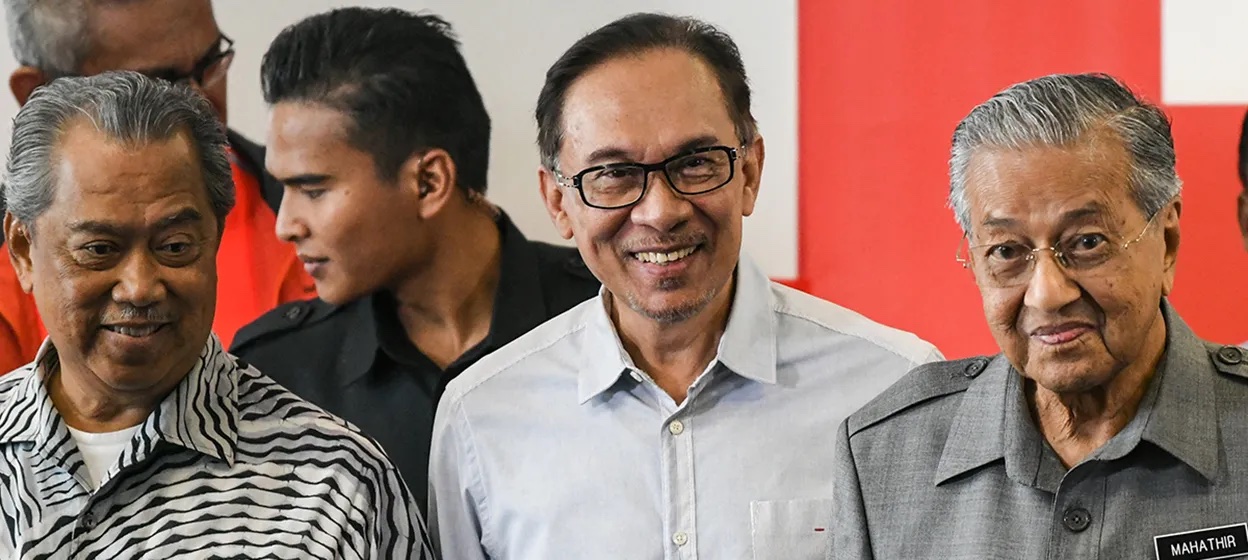
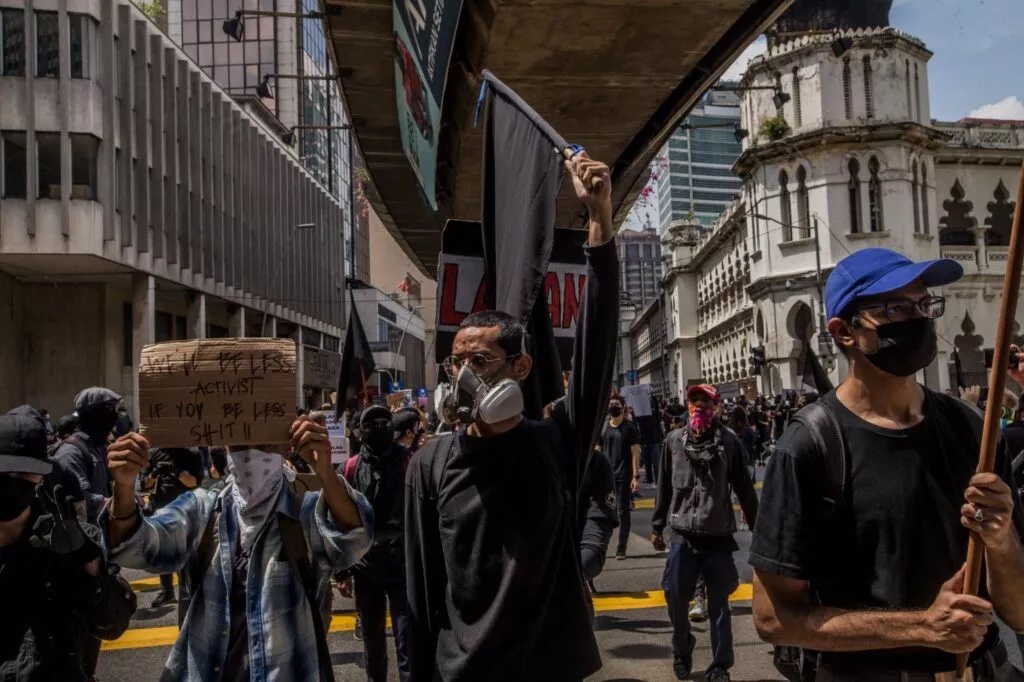


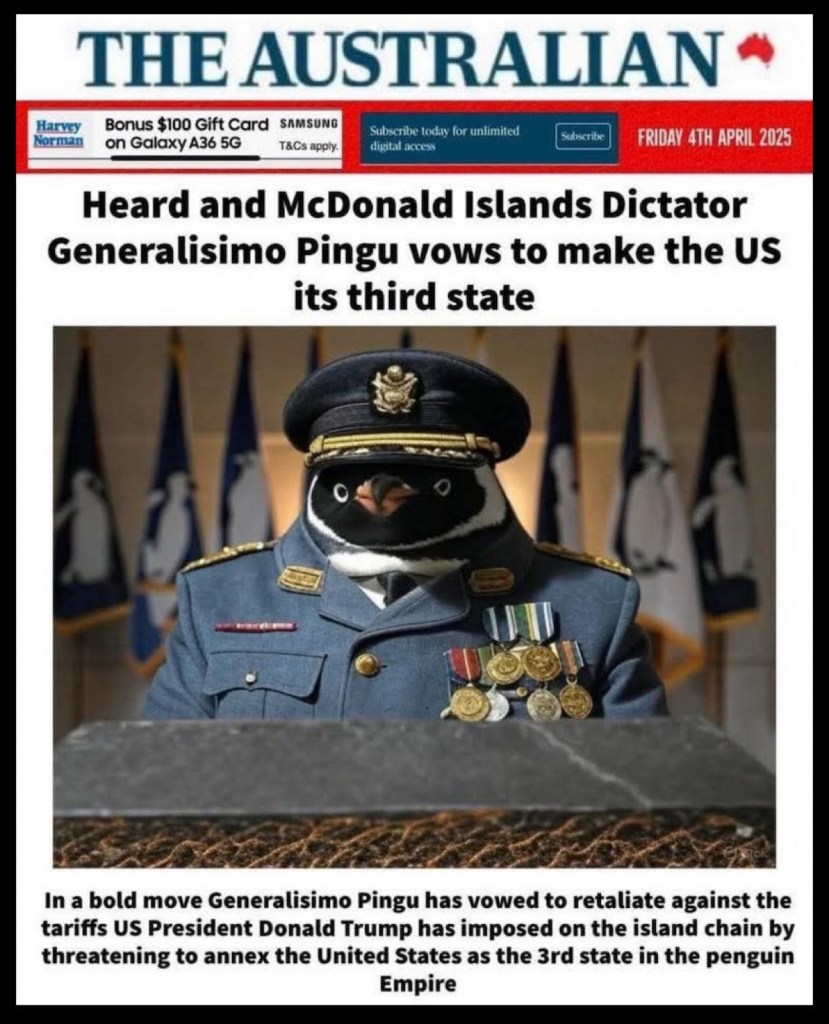



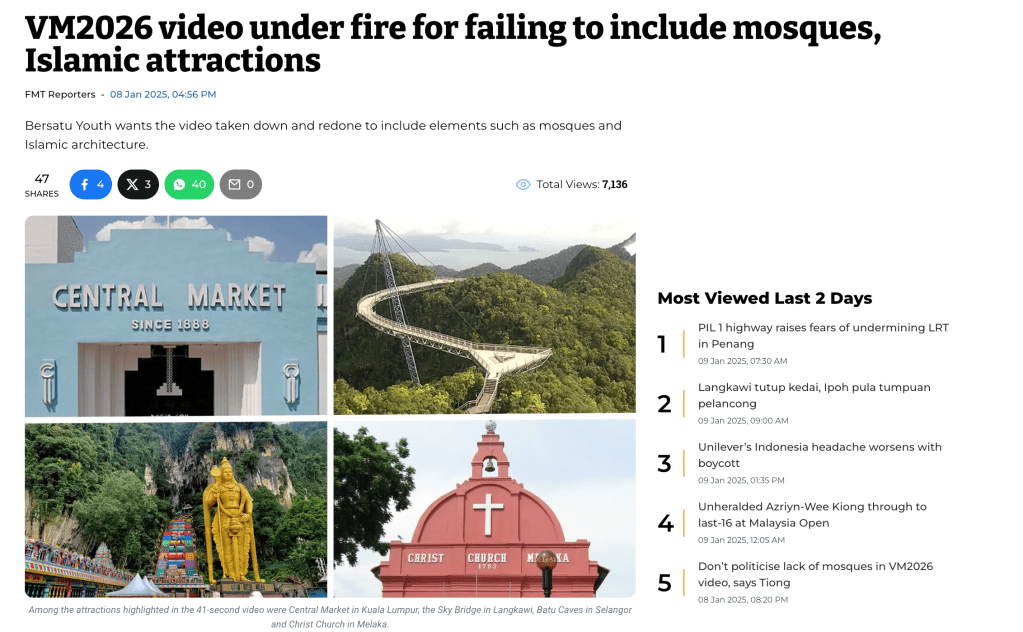




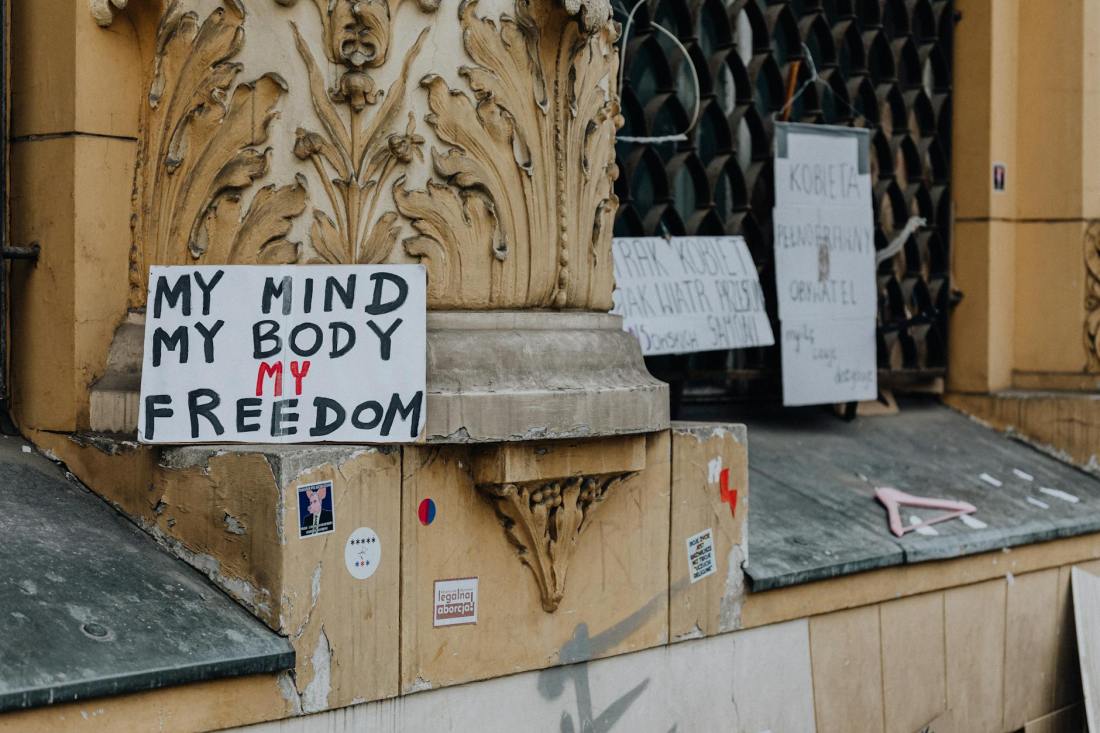
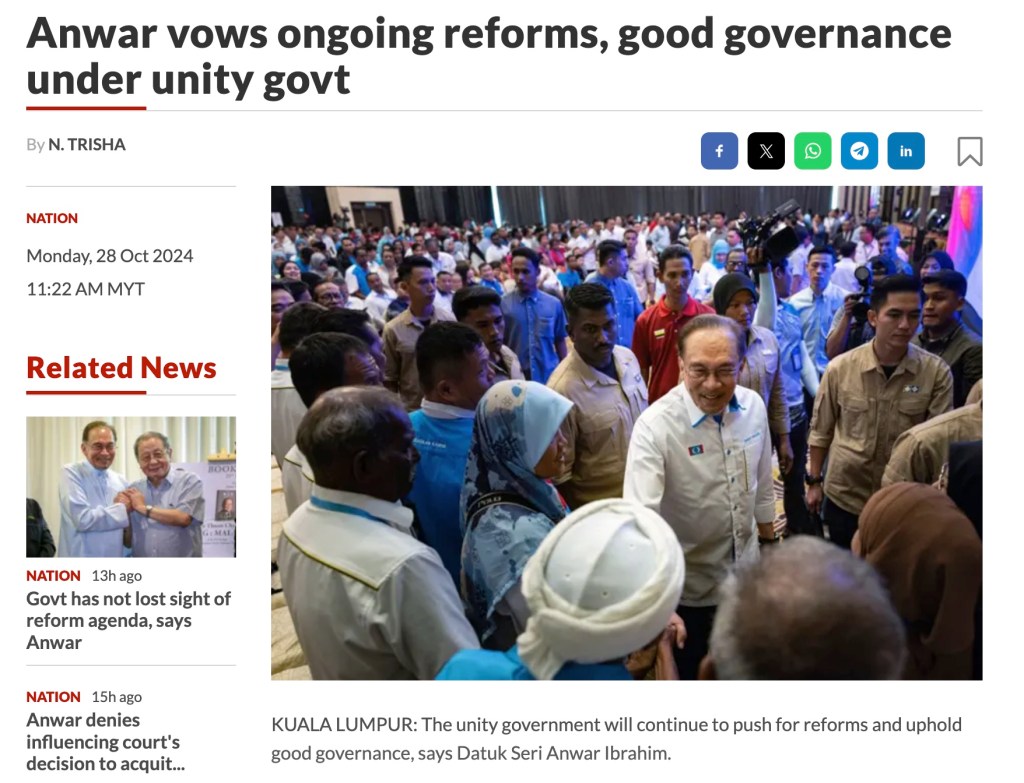
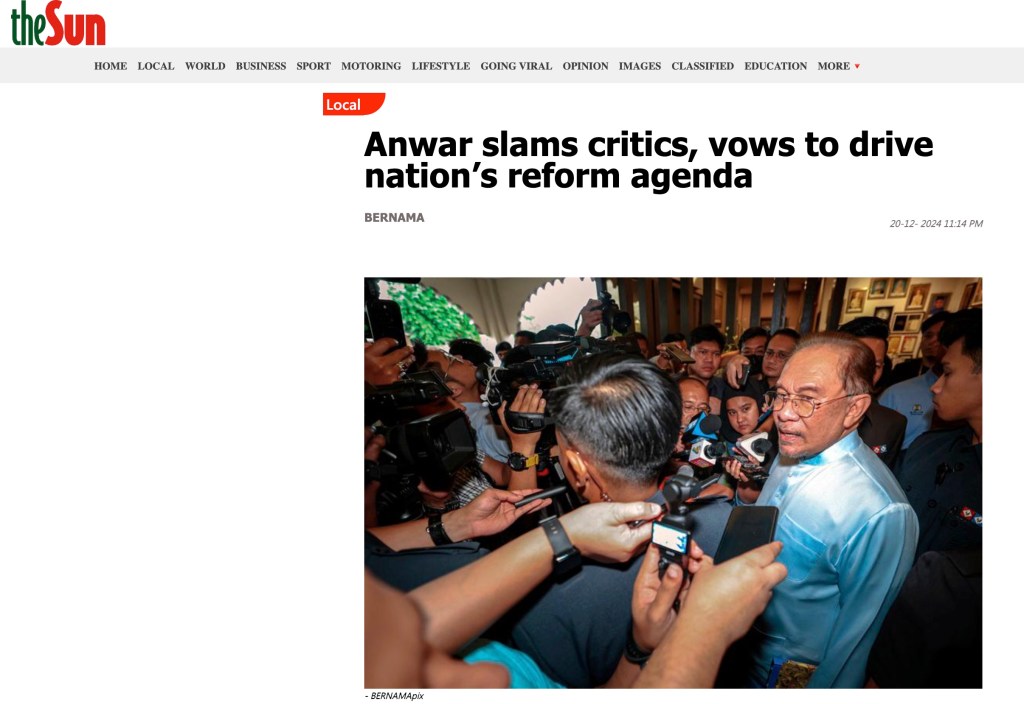

 myAsylum