An addendum walks into a bar…

Nothing travels faster than the speed of light, with the possible exception of bad news, which obeys its own special laws.

Douglas Adams, “Mostly Harmless”

We’re less than two weeks into 2025, and the year already feels like the title of this post: the start of a terrible joke.

First, it’s all those unnecessary police reports by PAS and their cohorts against Nga Kor Ming (“over the involvement of Muslims in a Christmas celebration on government premises“) and Hannah Yeoh (for the phrase “ambassador of God” in her 2014 book, “Becoming Hannah: A Personal Journey).

So, I’m not exactly sure what law(s) the Minister of Housing and Local Government broke – other than pissing PAS off, which last I checked isn’t a crime – but I’m sure the country’s foremost political animal in religious clothing will conjur some obscurantism to justify their favorite pasttime.

As for the 69 reports filed against Hannah Yeoh, I guess it took PAS over 10 years to reach page 7 where the phrase “ambassador of God” (the book was published in 2014); I have witnessed many toddlers read faster than that, which begs the question what mental age PAS collectively has.

All told, despite the rapid industrialization these past few decades, I guess Malaysia is still an agrarian society, with all the rage farming going on. Unfortunate though that rage farming doesn’t offer any positive economic returns… because we sure have a lot of it these days.

So yeah, if anyone has ever wondered why PDRM can’t solve actual and real crimes more than they do, one of the probable reasons is they’re obligated to unnecessarily spend resources to process the multitude of police reports made over the most idiotic of reasons. Malaysians, it would seem, have forgotten the art of intelligent human engagement – you know, like normal human beings in most other parts of the world.

And then, as if the first week and a half of 2025 didn’t already have enough stupidity, we have this whole big brouhaha over the “Addendum Order” by the previous YDPA, in relation to the Pardons Board hearing to address Najib Razak’s sentence for his conviction in the SRC criminal breach of trust (CBT) and power abuse case. For which he was sentenced to 12 years in prison and a fine of RM 210 M (USD 46.6 M at current rates).

To quickly summarize (this AP report has more details): the Pardons Board on 29 January 2024 issued an order to halve Najib’s sentence, pursuant to the Board meeting on the Friday prior (26 January), chaired by the then YDPA (the current Sultan of Pahang). But not long after that Najib claims there was an Addendum Order granting him to serve the remainder of his sentence under house arrest. The Home Ministry, however, stated only the primary order was received by the Prisons Department, but not the so-called Addendum Order.

Fast forward through almost a year of political posturing and finger-pointing, participated by none other than UMNO–the primary actor, which has made the full pardon of their former president their raison d’être–and more recently Perikatan Nasional, jumping on the hot potato bandwagon, for the purpose of milking every drop of political mileage they can.

What the Court of Appeal this past Monday, 6 January 2025 ruled: that there is such an Addendum Order (or at least the Pahang palace’s affidavit that one exists), giving leave for Najib to further pursue this in the High Court. Note, however, that the actual addendum order was never submitted to the Court of Appeal, only an affidavit from the Pahang palace affirming its existence.

A tsunami’s worth of questions arise in my mind:

  • If there was an Addendum Order (which the Appeals Court has now ruled into being), why wasn’t it mentioned in the official order by the Pardons Board?
  • Being that there is currently no specific legislation that allows for sentences to be served under house arrest, although the Prisons Act 1995 allows the Home Minister to specify designated locations for detention, could the then YDPA even decree house arrest for Najib?
  • When was the Addendum Order issued, and to whom was it addressed to and sent?
  • Is the Addendum Order even legally valid?

Questions, questions, questions… well, it’s up to the High Court to decide, and some point for the actual Addendum Order to appear. We’ll just have to wait for the next episode in this ongoing political telenovela. That said, I did come across one article that discusses the constitutional and legal aspects of the Addendum Order (an article written by advocate/solicitor GK Ganesan); I leave it to you to read as a homework exercise.

The one silver lining to all this is the government, in particular PMX, has refrained from any undue interference. Many of course don’t buy this, wanting to believe that PMX is pulling strings left, right and centre, hence using him as a focal blame point for, among other things, “hiding the Addendum Order”, and even treason. But as the GK Ganesan article rightly states, there needs to be more transparency on the part of the Government.

The minutes of the Pardons Board would answer the question. We do not have it. The Government should disclose this information. This will eliminate unnecessary speculation.

It is not an ‘official secret’ (and why should it be?). It has nothing to do with national security. Nor is it related to political manoeuvring – or so we are told.  In the interest of transparency, there is all the more reason that such information should come before the public.

GK Ganesan, “Could the King – or the Pardons Board – insert an Addendum into a Pardon?

In any case, that more or less sums the year so far.

Drama. Of Indonesian Sinetron levels, no less.

Sure there were a few other things that happened in the past nine or so days. But what I’ve shared here are the highlights. Or, if you must, lowlights.

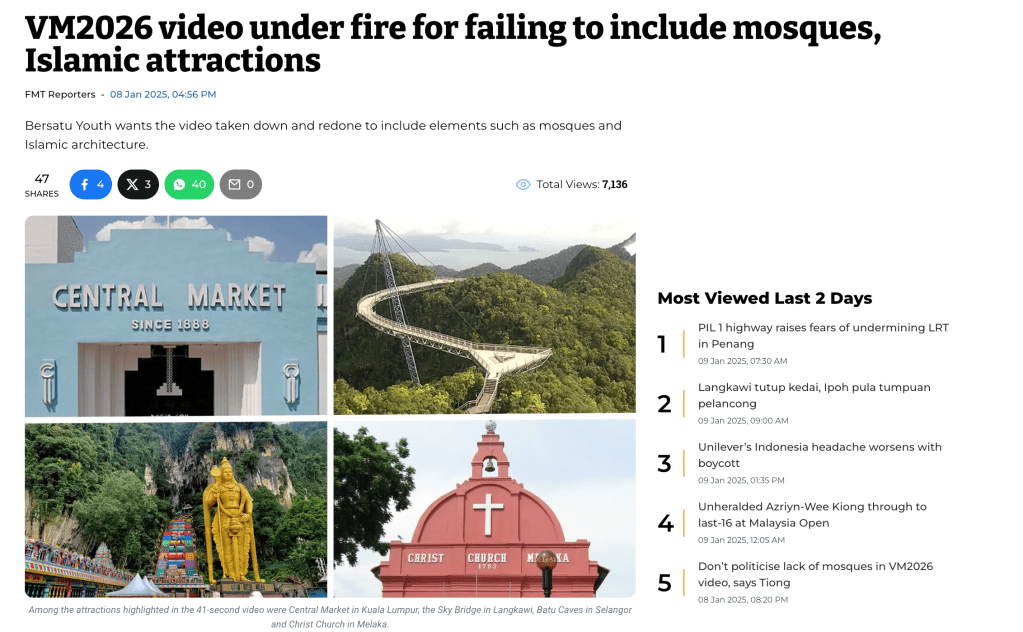
Oh, wait… an ADDENDUM: And this time it’s once again about Malaysia’s favorite agrarian activity: RAGE FARMING (click on the image to view the news report)
And that’s not even touching on the absurdities the incoming POTUS has been spewing the last few days. Which, for the sake of not making this post longer than it already is, I shall leave untouched. For now.

On a more personal note, the year’s been okay to me so far. Then again, it’s only been less than a fortnight. While 2025 doesn’t exactly fill me with much optimism, whatever the year throws at me must be met with positivity; make the best of what’s good, and mitigate the damage of what’s bad. That’s my plan.

So…

an Addendum walks into a bar. Orders a drink. And then another, and another after that… At closing time the barman asks the Addendum to settle the evening’s consumption. Addendum points to its right and says, “Put it on their tab”.

And who should be sitting there if not the people of Malaysia…

I did warn you it was a terrible joke…
Hook, Line & Stinker

The smart way to keep people passive and obedient is to strictly limit the spectrum of acceptable opinion, but allow very lively debate within that spectrum….

Noam Chomsky, The Common Good

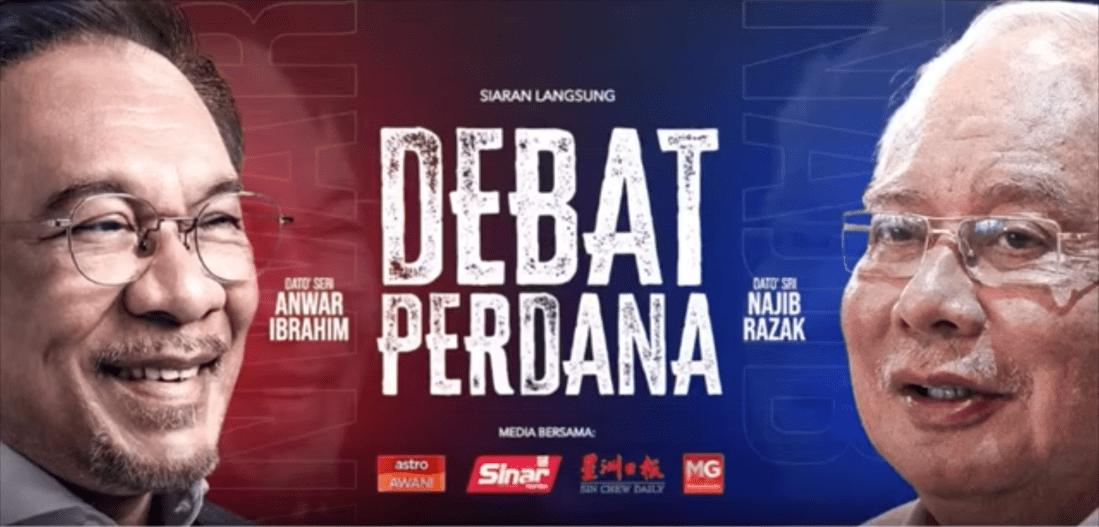
Walski isn’t against debates. But his beef with the debate that took place last Thursday night between Opposition Leader Datuk Seri Anwar Ibrahim and Former Crime Prime Minister Datuk Seri Najib Razak is this: why on Earth should Najib be given any kind of legitimacy?

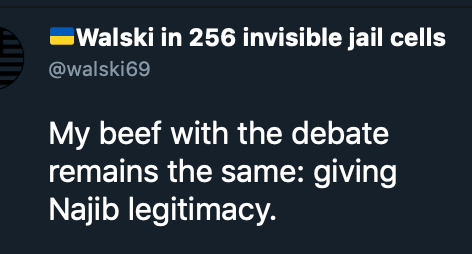
This he made quite clear in one of his recent tweets:

But that’s now water under the bridge; the so-called “debate” is over and done with. Walski put it in quotes simply because it wasn’t a true debate, but more a stage managed dialog/pseudo-debate between two very divisive characters in today’s Malaysian political landscape.

If you missed it, or want to watch it again, you can do so below (fast forward to 9:20 min, which is the point where the debate actually begins).

There were two topics that were discussed: should Sapura Energy be bailed out, and what should be the direction to move the nation forward. For Walski, the contents of what was said wasn’t so important – there was nothing new, or novel, or ground-breaking that was mentioned.

What is important, however, is the basis of what was said, and where each one of them comes from.

Sapura Energy: Blind Bailout vs. Due Diligence

In the case of Sapura Energy, Najib suggested a bail-out that he claimed wouldn’t cost the government a single sen, providing two options:

  • for Petronas to acquire/takeover Sapura Energy
  • government guaranteed loans by banks to take the conglomerate out of the red (sound familiar?)

Frankly, it doesn’t take a financial genius to suss out that both solutions are deceptive and deceitful, and in fact WILL cost the government. The second option is exactly what happened with 1MDB, for which the government has to service the debt.

And as for the first option, allow Walski to ask this simple question: WHO owns Petronas?

Answer: it is WHOLLY OWNED BY THE MALAYSIAN GOVERNMENT.

So, apart from the die-hard Bossku worshippers who’ve demonstrated that they have the collective IQ of a brick, who is Najib trying to con this time?

Walski needs to make this important disclaimer: he is no big fan of Anwar.

But between the two, it’s clear from the debate that Najib is incorrigible; bailouts are the only way, and worse, bailout first due diligence later. This borders on idiocy from a business perspective, but try telling that to the mindless TERBAEK Bossku minions (read: UMNO and their supporters).

Anwar, on the other hand, called for a forensic audit before any bailout actions be made. He also called out Najib’s assertion that “no government funds” would be incurred by asking the question of who owns Petronas.

So, what happened with Sapura Energy, once hailed as a darling of the homegrown integrated oil and gas service provider, to a situation where it’s pretty much on the verge of going belly up? It’s a long and convoluted tale, but this recent article from The Edge provides a good picture. In summary, partly mismanagement and partly market prices for hydrocarbons.

The bigger question from the debate, however, why the obsession to ensure that Sapura Energy doesn’t fail? (more on Najib’s part)

The Way Forward For Malaysia

The second topic of the night focused on what, in the opinion of the two debaters, would be the way forward for Malaysia. And here, too, nothing new or novel was proposed by either Anwar or Najib. But what they did say spoke volumes.

The thrust of what Anwar Ibrahim proposed hinged on structural reform, transparency, and the fight against systemic corruption. These are things that the Opposition Leader has long been pushing to the fore, as well as what PH was trying to do during the 22 months they were in power.

On the other hand, Najib’s idea of a better Malaysia: mega projects and GST. As if these two would be the panacea to right the ills that plague Malaysia. He also mentioned eradication of corruption, to which Walski couldn’t help but laugh. In essence, what he wants is to take Malaysia back to the days of unfettered largesse with little if any oversight.

Which do YOU think would serve Malaysia better in the long run?

So there was a debate. Now what?

Was there a winner in the debate? Did the debate itself matter? Will anything useful come out of the debate? Now that we’ve had the debate, what’s next?

The whole premise of the debate wasn’t hinged on winning or losing. But in terms of what was delivered, was there a clear “victor” between the two? Walski’s answer to that: it’s irrelevant.

Frankly, even entertaining Najib to a “debate” – a term used very loosely because the event was a stage-managed PR exercise more than anything else – gave the man undeserved legitimacy. Currently a convict awaiting sentencing appeal, nobody should have entertained the notion of having a debate with him in the first place.

But that aside, a clear dichotomy emerged: it was proper structural reforms vs. same ‘ol, same ‘ol largesse without oversight.

For Walski, between the two, and taking into account the current state of the nation, it’s blatantly clear which would bring about a better Malaysia. It boils down to a choice between rebuilding and strengthening the nation’s institutional foundations, or dancing and fiddling with reckless abandon while Rome burns to the ground.

What transpired on Thursday night may not be enough for many to make a decision. For sure, the so-called debate wouldn’t have swayed any fence-sitters. Partisan supporters would already have made their mind, regardless of whatever BS was flung (and there was a fair bit of it) to and fro.

But when it comes time for GE15 – whenever that might be – ask yourself this question: which of the two approaches would help create a Malaysia that you aspire for your children, your children’s children, and the many generations to come?

As far as Walski is concerned, however, the answer is straightforward and clear…

Post-script:

Rumor has it that the originally mooted format of the debate would have made it closer in feel to an actual debate. But one side didn’t agree to a more debate-like debate, so the other side had to accede. So it was more of a stage-managed dialog as opposed to a real debate. The audience was by invitation only, and the questions posed by the “audience”, too, was curated. Originally, it was suggested that questions posed to each debater would be by a member of the opposing party. The same side that didn’t want a more proper debate opposed this, hence what we got was a carefully curated event from start to finish.

Someone somewhere once defined debate as “de stuff you put on de hook to catch de fish“. Walski just wonders if there are those who actually bought what was being said, hook, line and sinker…