O Bangsa Malaysia, Wherefore Art Thou? (Part II)

Walski’s Note: This is the second of a two-part article by myAsylum’s first ever guest writer, Mikhail Hafiz (follow him at @IMMikhailHafiz on Twitter). Part I of this well-researched and well written piece may be found here. This two-part article provides one Malaysian citizen’s lament about the state of the nation, and what said citizen thinks may be the way forward. In this second part, Mikhail argues for a values based reconceptualization of what it means to be Malaysian. This is Mikhail’s second article in his Rediscovering Malaysia series of writings (a book, eventually, perhaps?). Kindly note that Mikhail’s preferred mode of English spelling is the British/UK variety, and as such this has been retained.
PART I: Read here.

PART II:

Forging a comprehensive national identity requires the collective individual to relinquish the archaic and communalistic mindset that considers diversity a liability and a threat to national development, and embrace pluralism as an asset and an advantage.

In the sagacious words of esteemed constitutional law expert Shad Saleem Faruqi:

“Creating unity in diversity is a long-term process that requires constant strengthening and recalibration. The job is not the government’s alone. All citizens have a role to play.” He further counsels: “We must recognise that our diversity, heterogeneity, pluralism and multi-culturalism are assets despite the inevitable challenges they pose.” [See Building bridges, dismantling walls by Shad Saleem Faruqi, via The Star]

While unity based on uniformity may prove to be elusive, or even undesirable, unity that is predicated upon diversity can and does exist. In other words, what is attainable here is a non-uniformitarian unity, as postulated by eminent academic Clive Kessler.

It is a pragmatic and feasible stratagem that employs “the acceptance and negotiation of differences as the basis of strength, the real source within complex socio-political entities of effective unity itself.”

It would be not be unreasonable to suggest that, for an ethnically plural, religiously diverse and vibrantly multicultural nation-state like Malaysia, “[p]ursuing this inclusive notion of non-uniformitarian unity, and so creating a framework for its realisation, is now the best, and probably the only way forward” to address the somewhat pressing issue of our existing identity crisis.

This significant paradigm shift undoubtedly presents a formidable challenge to our various ethnic communities, which have each been exposed – in varying degrees – to collective identity manipulation, and raised in a political culture fuelled by fear and distrust.

To complicate matters even further, unscrupulous politicians have exploited what local writer and academic Lloyd Fernando describes as “de-tribalisation anxiety” to ensconce themselves in positions of power and authority.

However, all is not lost. There is still light at the end of this dark and dangerous tunnel, even if it glimmers faintly in the distance.

Social thinkers (eg, Denis-Constant Martin, Ruth Wodak, Rudolf de Cillia, Martin Reisi and Karin Leibhart) have identified language (medium) and discourse (method) as the essential means through which the uniqueness and distinctness of a community and its particular values are presented.

As such, a common language and honest, meaningful and respectful discourse are both key instruments in the social construction of a nation, which is defined by political scientist and historian Benedict Anderson (1936-2015) as “a collection of imagined communities”.

It is impossible to overstate the importance of this engagement process, as national identity requires the process of self-categorisation, and it involves both the identification of in-group (identifying with one’s nation) and differentiation of out-groups (other nations).

Because they are “mobilised into existence through symbols invoked by political leadership” (Dryzek, 2006, p. 35), discourses are powerful in that they can construct, perpetuate, transform or dismantle national identities (Wodak et al., 1999).

After 64 years of independence, it is time for us to move away from the constrictive, divisive and pernicious realm of identity politics, and imbibe a set of universal values that are acceptable to Malaysians of every race, religion, colour, creed and class.

It is humbly submitted that this value system should be anchored by the centrifugal human attribute of integrity, for the fundamental reason that it is integrity that gives a nation-state credibility, especially in the increasingly important domain of international relations. This percipience is particularly pertinent in the wake of Malaysia’s irrefutably and significantly tarnished international reputation, due to its notoriety as a global kleptocracy (via reuters.com), following the hugely embarrassing revelations of the now infamous 1MDB scandal, much to the mortification of the Malaysian public, and disgraced former Prime Minister Najib Razak’s subsequent High Court conviction for abuse of power, criminal breach of trust and money laundering in July 2020. [see Najib Razak, Malaysia’s Former Prime Minister, Found Guilty in Graft Trial, via nytimes.com]

Former Attorney General Tommy Thomas contends that “[s]ince Merdeka, Malaysia has placed much emphasis on how the world perceives her. Image building has been very much the cornerstone of her foreign policy.”

Erstwhile federal lawmaker Tawfik Ismail (son of the late Tun Dr Ismail Abdul Rahman, widely regarded as the best Prime Minister Malaysia never had) asserts that integrity is “one of the most important core values around which other desirable ends are built, such as the integration of our society into a cohesive, inclusive community”. [“Integrity – the core quality we need” via The Star]

This prized attribute acquires additional heft if we support the argument that the long term goal of Merdeka is, from an individualistic perspective, the emergence of an intelligent, empowered and virtuous Malaysian citizen; and collectively, the creation of a Bangsa Malaysia that is imbued with an impregnable sense of integrity.

As a plural society, we are in the enviable position of being able to harness the potential of every faction in our combined efforts to weave a rich tapestry of national values, where the final product is considerably more than the sum of its parts.

In this particular context, the success of our nation building effort is, to a significant extent, dependent on our ability to pinpoint the equilibrium by attaining a delicate balance between “more is more” and “less is more” via a judicious selection process.

Our ultimate nation building challenge, then, is to identify a set of compatible and complementary values that define and represent the collective and connective ownership of a nation we fondly refer to as “tanahairku”, and couch them into a congruous narrative.

As we look ahead to what appears to be an uncertain and unpredictable future, do we want to spend the next six (and a half) decades lamenting the missed opportunities and commiserate about the unfulfilled potential of our nation?

Or do we knuckle down and construct an inclusive and non-discriminatory national identity that we can proudly proclaim as uniquely and distinctively Malaysian?

Public intellectual Ooi perceptively opines that “building a country and a society that one can be proud of is a process and the work starts immediately in the individual’s mind and heart.”

He adds that while cynicism has become one of the underlying attitudes among many Malaysians, “the future is not for cynics to build. It is built by people who dare to dream and hope, who are bold enough to forgive if not forget.”

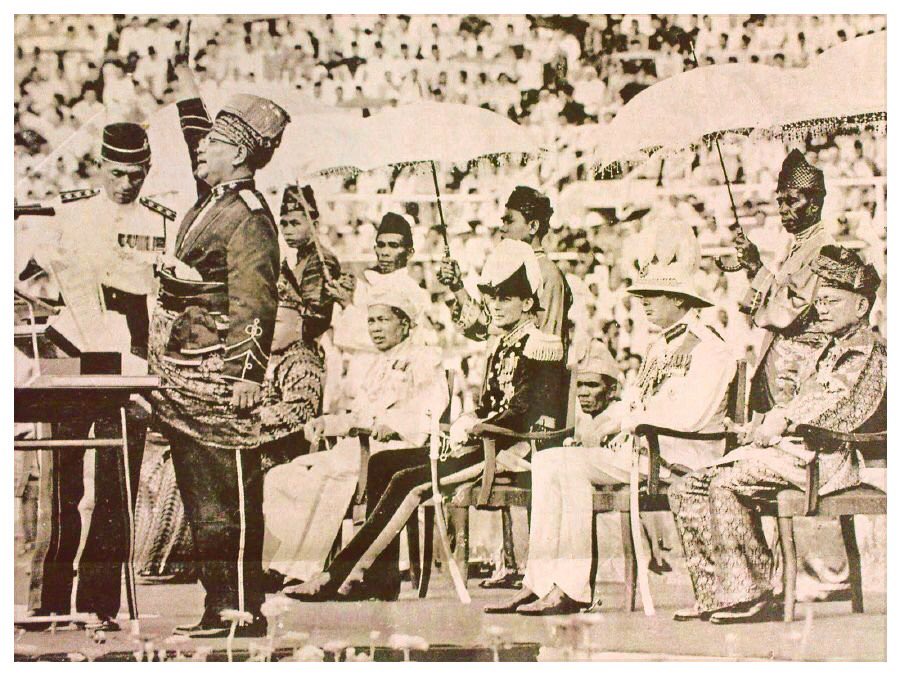
Perhaps these stirring words, brought to visceral, invigorating life by Tunku Abdul Rahman Putra Al-Haj, Malaya’s (and subsequently, Malaysia’s) first Prime Minister and Father of Independence, on the historic day of 31 August 1957, can serve as an inspiration:

“But while we think of the past, we look forward in faith and hope to the future; from henceforth we are masters of our own destiny, and the welfare of this beloved land is our own responsibility.

Let no one think we have reached the end of the road: Independence is indeed a milestone, but it is only the threshold to high endeavour – the creation of a new and sovereign State.”

Tunku Abdul Rahman Putra Al-Haj, First Prime Minister of Malaya/Malaysia
To paraphrase a famous saying of the Italian patriot Massimo d’Azeglio (1798-1866): “We have created Malaysia. Now all we need to do is to create Malaysians.

And so, besides “What is it that truly makes us Malaysian?”, the other salient question we should strive to answer – both individually and collectively – in relation to the reconfiguration of our national identity is: “When does one effectively become a Malaysian?

Formulating a unique and distinctive national identity may be a formidable challenge, but it is one where the rewards far exceed the efforts expended.

The success or failure of this noble endeavour is predicated upon the intents and actions of both the political establishment and the general populace and diaspora, which are, to a significant extent, interdependent and inextricably linked.

Constructing a unique and definitive national identity is like building a sturdy and durable home. The structure of our national ethos should be clearly and unequivocally defined, just as the framework of the building should be scrupulously and securely erected.

Additionally, the set of chosen values to be incorporated as part of our national identity should build on this structure, just as the various materials employed in the construction process should strengthen the underlying substratum of the residence.

A Malaysian identity that is based on the twin pillars of integrity and diversity acts as a robust bulwark against intemperate racial and religious polarisation, just as a solidly constructed dwelling protects its inhabitants from even the most extreme elements of nature.

Can Malaysian citizens muster an unyielding determination and unstinting commitment to undertake this arduous yet fulfilling task to completion, if they are given the opportunity to do so?

Reciprocally, can Malaysia’s current (and future) leaders cast aside their partisan interests and overcome their political shortsightedness and inertia to spearhead a genuinely substantive nation building process?

Only time will tell.

However, since every accomplishment begins with the decision to try, it would perhaps be prudent for us to heed the advice dispensed by American founding father Benjamin Franklin (1706-1790), who advocates action in favour of procrastination:

Don’t put off until tomorrow, what you can do today.

Carpe diem, Malaysia!

[END OF PART II]
Part I of this article may be found here

O Bangsa Malaysia, Wherefore Art Thou? (Part I)

Walski’s Note: This is the first of a two-part article by a guest writer. Being that Walski isn’t as productive in creating content as he used to be, he thought it would be a good idea to post articles that he thinks are worthwhile to share. This two-part article was written by Mikhail Hafiz (follow him at @IMMikhailHafiz on Twitter), and provides one Malaysian citizen’s lament about the state of the nation, and what said citizen thinks may be the way forward. This is Mikhail’s second article in his Rediscovering Malaysia series of writings (a book, eventually, perhaps?). Kindly note that Mikhail’s preferred mode of English spelling is the British/UK variety, and as such this has been retained.

(Standfirst: Decades of uninspired post-Merdeka nation building has left Malaysian nationalism in a parlous condition: suspended in a narrative limbo and stranded in an ideological purgatory.)

[NOTE: In the first part of this article, I explore the interconnected concepts of nationhood, nation building and national identity, and outline the ideological dichotomy of the ethnic nation-state and its civic counterpart, from a uniquely Malaysian perspective.

In Part II, I argue for a values based (re)conceptualisation of an existing quasi-variant of the Malaysian identity, anchored by the centrifugal human attribute of integrity, and assert that, in our quest to attain national unity, diversity should be regarded as an ally.]

INTRODUCTION

“Malaysia, bereft of a unifying national identity, is like an unmoored boat, drifting aimlessly in the sea of identity politics.

As it strays further into treacherous waters, the boat continues to be buffeted by increasingly turbulent waves of racial bigotry and religious intolerance.

The roiling waves, which continue to gather speed and momentum, are soon to be accompanied by torrential downpour, crashes of thunder, flashes of lightning and howling winds that have appeared in the not-too-distant horizon.

The inevitable confluence of these menacing and malevolent elements signals the imminent arrival of a tropical storm of relentless and rampant racial and religious polarisation that threatens to capsize and destroy the boat.

Will Malaysia be able to steer herself to safe waters and tether herself to the sturdy and reassuring harbour of an inclusive and non-discriminatory national identity? Or will she be rent asunder by the tempestuous storm and sink ignominiously to the bottom of the ocean?”

PART I:

Nationhood. Nation building. National identity.

Three distinct, yet interconnected socio-political concepts, each representing a crucial and chronological component in the initial stages of national development. The successful establishment of a post-colonial nation-state leads to the emergence of a sovereign nationhood.

The existence of this newly formed political, economic, social and cultural polity necessitates the process of nation building, which, at some point, and with the requisite effort, usually results in the formation of a unique and definitive national identity.

[NOTE: In the intermediate and advanced stages of national development, it is imperative for the nation-state to continue to exist while nation building progresses. Similarly, a multi-dimensional relationship can, and often does, exist between nation building and national identity. The former does not necessarily come to a grinding halt once the latter is constructed. This “revelation” is hardly surprising, considering the fact that nation building dynamics of most countries are influenced by geo-political, socio-political and religio-political developments in the domestic, regional and global spheres, since they are not hermetic in nature.]

Malaya’s sovereign nationhood was both intentional and aspirational: it was willed into existence through a protracted series of extensive diplomatic negotiations between the local political elite and a retreating British empire in the mid-twentieth century, justifying her current status as a nubile nation-state and fledgling democracy.

The yen for political self-determination was also buttressed by the formation of the Reid Commission in March 1956, to draw up a secular constitution for the independent and fully self-governing Malaya, after centuries of colonial rule by three major trading Western European empires (Portuguese, Dutch and British, in chronological order), interspersed with regional suzerainty (Acheh and Bugis) and the Japanese occupation during the Second World War.

And yet, more than six decades after freeing herself from the shackles of Pax Brittania’s global hegemony, Malaysia still suffers from an identity crisis, as she experiences continual and inevitable growing pains in her rite of passage to eventual sovereign maturity. Without a cohesive national identity, Malaysia is an amorphous, ambivalent and ambiguous entity, devoid of any unique, defining characteristics.

Without an edifying social structure, our nationhood remains fragmented, factionalised and fragile. [See Why National Identity Matters by Francis Fukuyama]

Ironically, Malaysia’s ongoing identity crisis is effectuated by our very own inability to come up with a decisive and unequivocal answer to a deceptively simple yet ultimately perplexing question:

What is it that makes us truly Malaysian?

It is therefore unsurprising to note that, in a 2016 survey of attitudes and ethnoreligious integration to meet the challenge and maximise the promise of a multicultural Malaysia involving 1,504 adult citizens based in Peninsular Malaysia, “there was an indication that being Malaysian meant different things to different groups, and further research is needed to tailor integration efforts based around promoting the national identity so that such efforts do not inadvertently push people further apart”.

Also, this survey revealed that “[r]espondents from all ethnic groups identified more strongly with their ethnic group than they did with being Malaysian, though for Malays, these identities were more similar in strength than for non-Malays.” (Al Ramiah et al, 2017)

Political analysts Ahmad Fauzi Abdul Hamid and Che Hamdan Che Mohd Razali offer this trenchant observation on the indeterminate status of our national identity:

“Despite over 60 years of uninterrupted nation-building under [then governing coalition Barisan Nasional], consensus on the character of Malaysia’s national identity still eludes the various ethnic and religious groups that make up the country.”

This question inevitably leads to a related query: what kind of national image are we projecting to the international community? How can Malaysia represent herself accurately on the global stage without a clear, coherent and conclusive self-identity?

Without a collective self-image that is both articulate and authentic, our national psyche remains diffuse and unfocused. Also, the opportunity to develop a sense of commonality is lost.

This sense of common purpose and communal belonging was eloquently expressed by His Royal Highness Sultan Nazrin Shah (then the Crown Prince of Perak) in a speech at the First Annual Student Leaders’ Summit in 2007, in which he artfully enunciated the clear-eyed recognition that “Malaysians of all races, religions and geographic locations need to believe beyond a shadow of a doubt that they have a place under the Malaysian sun”.

(According to political analyst Ooi Kee Beng, “[t]his insight gains power not through the fact that inter-ethnic relations have been worsening in recent years, but because it bravely directs attention to the worry that [Malaysia] has been developing a stubbornly multi-tiered citizenry”.)

Malaysia’s peaceful and orderly transition from a subject of the British empire to a post-feudal, post-colonial independent political entity has necessitated the promulgation and implementation of idiosyncratic nation building measures and state building procedures.

While our state building efforts have been solid, if not spectacular, the same cannot be said of our nation building endeavours, which can, at best, be described as lacklustre and haphazard.

To exacerbate matters, our nation building initiatives have constantly been hampered, hamstrung and hindered by the confrontational and discordant nature of our country’s communitarian and sectarian politics.

Given the prominence of the anachronistic quagmire that is the race paradigm (and its subsequent cooption of religion) in our socio-political consciousness, as reflected in the deliberate ethnicisation of our public institutions and social structures (Frederik Holst, 2014), and half-hearted attempts to codify a national identity, Malaysian political discourse is blighted by dissonance, conflict, and superficiality.

(Similarly, our education system is geared towards fulfilling the demands of the state apparatus: to equip the citizenry with functional knowledge and academic qualifications that will enable them to occupy various positions in our civil service and private enterprises.)

If we acknowledge the predicament that our previous attempt(s) at nation building have been subpar, how do we remedy this shortcoming?

It would not be unreasonable to postulate that a reconceptualisation (ie, redefining or reshaping) of our national identity is imperative.

So, how do we define our national identity?

Three main schools of defining national identity exist.

Essentialists view national identity as fixed, based on ancestry, a common language history, ethnicity, and world views (Connor 1994; Huntington 1996).

Constructivists believed in an importance of politics and the use of power by dominant groups to gain and maintain privileged status in society (Brubaker, 2009; Spillman, 1997; Wagner-Pacifici & Schwartz, 1991).

Finally, the civic identity school focuses on shared values about rights and State institutions’ legitimacy to govern.

The genesis of Malaysia’s identity dilemma can be traced back to her post-1969 political reconstruction; since then, Malaysian nationhood has veered between a civic-territorial ideal and an ethnic-Malay genealogical vision.  (Loh, 2017).

Our predominant nation building initiatives have been a binary, Dickens-seque “tale of two narratives” that pits ethnic nationalism, characterised by its inherent rigidity and stridency, against civic nationalism, which is consultative, consensual and conciliatory.

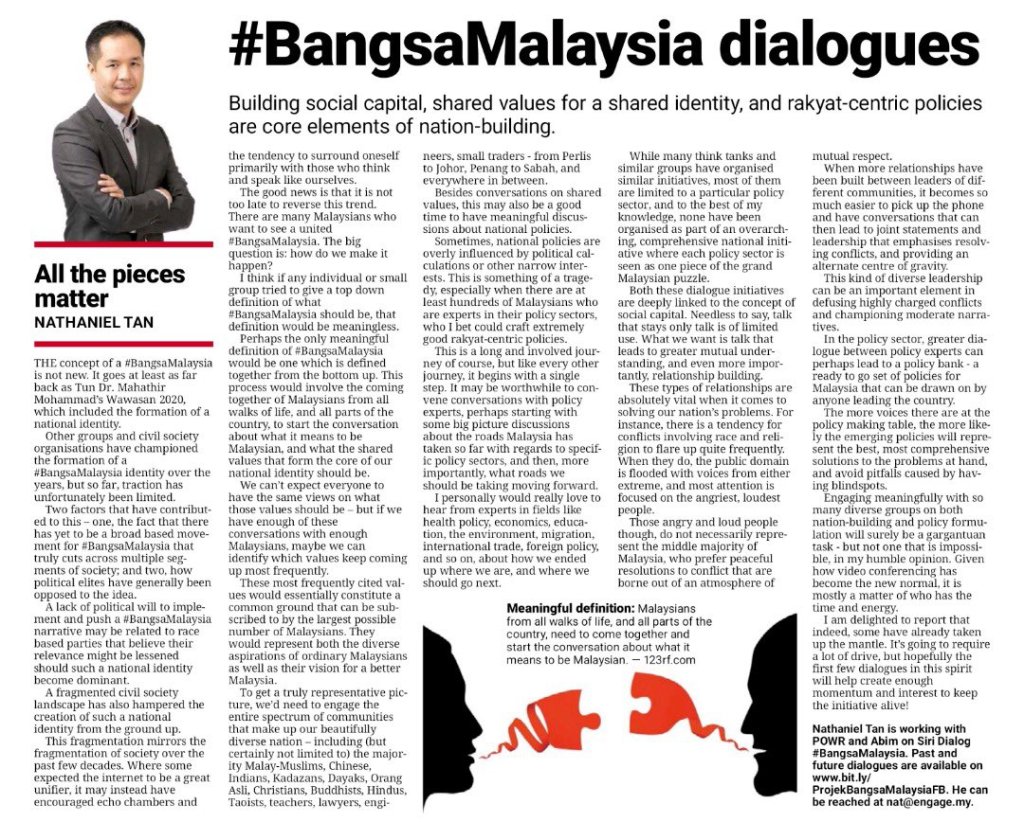
The most recent manifestation of this ideological dichotomy is evidenced by all three major ethnoreligious nationalist political parties in the governing coalition pursuing a Malay-centric approach, even though ethnocentricism, as an ideology for modern nation building, effectively dismisses the inherent and prevailing inter-cultural hybridity and cosmopolitanism of our country (specifically) and the South East Asian region (generally). Meanwhile, civil society favours a more collaborative approach, as delineated by political and current affairs columnist Nathaniel Tan in an informative and illuminating article, appropriately titled “#BangsaMalaysia dialogues”, in which he argues, convincingly and persuasively, that “[b]uilding social capital, shared values for a shared identity and rakyat-centric policies are core elements of nation-building”.

Screenshot of Nathaniel Tan’s article from The Star.

Post GE14, Malaysian nationalism appears to have arrived at an ideological crossroads. What type of nation-state do Malaysians desire: an inclusive civic nation, or an ethnocracy driven by identity politics?

Former military officer and incumbent academic Muthiah Alagappa asserts that “based on the principle of one person, one vote, Malaya and later Malaysia were intended to be civic nation-states in which all citizens had equal political rights, opportunities, and responsibilities.” However, the commitment of these ethnoreligious nationalist parties to the creation of an ethnic Malay-Muslim nation-state, despite immanent, well-documented flaws in its communitarian and exclusionary ideological foci – facilitating zero-sum competition, heightening the siege mentality of the ethnic majority via fear and hate mongering, invoking negative connotations of race, religion and language, demonising the benign (and neutral) concepts of secularism, liberalism and pluralism, encouraging minority groups to seek political alternatives instead of building loyalty and consolidating support for the nation-state – ensures that Malaysian identity remains a contentious issue, one that will only be resolved when all parties (eventually) subscribe to the idea of a civic nation.

[END OF PART I]

Part II of this essay may be read here.

The Journey Spiritual in a Dogmatic World

The only way to deal with an unfree world is to become so absolutely free that your very existence is an act of rebellion

Albert Camus

Every human is born a free spirit, and it is the experience of life that shapes who we eventually become. And although we have “become“, possibilities and opportunities will always present themselves to enable us to redefine ourselves.

But only if we want to.

Just so you don’t read the rest of this post confused, allow Walski to elucidate why he’s writing this. Some weeks back, he completed reading an important book by author, journalist and thinker Mustafa Akyol, “Reopening Muslim Minds“. To say it’s an important book would be an understatement. Walski believes everyone – Muslims in particular – should read it. And for selfish reasons, Muslims in Malaysia especially.

(Disclaimer: Walski is a Malaysian, hence the slight selfishness)

One of the things he thought of doing was to write an unsolicited review on the book, and why Walski thinks it’s important, especially for Malaysia currently. But before that, he thought it only fitting that Walski share a little bit about his own spiritual journey, so that the review might have some foundational context as to where Walski comes from.

And so, with that out of the way, let’s begin our journey. Well, Walski’s journey…

Let’s start at the beginning. Or, as close to the beginning as practical.

Walski grew up in a middle class family, both parents in the civil service, as were his granddads on both sides of the maternal/paternal divide. He was born in the mid-60s, and grew up during a time Malay/Muslims weren’t so obsessed with performative piety as they are today. A lot less uptight, too, about… well, just about everything, really.

Sure, Islam was observed in the family then. 5-times a day prayers, fasting in Ramadhan, etc. But apart from that, by and large Islam wasn’t something every damned thing revolved around like it is in Malaysia today. Yes, the state did have some level of control, but by and large it was a personal belief matter. And in the 70s and early 80s, no one talked about religious rehabilitation.

Fast-forward to 1990, when Walski returned to Malaysia after spending 8 years abroad, doing his tertiary education and briefly working after that. By then, Malaysia was already in the early stages of metamorphosis, religion starting its creep into the public sphere. Later in that decade the now infamous Lina Joy case made it clear that government departments were bound by what religious authorities dictate. Religion – specifically Islam – was no longer something between an individual and God, but between an individual and state dictates. And what the state dictates shall be what “Islam” is in Malaysia.

So if the state dictates a particular school of thought is the only permissible school of thought, then that’s that. Personal conscience? Doesn’t exist in Malaysia; at least not among anyone unfortunate enough to be born into a Muslim family, or decided to embrace the religion.

What changed Walski, looking back, was probably the Black Metal police raid that happened on New Year’s eve 2006 in KL, and before that, another in December 2005 (in Seremban). These two police raids, it would appear, were the direct result of moral outrage caused by religious councils about the evils of Black Metal, which later morphed into fantastical articles in Mastika (yes, that literary giant), and which eventually drove PDRM to act. Later in 2006 the National Fatwa Council made it “officially” haram.

Ok, first off, Walski is not a big fan of Death Metal. And the real point is not this specific genre being banned, but how the opinion of religious bodies (a fatwa, by definition, is an opinion) could drive enforcement apparatus of the state to act. Which leads to another question: do religious authorities have the power to shape legislation, and the actual people responsible to create legislation (Parliament and the respective State houses) have no choice but to comply?

Sadly, as we have slowly discovered since then, the answer is yes. Whether or not this power of sway is based on actual laws or not is irrelevant – what they say, goes. Or else, the legion of Islamic NGOs creep out of the woodworks to shout loudly. And this government, which has historically relied on the Muslim vote to remain in power, kneejerks into action. The question of legality doesn’t even arise – the religionists speak, and therefore MUST BE OBEYED.

Also interesting was this popular notion going around during the Lina Joy trial – she had abandoned Islam (and did it publicly), therefore must be eliminated. Killed. Wait, what? Isn’t Islam a religion of compassion and peace? Or, at least, that’s what Walski had been brought up to believe.

And then there was also this thing about certain words that are exclusive to Muslims in Malaysia, and no one else may use them. Huh? How and when did Islam become so exclusivist?

There are other things that popped up in addition to these two, but suffice it to say Walski had to find out more. And thus, in 2006 his spiritual journey began. The year he turned 42. Which, coincidentally, is also the ultimate answer; the answer to life, the universe, and everything.

But just like in Douglas Adams’ series of HItchhiker books, the quest became to seek what questions to ask. And the questions were many.

And it was also at this point that Walski (finally) took the trouble to read the Quran. Not merely recite it while not knowing what it says, but really read it. And understand it (or try, at least). Back in 2006 there wasn’t the abundance of tafseer (or “translation”, loosely translated) to be found on the Internet like there is today. But there were enough resources, that said.

And what Walski found out was actually in the Quran? Eye-opening and enlightening, to say the least. More importantly, a lot of what today constitutes Islamic practice and belief is not in the Quran at all. Like, for instance, that apostates and blasphemers may no longer live. Sure, there’s damnation and all, but no worldly punishment. Similarly, the punishment of stoning to death – nowhere in the Quran.

Also eye-opening was the much-repeated appeal for us to use our intellect and reason. And not at all like what most religionists today demand, that we must accept their truth as the only truth, and most of all, never question.

So what happened to Islam between the time the Quran was revealed, as the seal of revelaion and God’s final word to mankind, and the present day? In a nutshell, a lot. Put it this way: if the very basis of this nation being secular in nature can be altered, challenged and re-interpreted 60-some years after 1957, what more a faith that’s been around for over 1,400 years?

Which brings us to back to Mustafa Akyol’s book, “Reopening Muslim Minds“. Its subtitle, by the way: A Return to Reason, Freedom and Tolerance. Not ‘opening’ but Reopening. Not ‘Towards’ but A Return to. Think about the title and their implications.

And when Walski gets around to writing the review, we’ll discuss this more.

So that’s the journey Walski embarked on in 2006, and which continues till this day. A journey of asking questions, and seeking answers. It’s a journey that will continue until his last breath, in all likelihood. There have been more questions than answers, but that’s okay.

Such is the nature of spiritual journeys, it would seem.

No Fly Zone

You know it’s kinda hard just to get along today

Our subject isn’t cool but he fakes it anyway

He may not have a clue and he may not have style

But everything he lacks well he makes up in denial

The Offspring, Pretty Fly (for a White Guy)

Not everyone can speak off the cuff well. Particularly in public. And some politicians, well… they probably shouldn’t speak off-the-cuff in public at all, anywhere.

Adham Baba’s latest verbal blunder (FYI: Spanish Flu is not the past tense of Spanish Fly…)

Dr. Adham Baba is Malaysia’s Health Minister. And he has a spectacularly shameful track record of saying the wrong things in public. He’s one of those politicians who shot into prominence courtesy of Perikatan Nasional’s Sheraton Backdoor Coup in February 2020.

Last year the minister became the butt of netizen’s jokes when he suggested, on national TV no less, that drinking warm water could avert someone from getting COVID-19 (complete with a demonstration of how to drink warm water). Not long after, his gaffe about being in a virtual conference with 500 other countries (when he meant 500 delegates from around the world).

He became such an embarrassment that subsequently Malaysia’s COVID-19 daily situation report has since been delivered by the Ministry of Health’s Director General (save a few occasions). And you’d think the vaccination program coordination would be led by the Minister of Health, right? Well, that task (and some might add thankfully) has been taken over by the Minister of Science, Technology and Innovation, on the pretext that this was more under the purview of that ministry.

Let’s think about it – vaccine vials and syringes aren’t exactly rocket science. And Walski suspects that the real reason is because the Health Minister has presented himself to be slightly less than inept. Yes, he’s become that big of an embarrassment. At least in Walski’s eyes.

And so it brings us to Adham Baba’s latest embarrassing mis-delivery: saying Spanish Fly when what he wanted to say was Spanish Flu. And screwed up the year as well (it was 1918).

Trust Malaysia’s premier punk-activist artist Fahmi Reza to generate a quick response!

Walski did consider the possibility that knowing what “Spanish Fly” is could be general knowledge the average Malaysian didn’t have. But Walski doesn’t think that’s the case at all; the number of people who almost immediately recognized the gaffe made was significant. And if they didn’t already know what Spanish Fly refers to, thanks to Adham Baba, Malaysia’s Health Minister, they do now.

Regardless, it’s now become abundantly clear where Adham Baba’s No Fly Zone is: public speaking of any kind!

VaccinedNation

Normalcy was declared. (Normalcy was always a declaration.)

Arundhati Roy, “The Ministry of Utmost Happiness”

So today is the day Walski gets his second SinoVac jab, three weeks after the first dose in late June. About darned time, if you ask him. No, he’s not complaining – he’s just relieved the waiting is over.

Post-First Dose Pose (June 21, 2021)

The second dose today was administered at the same vaccination center, housed in the Setia City Convention Centre in Setia Alam, where I got jabbed the first time. The only difference between three weeks ago and today – a heck of a lot more people.

Which is a good thing – for the past several months it seems like the vaccine roll out was moving at a snail’s pace. Fortunately it has ramped up significantly in the past month, and right now just over 10% of the adult population have received both doses of their COVID-19 vaccines, either the SinoVac (which is what I got), the Astra-Zaneca or the Pfizer varieties.

It’s now been about 5 hours since I got the second dose, and so far the side effects aren’t very discernible yet. Apart from feeling some discomfort from what felt like elevated body temperature (but still below 37º C), and a touch of lethargy (more drowsiness, actually), the first jab was pretty much without major side effects.

Rock ‘n Roll, mofos! Walski’s fully vaccinated…

In the months since the so-called “emergency” was declared earlier this year, the number of new daily cases hasn’t been encouraging. And the many versions of MCO (semi-lockdowns) have not aided in bringing the infection numbers down either. Walski won’t go into the nitty gritty details of why these “efforts” haven’t achieved their desired results, but suffice it to say it’s been the seemingly uncoordinated rollouts, unequal enforcement, and ad hoc caveats introduced midstream that have been the modus operandi. Not impressive, to say the least.

Be that as it may, the ONLY way forward for us to get out of this mess of a pandemic is through mass vaccination. That’s how Walski sees it. And today, Walski joins the 3+ million other Malaysians who have been fully vaccinated.

With the daily dose administration standing at about 300k, and expected to reach 400k per day soon (with more vax channels opened), Walski hopes that we can reach the 75% vaccinated population threshold sooner, rather than later.

The FUBAR of a political mess Malaysia is in aside, it’s a VaccinedNation that will bring some level of normalcy back into our lives here in Malaysia. Perhaps not the normal normal we’ve come to miss, but enough of it to allow us to function better, and more importantly for many, start to earn their living again.

Stuck in a virus-go-round…

So ’round and around and around we go… where the world’s headed, nobody knows

Ball of Confusion – The Temptations (1970)

The COVID-19 pandemic didn’t start yesterday. Or last few weeks. Or even last few months. If you count from the date the MCO was first instituted – March 18, 2020 – we’re today in the 453rd day of various MCO alphabet soup movement restriction modes.

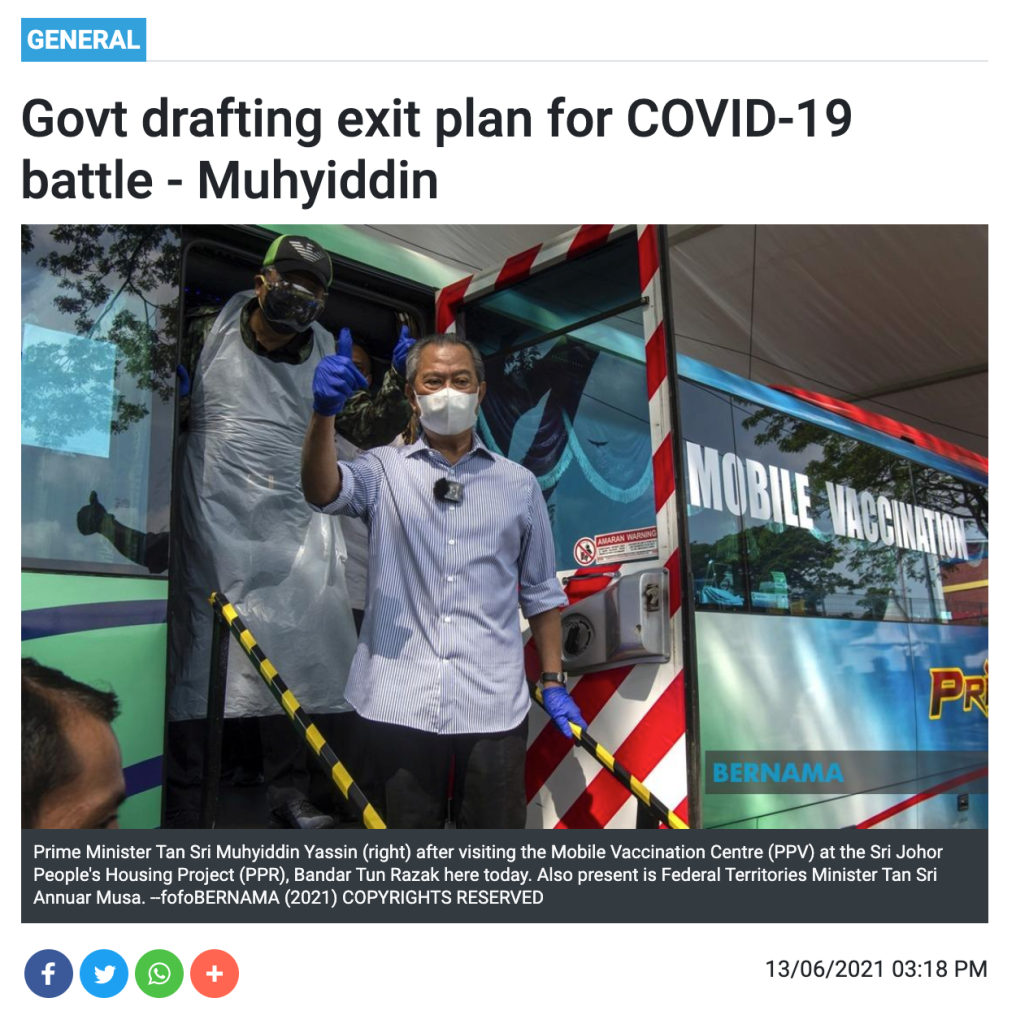
So it came as a bit of a surprise when Walski saw this being reported today (originally from the Malaysian national news agency Bernama, carried by New Straits Times):

JUST drafting?? Now?? Kind of a major oversight to not have a clue of how to get out of this frickin’ mess, don’t you think so? The headline you see above is how Bernama reported it (NST calls it the “rehabilitation plan”).

You know what it sounds like? PN’s plan to QUIETLY exit… presumably while no one’s looking. Since PN pretty much stole the government from right under PH’s noses, that’s what thieves do – how to escape after it’s all said and done.

Of course, that’s not what it means. Fortunately. Just the cynical side of Walski’s brain on overdrive. And it’s a humid but otherwise dull Sunday afternoon. Like, what else is Walski gonna imagine?

Meanwhile, on the pandemic front…


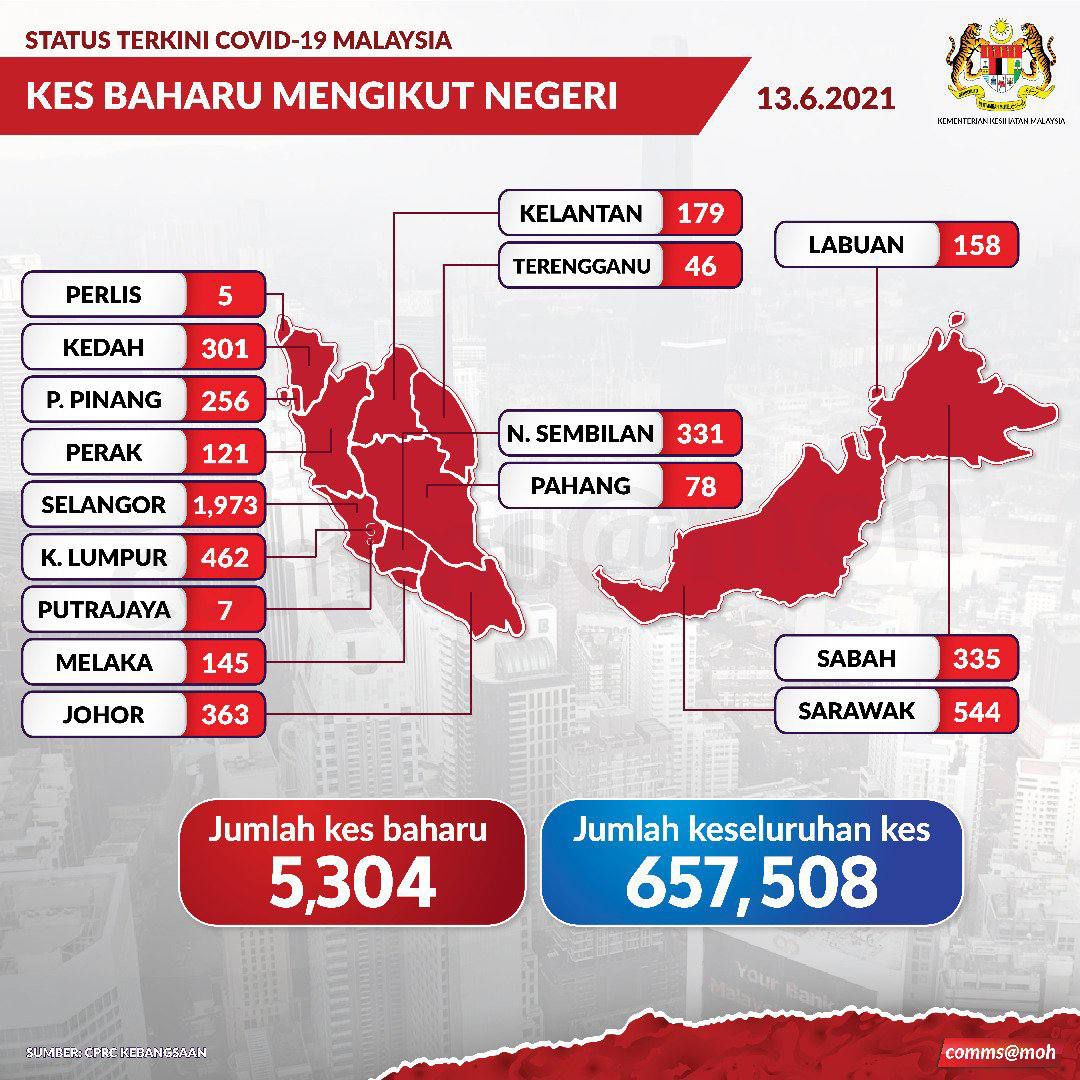
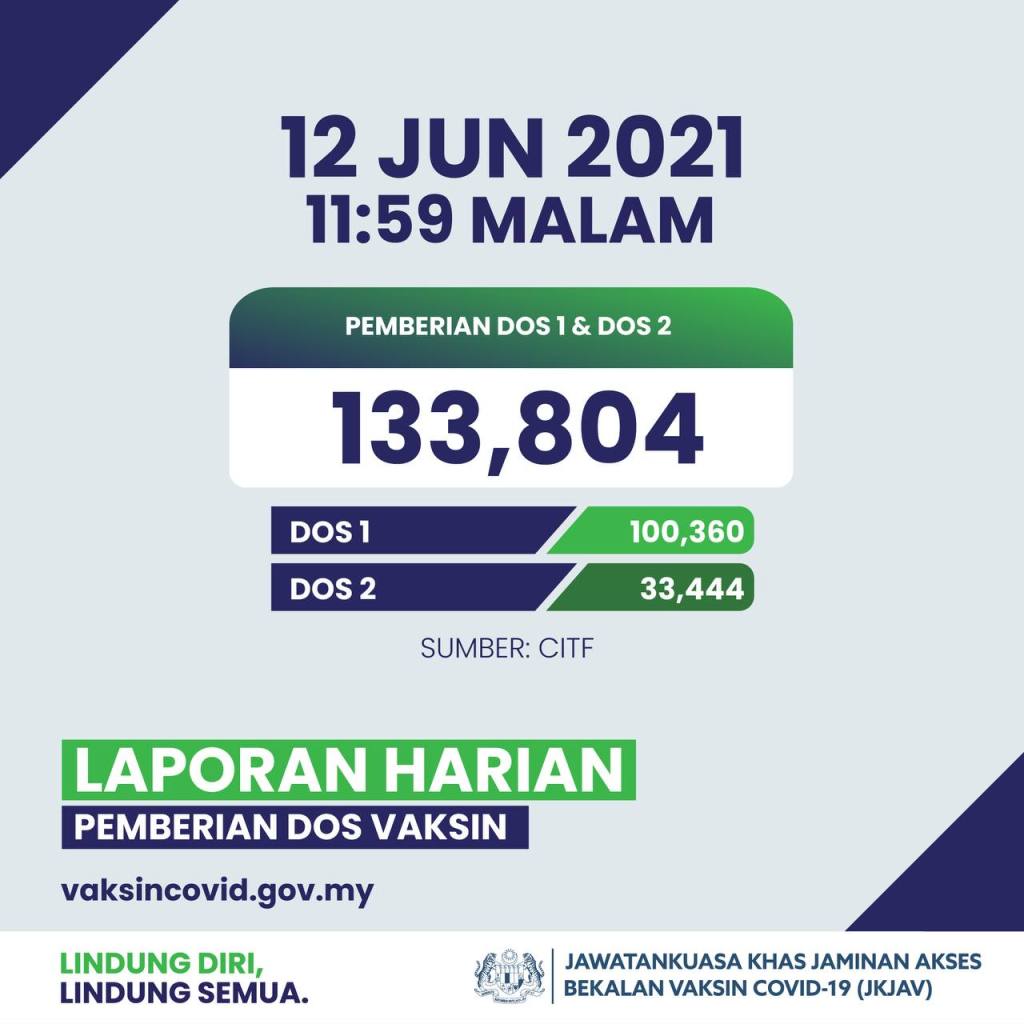
… we have about 489 less cases today compared to yesterday. And Maxis has successfully administered another 133,804 doses of vaccine as of midnight yesterday.

(Now, tell Walski he’s not the only one who thinks those vaccine infographics look like Maxis ads. Right? Right?)

So yeah, good news on that front. Except Walski still hasn’t gotten his vaccine appointment yet. But hopefully Walski won’t have to whine about that anymore soon. And soon couldn’t come sooner enough.

But back to that recovery/exit plan drafting exercise just announced…

Why wait only until now to start thinking of a recovery plan? Shouldn’t this have been done, oh, maybe about six or even eight months ago? So it’s no wonder why the hashtag #KerajaanGagal (failed government) has continued to resonate and trend on Twitter for the past several weeks. For a coalition that was so gung-ho in stealing the people’s mandate, these guys certainly haven’t been anywhere close to exemplary in handling the COVID-19 crisis. Not in Walski’s book, at least.

Ok, he will give this much to them: they DIDN’T SUCK. Overall report card: C+. Just slightly above average. Nothing to shout about.

Some people have been laying praise on this government for doing what they’re supposed to. Walski really didn’t realize just how low we’ve set the bar for ourselves, because the government has performed… exactly how they should have, no more, perhaps a bit less.

In any case, the gradual dip in the number of new cases in the last couple of days doesn’t mean we’re out of the woods yet. Especially when there have been reports that overall there has been less testing done. The less we test, the less new cases we uncover. That’s just the way it works.

So let’s wait and see if those number improvements sustain. Walski honestly hopes they will, don’t get him wrong.

Well, so much for now. Pray that Walski gets inspired to write about something other than related to this pandemic we’re stuck in next. Because frankly, it’s tiring to even think about this mess we’ve been in for the better part of the last year and a quarter.

As a very good friend of Walski’s always says, “… tired lah, dei!