Walski’s Note: As a follow-up to his essay New Malaysia: Democracy, Interrupted? that we published yesterday, guest writer Mikhail Hafiz penned this afterword, which in a sense brings us up to speed from the time he wrote the essay was originally written in late 2022. In a way, it provides some closure, but not how you’d usually think about closure. More of an affirmation, that while the details may have changed, where we are in the political spectrum hasn’t changed all that much. As with Mikhail’s other essays, this was originally published as an X/Twitter thread on 9 May 2025.
History says: Don’t hope on this side of the grave. But then, once in a lifetime, The longed-for tidal wave of justice can rise up And hope and history rhyme.
Seamus Heaney (1939-2013)
Seven years ago today, Malaysia experienced a violent political fracturing that reshaped our local political landscape after decades of BN’s uncontested hegemonic dominance, and resulted in the first change of federal government in Malaysian political history.
In the intervening years, however, our beleaguered nation has weathered a political coup that led to the formation of two consecutive morally illegitimate and constitutionally questionable governments, and soldiered through a debilitating global pandemic, amidst the ominous rise of a militant conservative Islamist movement, and worsening racial and religious polarisation, as Malaysia transitions from the ancien régime of hegemonic authoritarianism to a dynamic era of mercenary multipolarity.
Paradigmatically, Malaysia now finds itself in an unenviable predicament: caught between the proverbial rock and hard place, unlikely to return to the bygone days of single-party state dominance, even as the coalition-of-coalitions blueprint remains untested.
Indeed, the crucial issue that may come to dominate GE16, as Malaysia’s tilting ship of state navigates herself through such perilously uncharted waters, is that in an era of pernicious political fragmentation, will our first-past-the-post system still encourage a binary logic?
In other words, will the centre(-right) continue to hold, so as to ensure that it does not fall apart? Or will the “green wave” of Islamist conservatism continue to gain momentum, causing the nation to lurch even further to the right?
If one takes a longue durée approach to Malaysian politics, it is not inconceivable that, given the similarity of our electoral systems, journalist Andrew Marr’s predictions of the UK’s political fortunes could also unfold in our country: “With four or five parties competing in an atmosphere of pessimistic political turbulence, the likelihood is of a sequence of coalitions, failing to produce quick solutions, then collapsing and being replaced by others; a kind of downward spiral of protest, disappointment and political chaos.“
And so, after a turbulent and rancorous interregnum that has seen the appointment of four different prime ministers in as many years, has Malaysia’s very own Velvet Revolution run out of steam, as indicated by its staunchest supporters’ rumblings of discontent?
Has the much vaunted Reformasi movement, (once) embodied by the messianic figure who now helms the unity government, been hampered, hamstrung, and hindered by opportunistic realpolitik in the ostensible pursuit of domestic political stability? Has the exhilarating moment of collective euphoria and exultant joy of that sultry May night – so memorably captured in spontaneous eruptions of rapturous celebrations across the country – given way to creeping dissatisfaction, disenchantment, and despondency?
EPILOGUE:
The incumbent governing coalition is trying to thread an excruciatingly narrow political needle: reiterating its commitment to the reform agenda, whilst seeking to bolster its political legitimacy by courting the support of the Malay-Muslim polity, even as the bellicose and feckless ethnoreligious chauvinist opposition continues to frame the Madani government and its intended reforms as an existential threat to the ethnic majority, instead of functioning as a responsible and reliable check and balance mechanism.
While our long days’ journey into the night, so to speak, remains uncompleted, one remains hopeful that Malaysia will someday take her place among the great nations of the world as “a beacon of light in a disturbed and distracted world”, as envisaged by our founding fathers.
After all, in the words of the English poet Alexander Pope, “hope springs eternal in the human breast”.
So hope for a great sea change, On the far side of revenge. Believe that a further shore Is reachable from here.
Seamus Heaney (1939-2013)
Author’s Note: This thread serves as an afterword to “New Malaysia: Democracy, Interrupted?“, my latest #RediscoveringMalaysia article, in which I chronicle Malaysia’s historic electoral Zeitenwende, and the circumstances that led to this momentous occasion.
(The original main essay, New Malaysia: Democracy, Interrupted? may be read here)
Walski’s Note: Originally published on 17 November 2022 as an X/Twitter thread in four parts, guest writer Mikhail Hafiz‘s essay brilliantly examines the developments in Malaysia’s democratic space. For the sake of continuity and easy reading, it is presented here as a single essay. I have taken some liberty to apply some minor editing (spelling and language), but otherwise, the content presented here is identical to the original threads.
Democracy is the government of the people, by the people, for the people.
Abraham Lincoln (1809-1865)
The battle for contemporary Malaysia remains a tensile, to-and-fro tussle between two concomitantly contesting political pathways: democratic consolidation and authoritarian expansion. Will either ideological trajectory eventually emerge triumphant?
INTRODUCTION
The end of rebellion is liberation, while the end of revolution is the foundation of freedom.
Hannah Arendt (1906-1975)
On 9 May 2018, Malaysia witnessed its very own Velvet Revolution.
This remarkable, precedent-defying electoral Zeitenwende, which has so far registered the highest reading on the Malaysian political Richter scale, was not attained via battle and bloodshed, but through the long queues at polling stations across the nation, where over 12 million Malaysians lined up patiently to cast their ballots on that fateful day.
As political observers watched the cataclysmic collapse of the hegemonic Barisan Nasional (BN) behemoth unfold with a mixture of surprise and schadenfreude, this historic epochal affirmation of political possibility shattered the seemingly immutable political myth of “the eternal yesterday” that Malaysia would be governed by the same consociational coalition until kingdom come, clearly demonstrating that while the past cannot be dismissed or denied, it does not conclusively define the present, nor does it necessarily dictate the future.
For more circumspect Malaysians, however, this watershed moment marked more than the vanquishment of a truculent, kleptocratic ancien régime, and the culmination of a seismic, albeit glacial, decade-long transition from a one-party state system to its two-coalition counterpart. Most importantly, it signalled the sobering and instructive start of a long and arduous task to steer the wayward and listing state vessel that is Malaysia back on her right course, en route to eventual sovereign maturity, in the hope that she can someday take her place among the great nations of the world as “a beacon of light in a disturbed and distracted world”, just as our founding fathers had envisaged, and to do so unencumbered by the undesirable, uncharitable and unsolicited monikers often ascribed to hybrid regimes.
Unfortunately, this narrow window of opportunity was slammed shut by the Sheraton Move, an abhorrent, baleful, calamitous and dastardly political coup de main that subsequently ushered in Malaysia’s ‘Democracy: Interrupted’ era, and saddled our nation with two consecutive mandate-less and manifesto-less governments in 2020. Two years on, this abominable post-election non-sequitur continues to cast a lengthy and ominous shadow over the integrity of our democratic process.
This brazen and odious legislative volte-fa(r)ce is, in retrospect, hardly surprising. Malaysia’s functional relationship with representative democracy, like that of its regional counterparts, while not quite adversarial, has nevertheless been fraught and troubled: expectantly complex, inherently discrepant and frequently problematic.
As Lindsey W. Ford and Ryan Hass of the Brookings Institution perceptively surmise: “Widespread democratization throughout the 1980s and 1990s shifted the complexion of the region away from its illiberal past, ushering in rising hopes of a democratic wave. In recent years, however, democratic backsliding has shifted the political tides in the opposite direction, leading to a resurgence of illiberalism, and in some cases, rising authoritarianism.” (Brookings Institution website)
Michael Vatikiotis, Asia Regional Director of the Centre for Humanitarian Dialogue, a Geneva-based private foundation that facilitates dialogue to resolve armed conflicts, agrees.
In ‘Blood and Silk: Power and Conflict in Modern Southeast Asia‘, his illuminating 2017 literary offering – ambitious and expansive, yet accessible and engaging – which surveys the power structures that define the region, Vatikiotis concludes that:
“If the 1990s was a decade of reform and political transformation in Southeast Asia, then the first two decades of the twenty-first century have seen disappointing dividends.“
“Across the region, respect for human rights, democracy and popular sovereignty has continued to diminish.”
Troublingly, persistent and protracted political polarisation across ethnic, religious and ideological cleavages, along with the wariness or reluctance of most regional leaders to address the consequential risks of authoritarian political influence, only adds to the complex stresses and strains encountered by Indo-Pacific nations.
While democratic erosion precipitated by harsh political conflict is not yet so debilitating for our nation to be threatened by the spectre of democratic dissolution, political violence, or civil war, the warning signs are nevertheless disquieting. This worrying trend is not only confined to Malaysia but rather, part of a larger regional phenomenon, where deepening divisions, frequently fuelled by partisan majoritarian political agendas, are enabling anti-democratic action, and driving democratic regression in key countries throughout the South and Southeast Asia regions. (Carothers & O’Donohue, 2020)
In our understandable haste and eagerness to embrace (and forge) a more benign democratic rule, we may have unintentionally overlooked a crucial axiomatic tenet of political governance: incumbent turnover is a necessary but not a sufficient condition for regime change.
While it may mark the symbolic commencement of a polity’s transition from competitive authoritarian system to functioning democracy, the alternation of power itself does not necessarily result in the substantive process of democratisation.
As Meredith L. Weiss, professor of Political Science at the University of Albany, State University of New York, asserts in her thoughtful and thought-provoking 2020 opus, ‘The Roots of Resilience: Party Machines and Grassroots Politics in Singapore and Malaysia‘: “Real regime change (ie, regime restructuring) requires both alternation of power and a change in linkages and governance. The first of these transformations does not necessarily entail the second.“
In this disjointed, discordant, dysfunctional and (temporarily) derailed epoch of constitutional democracy, the only predictable aspect of contemporary Malaysia’s protean political landscape is its very unpredictability.
As such, the reading of political tea leaves in Malaysia’s ‘Democracy: Interrupted’ era is proving to be an extremely imponderable – if not impossible – endeavour, given the incalculable, volatile and dynamic temperament of our local political environment.
Indeed, any idiosyncratic predictions or temporal projections of intra-party, inter-party and inter-coalition elite machinations by the intellectual intelligentsia have come to resemble a Rorschach test of sorts.
In a 2002 article titled ‘Elections Without Democracy: The Menu of Manipulation‘, Andreas Schedler, Senior Research Fellow at the Central European University Democracy Institute, brings clarity to a common misperception linking suffrage to popular sovereignty:
“The idea of democracy has become so closely identified with elections that we are in danger of forgetting that the modern history of representative elections is a tale of authoritarian manipulation as much as it is a saga of democratic triumphs.
Since the early days of the “third wave” of global democratisation, it has been clear that transitions from authoritarian rule can lead anywhere. Over the past quarter-century, many have led to the establishment of some form of democracy. But many others have not.“
Schedler argues, instead, that “[t]hey have given birth to new forms of authoritarianism that do not fit into our classic categories of one-party, military, or personal dictatorship”, and are categorised as “electoral authoritarian regimes”.
As Harvard University political scientists Steven Levitsky and Daniel Ziblatt incisively observe, in their critically acclaimed and well received 2018 tome ‘How Democracies Die‘, “[t]he tragic paradox of the electoral route to authoritarianism“, while less dramatic in comparison to the military might and coercive forces of a coup d’état but equally destructive, “is that democracy’s assassins use the very institutions of democracy – gradually, subtly, and even legally – to kill it.”
In other words, “[d]emocracy’s primary assailants today are not generals or armed revolutionaries, but rather politicians […] who eviscerate democracy’s substance behind a carefully crafted veneer of legality and constitutionality.” (Levitsky & Ziblatt, 2021)
MALAYSIA: ILLIBERAL DEMOCRACY OR COMPETITIVE AUTHORITARIAN REGIME?
In every age it has been the tyrant, the oppressor and the exploiter who has wrapped himself in the cloak of patriotism, or religion, or both to deceive and overawe the People.”
Eugene V. Debs (1855-1926)
As Marina Ottaway, Middle East Fellow at the Woodrow Wilson Center, astutely observes in her seminal 2003 tome, ‘Democracy Challenged: The Rise of Semi-Authoritarianism‘:
“They (semi-authoritarian regimes) are ambiguous systems that combine rhetorical acceptance of liberal democracy, the existence of some formal democratic institutions, and respect for a limited sphere of civil and political liberties with essentially illiberal or even authoritarian traits.
This ambiguous character, furthermore, is deliberate.“
It is not without reason that Ottaway, a long-time analyst of the formation and transformation of political systems, pointedly highlights the insidious and sinister intent behind this malignant equivocality:
“Semi-authoritarian systems are not imperfect democracies struggling toward improvement and consolidation but regimes determined to maintain the appearance of democracy without exposing themselves to the political risks that free competition entails.“
In a 1999 working paper titled ‘Challenge of Semi-Authoritarianism‘ for the Carnegie Endowment for International Peace, Ottaway and co-author Martha Brill Olcott remark that while “semi-authoritarian regimes continue to go through the motions of a democratic process,” they have also become “masters at stifling electoral competition or at keeping parliaments powerless and judiciary systems cowed“, and “learned to manipulate public opinion“, shrewdly employing a Janus-faced juxtaposition of claiming that “they are committed to popular empowerment and the redistribution of power” on the one hand, and yet, emphasising “the risks of instability they claim are inherent in untrammeled competition and by doing so succeed in deflecting criticisms and reducing internal pressure for democratization” on the other, combining “formal democracy, a modicum of political openness, and fundamental authoritarian tendencies“. The defining characteristic of such regimes is: “the existence and persistence of mechanisms that effectively prevent the transfer of power through elections from the hands of the incumbent leaders or party to a new political elite or political organization.” (Carnegie Endowment for International Peace website)
Accordingly, the aim of this illiberalism, as postulated by American academic and author Christopher R. Browning, the Frank Porter Graham Professor of History Emeritus at the University of North Carolina at Chapel Hill, is a ” ‘managed democracy’ [where the public is shepherded, not sovereign,] unchecked by an independent judiciary and untrammeled by the inconvenience of real democratic accountability that comes through the hazard of electoral defeat and alternating parties in government.“
It is this constant and continual “push-and-pull” of antithetical/contradictory political forces between democratic consolidation and authoritarian expansion that continues to generate an as yet unresolved – and possibly even Gordian knot of unresolvable – ideological tension in hybrid regimes.
More often than not, this tension also galvanises various political actors from opposing sides of the political spectrum to adopt more calcified positions; the resultant rigidity only serves to perpetuate the bruising political stalemate and stultifying ideological impasse.
While much scholarly attention has been focused on incumbent turnover as the principal determinant and prerequisite of democratic consolidation, it is imperative to consider three other salient factors that contribute to authoritarian resilience in Malaysia: illiberal democratic practices (gerrymandering, malapportionment) instituted by successive authoritarian governments; authoritarian innovations employed by new configurations of opposition forces; and authoritarian acculturation of the electorate via personalistic politics.
COMPETITIVE AUTHORITARIANISM IN MALAYSIA
The liberty of a democracy is not safe if the people tolerated the growth of private power to a point where it becomes stronger than the democratic state itself. That in its essence is fascism: ownership of government by an individual, by a group, or any controlling private power.
Franklin D. Roosevelt (1882-1945)
Antidemocracy, executive predominance, and elite rule are basic elements of inverted totalitarianism.
Sheldon S. Wolin (1922-2015)
The examination of competitive authoritarianism in Malaysia can be divided into three phases: genesis, evolution and consolidation.
GENESIS: SOFT AUTHORITARIANISM
How did authoritarianism become so inextricably woven into our political tapestry, and so indelibly enmeshed in our social fabric?
It is only apposite that, in seeking to countenance the vice-like grip which competitive authoritarianism continues to exert over Malaysian sociopolitical consciousness, we return to the idiosyncratic circumstances which led to the transformation of an anti-colonial entity defined by its hostility towards Western European imperial powers to a post-colonial polity predicated on the political ideology of popular sovereignty.
In what can arguably be described as a shortsighted miscalculation, an executional oversight or an executional flaw, democratic implements and procedures that were transplanted wholesale to the newly constituted polity of Malaya were ultimately found to be wanting in terms of efficiency and efficacy, due to the failure of our hastily departing colonisers to inculcate a democratic culture among the local population.
According to the eminent scholar of Malaysian politics Gordon Paul Means, the genesis of Malaysia’s bifurcative political system can be traced back to her singular quest for colonial independence, and damage control exigencies of a retreating British empire in the aftermath of the Second World War:
“Instead of gradual transition to democracy and independence, the British were forced into making piecemeal concessions to one ethnic community after another. Therefore, the introduction of democratic institutions was retarded as the British strove to manage rising ethnic conflict by negotiating directly with the leaders of the main ethnic communities. None questioned whether democracy was congruent with “Asian values,” or doubted that an independent judiciary was needed to protect human rights against the sovereign powers of new governments. As a consequence, the wholesale transplanting of British-style democratic institutions was easily accomplished and received wide popular support.“
“The introduction of elections and representative institutions did not produce widespread popular participation in political affairs. Neither the public nor elites had experience with democracy. The colonial system, even in its most benevolent phases, had been highly authoritarian. Each ethnic community supported leaders from traditional status hierarchies or at the apex of various patron-client networks.“
“For all communities, ‘Asian values‘ meant communal loyalty, distrust of government, and avoidance of individual or collective responsibility for wider public interests. Few could acknowledge or empathize with the claims of ethnic communities other than their own. In this climate, elections and parliamentary government became the basis for the rituals of legitimacy, while the habits and attitudes required for a civic culture and participatory democracy went largely uncultivated.”
This disjuncture enabled the incipient seeds of incremental (or creeping) authoritarianism, which were sown during the Abdul Razak Hussein and Hussein Onn premierships, to be nurtured from the first Mahathir Mohamad administration through the Abdullah Badawi and Najib Razak eras right up to the present day.
A democracy is more than a form of government; it is primarily a mode of associated living, of conjoint communicated experience.
At this point of the discussion, it is imperative to identify the wide range of political controls instituted by successive BN-led, UMNO-dominated governments that restricted scope for criticism and opposition, thereby favouring the ethnic majority ruling elite. The most comprehensive and extensive powers available to the federal government are provided by Article 150 of our Federal Constitution, pertaining to the proclamation of Emergency.
Other legislative forms of political control include the Internal Security Act (1960) which permits detention without trial (repealed in 2012); The Sedition Act (1948) and The Official Secrets Act (1972) that place far-reaching restrictions on political discussion, and issues that the opposition could raise against the government respectively; the Printing Presses and Publications Act (1984) that controls the press and other publications; the Trade Union Act (1959) to prevent the growth of a strong trade-union movement that might fall under the political influence of the opposition; the Universities and University Colleges Act (1971) to prohibit student participation in local politics (later amended); and the Societies Act (1966) relating to the registration of societies.
The distinguished academic Harold Crouch notes that while “[t]he government’s authoritarian powers were ostensibly acquired to maintain political stability and public order“, they were also in reality “used to preserve the position of the ruling coalition and the dominant faction in its dominant party“. As such, “the authoritarian character of the regime was enhanced incrementally“, in response to various domestic political crises, most notably during the 1969 Emergency, the 1975-1977 UMNO crisis, the 1977-1978 Kelantan Emergency, the 1987 Operasi Lalang, the 1988 UMNO split and judicial crisis, and the 1993 confrontation with the Malay rulers.
This continuing evolution of incremental authoritarianism led Ooi Kee Beng, Executive Director of the Penang Institute, to caution in 2001 that “[a]ny euphoria over the phenomenal growth in economic strength and the increase in national pride must however be balanced by an acknowledgement of the damage that has been done to the democratic traditions of the nation.”
Following the resignation of authoritarian strongman Mahathir Mohamad in 2003, his handpicked successor Abdullah Badawi assumed helmsmanship of the nation, promising not only a wide range of political reforms that included the promise of greater accountability, transparency and a thorough overhaul of key national institutions (civil service, judiciary, police force), but also to be a prime minister for all Malaysians.
Appropriating the informal, avuncular sobriquet of “Pak Lah”, Badawi capitalised on his popularity, burnished by his religious credentials and untarnished reputation, in his congenial appeal for Malaysians to “work with me, not for me“.
Malaysian voters responded rapturously by bestowing the largest ever electoral mandate upon BN the following year, with the coalition winning an overwhelming majority of 198 parliamentary seats, and securing 63.9% of the popular vote.
Sadly, many of the promised reforms failed to materialise. While Badawi and BN were lulled into a soporific slumber by confirmation biased faux reassurances emanating from ever distancing and isolating media echo chambers manipulated by their sycophantic supporters, the increasing friction caused by festering grievances of mainly non-Malays and moderate Malays that had been building up over the last few years, further exacerbated by the belligerent rhetoric and weapon-waving antics of a youth leader during UMNO’s annual general assemblies, eventually ruptured the nation’s political tectonic plates, causing an unexpected and unforeseen electoral earthquake in GE12 (2008); it was a sudden and rude awakening that not only revoked the incumbent coalition’s hitherto unchallenged two-thirds majority – thus circumscribing its unfettered ability to amend our Federal Constitution with impunity – but also handed legislative control of five (later four) state governments to the opposition bloc.
In the final analysis, the Badawi administration, according to academician Farish A Noor, was one that was “long on gimmicks and novelties, but short on substance and delivery“.
Following BN’s dismal performance, Badawi was supplanted by Najib Razak in 2009, who came to power promising reform of our nation’s arcane security laws that impede free speech, and affirmative action policies that privilege the Bumiputeras and marginalise the non-Malays and Muslims but fared no better than his immediate predecessor during his nine year tenure.
Not only did BN fail to regain its much-coveted two-thirds majority, but the coalition also lost the popular vote share for the first time in GE13 (2013). As chronicled by Vatikiotis, “when his legitimacy was called into question after revelations that billions of dollars were misused or went missing from a development fund he managed, Najib veered sharply off the path of reform and began shoring up his position using the tools of despotism and division.“
Indeed, nowhere were Najib’s authoritarian tendencies more pronounced than in his iron-fisted, heavy-handed response to quell public dissent and silence criticism of the 1MDB debacle, as summarised by retired academic Francis Loh Kok Wah:
“[Najib Razak] responded to the deepening scandal by sacking his Deputy Prime Minister and several other ministers when they questioned him on the 1MDB fiasco. He also terminated the services of the previous Attorney General, the previous Governor of Bank Negara and the head of the Malaysian Anti-Corruption Commission as they, reportedly, closed in on the case. His new Attorney General then declared that he could find no evidence of corruption and abuse.
Instead, he and other law enforcement agencies charged, imprisoned or took to court Malaysian whistleblowers and others who had persisted in criticising the prime minister.”
Meanwhile, the (alleged) murders of Kevin Morais, Hussain Najadi and Teoh Beng Hock remain quietly unsolved, as do the (en)forced disappearances of Amri Che Mat, Raymond Koh, Joshua Hilmy and Ruth Setapi, cruelly depriving their families of much-needed closure.
CONSOLIDATION: SHERATON MOVE & THE FALL OF NEW MALAYSIA
While PH triumphed against the odds in GE14, despite BN’s distinct advantage in terms of the “three Ms” – (party) machinery, media and money – it appeared to have developed an acute case of political stage fright afterwards.
John Funston, Visiting Fellow in the College of Asia and the Pacific at the Australian National University, notes that “[a]fter a promising start, the Pakatan government soon lost its way. The early stages saw a slew of progressive reforms. Malaysians of integrity were appointed to key government offices. Legal action was taken against corrupt politicians. Human rights issues gained prominence, and media freedom became a reality.” (East Asia Forum)
To complicate matters further, PH inadvertently ceded the national narrative to the newly formed Muafakat Nasional (MN) opposition bloc, which constantly framed the multi-ethnic ruling government and its intended reforms as an existential threat to the Malay-Muslim community.
Promises to ratify the UN International Convention on the Elimination of All Forms of Racial Discrimination (ICERD) and the Rome Statute of the International Criminal Court were abandoned after the reformist government encountered ferocious backlash from the ethnic majority, in the wake of a vituperative campaign orchestrated by UMNO and Parti Islam SeMalaysia (PAS), the constituent parties of MN, and disparate elements of the political right, to heighten nativist sentiment.
Internecine power struggles and the failure to address several key issues, ranging from the Malay-Bumiputera Agenda and the 1963 Malaysia Agreement (MA63) to political Islam and a clear timetable for transition of power (Chin, 2019), eventually led to crippling defections, which in turn triggered its collapse in February 2020, enabling the hitherto defeated BN to return to federal power in a preponderantly Malay-Muslim coalition that incorporated PAS, Parti Pribumi Bersatu Malaysia (PPBM) and the separatist faction of Parti Keadilan Rakyat (PKR). After being banished to electoral purgatory in GE14, “Old Malaysia” had effectively outmanoeuvred “New Malaysia” and staged a successful revanchist comeback in 22 months.
Having been appointed by procedures that defied Westminster democratic conventions, Muhyiddin Yassin – the newly anointed premier of the Perikatan Nasional (PN) government – then proceeded to govern in a similar manner, by dispensing political largesse to shore up his precarious and unendorsed parliamentary majority, and consolidating his tenuous position through Emergency rule and the prorogation of Parliament.
Democratic decline proceeded apace, as media freedom reverted to the pre-New Malaysia era, while opposition politicians faced an array of legal harassment.
The much vaunted post-Sheraton Move “backdoor government”, the crowning achievement of Malaysia’s ethnoreligious tribalist faction – described by Ooi as “an unholy and unstable alliance” – would, however, turn out to be a short-lived, self-inflicted Pyrrhic victory:
“In 2020, the toppling of the Pakatan Harapan government achieved something Malay supremacists had wanted along – effectively an all-Malay government.
But since the fulfilling of that goal, no significant ideological difference is apparent among the top leaders in PN, UMNO and even the Islamist Parti Islam SeMalaysia (PAS).
To the common man, top-level politics in Malaysia today appears to be about power as a goal in itself – no nation-building vision, no unity programme, and no economic development masterplan that can be taken seriously.“
Hardly surprising then, that in a classic case of “things fall apart, the centre cannot hold”, to quote a line from ‘The Second Coming” by English poet WB Yeats, just as hastily as it had been stitched together, this morally illegitimate and constitutionally questionable government unraveled at breakneck speed, and finally met its ignominious end on 16 August 2021. (see Mikhail Hafiz’s X/Twitter thread from 17 Aug 2021)
UMNO’s audacious power grab notwithstanding, the unlamented demise of this kakistocratic intermezzo is undoubtedly connected to its woeful 17 month performance, as expounded by Bridget Welsh, Honorary Research Associate with the University of Nottingham Asia Research Institute Malaysia: “Muhyiddin’s ‘all Malay’ government gave ethnonationalists what they asked for, and it has not performed. More Malays are taking a hard look at ethnonationalist governance and find it wanting.
Malays have experienced the most COVID-19 deaths and been hard hit by deficiencies in the social safety net. Their views of their leaders are shifting.”
“Government failure has led to a rethink of its role as problem solver. More now see it as the problem and have greater appreciation for the power of action from below.” (East Asia Forum)
Perhaps the most damning indictment of the grand larceny of the GE14 electoral mandate committed by the Sheraton Move conspirators is evidenced in a forcefully articulated argument by intellectual activist Clive Kessler on moral legitimacy (i.e., the right to govern that is predicated upon the results of a free and fair election, as opposed to predetermined selection):
“[E]lections are indispensable and fundamental to representative parliamentary democracy: Not just because, through this device, governments emerge and are installed.
But, more basically and importantly, because it is by means of national elections that the government, the regime it heads and the entire political order at whose apex the government stands, are morally empowered, ‘made legitimate’ “.
In this way and by no other means, our governments are given that special kind of “secular democratic sanctity” that endows modern governments and states with moral authority.
A compelling authority that obliges all citizens to heed their decisions, and so makes government authoritative and effective.” It is a moral and intellectual position that elicits strong support from the East Asian Forum Editorial Board:
“Nobody expects countries like Malaysia or Thailand – let alone even more politically blighted neighbours – to emerge as textbook liberal democracies any time soon. But a mandate earned at the ballot box, once all else falls away, is sacrosanct in even the most flawed democracy.
The least Southeast Asia’s political elites can do for the maturation and legitimacy of democratic norms is to not violate the mandate extended by the voters who handed them government, or to disenfranchise outright many millions of voters who exercise their right to choose differently.” (East Asia Forum)
The sacrosanctity of the electoral mandate as the bedrock of institutional, moral and sovereign legitimacy in an parliamentary democracy is powerfully driven home by Ooi in his blistering denouncement of illiberal democratic practices:
“[I]t is with the free and fair vote that a democratic culture comes into being. That is how notions of fairness penetrate society, and bring dignity to its politics. The integrity of its vote is the measure of a society’s self-esteem.”
“Gerrymandering and malapportionment of constituencies, which are rampant and par-for-the-course in the case of Malaysia, do make elections farcical to a painful degree. When you compromise the egalitarian vote, you compromise the legitimacy of the system, and you damage the reputation of the country. Worse than that, you open a Pandora’s Box of corruption, arrogance, accountability and non-transparency.“
At federal level, the concentration and consolidation of power in the executive branch of Malaysia’s electoral democracy, often at the expense of the legislative, judiciary, civil society, media and press has been achieved through “coercive legalism” by the BN-UMNO state; this predicament may account for the widely held perception of “rule by law” among Malaysians, as opposed to “rule of law“, which connotes a system of constitutional democracy with balances and checks in place, leading critics to designate Malaysia as a “quasi-democracy“, a “semi-democracy”, a “repressive-responsive regime” or even a “statist democracy“. (Loh, 2006)
Malaysia’s (infamous) reputation as a bastion of competitive authoritarianism is reinforced by its “Partly Free” status in the Freedoms In The World index by Freedom House for the last two years. (Freedom House)
The continuing political instability has also led to the expanding political influence of Malaysia’s monarchs, vis-à-vis the constitutional powers invested in the reigning Yang di-Pertuan Agong in the appointment of the Prime Minister and the proclamation of the Emergency.
Additionally, Ford and Haas have observed “[another] worrisome trend across the Indo-Pacific region in the past few years”, which is “the uptick in new legislation limiting individual and civil liberties, placing restrictions on freedom of assembly, civil society organizations, religious institutions, and the freedom of the press.” In many cases, these developments, additionally accelerated by the global CoVid-19 pandemic, “are less of a new trend than a reversion to the mean, with governments turning to familiar illiberal tools and practices in a bid to stifle unrest and prop up their own positions in a more volatile domestic political environment.“
CONSEQUENCES
In a democracy dissent is an act of faith. Like medicine, the test of its value is not its taste but its effects, not how it makes people feel at the moment, but how it inspires them to act thereafter.
Criticism may embarrass a country’s leaders in the short run but strengthen their hand in the long run; it may destroy a consensus on policy while expressing a consensus of values.
Criticism, in short, is more than a right; it is an act of patriotism, a higher form of patriotism, I believe, than the familiar rituals of national adulation.
James William Fulbright (1905-1995)
The enfeebling effects of competitive authoritarianism in Malaysia are most conspicuously evidenced in three areas: strategic economic development; intellectual integrity; and electorate expectation.
STRATEGIC ECONOMIC DEVELOPMENT
Sustained economic growth in East and Southeast Asia in the last few decades has led to the emergence of “developmental states”, which are characterised by the strong state intervention, as well as extensive regulation and planning.
There is, however, one significant drawback: it is difficult, if not impossible, for (semi-)authoritarian regimes to maintain or improve their performances as “development states” in the long run.
As Wong Tek Chi, Research Assistant at Australian National University’s Tax and Transfer Policy Institute, eloquently espouses: “Authoritarian order means that a lack of appropriate checks and balances for those in power leaves the system susceptible to corruption.
At the same time, social and economic development gives rise to new needs and demands of accountability and integrity from the public. As a result, political and social tensions emerge.”
Unlike other East Asian developmental states which have either resorted to democratisation (South Korea, Taiwan) or militant elimination of corruption (Singapore) to address this issue, Malaysia is, however, “stuck in the middle.“
He elaborates: “Not only is it in the middle-income trap, but it is also wrestling between authoritarianism and democracy. The quality of its institutions, including its cabinet system, parliament and judiciary, has been on the decline and they cannot mount any effective checks and balances against UMNO, the dominant ruling party. Resultantly, corruption and patronage are widespread in the government.“
“This has serious implications for the economy, particularly when the country is seeking to leave the middle-income trap. To entrepreneurs, rent-seeking is simply more profitable, as reflected by the fact that most of the wealth of Malaysian billionaires is created in rent-heavy industries, like banking, construction, housing development and resources. All of these forces are embodied in the recent 1MDB scandal.“
Wong goes on to point out that “[i]f there is one lesson we can learn from South Korea and Taiwan, that would be democratisation can help to change the underlying political structure and strengthen the quality of the state. Through intensified political competition and appropriate checks and balances, the public can put more pressure on those in power to be more accountable and focus on economic development.“
INTELLECTUAL INTEGRITY
One of the most disturbing developments in both the New Malaysia and ‘Democracy: Interrupted’ eras has been the ascendancy of “intellectual authoritarianism” in the form of constitutional charlatanism and revisionist historicism, propagated by a congerie of intellectually dishonest ethnoreligious chauvinist academicians through our institutions of formal learning, in their conscious and concerted attempts to subvert and subjugate our Federal Constitution and national history.
The disdain and contempt for such feckless and flagrant assaults on Malaysian constitutionalism is elegantly enunciated in an elucidative exposé by constitutional law specialist Mohd Nazim Ganti Shaari: ‘The Deep State in Academia’, his aptly titled riposte, is as much a robust rebuttal of spurious (re)interpretations to our supreme law of the land – “peculiarities” he contends that “any first-year law student studying constitutional law could easily tell […] is a form of academic fraud” – as it is a lacerating critique of the perpetrators’ bald-faced attempts to propagate such pernicious promulgations, in the perverse spirit of bad faith (mala fide) and bad taste.
Tellingly, Mohd Nazim notes that “[t]he academics who have been diligent in participating in this exercise of disinformation have never bothered to disclose the whole truth regarding the subject matter at hand“, nor has there been “any active effort from our universities to counter the misrepresentation and disinformation that has been spread out by these academics“. (Malaysiakini)
Similarly, influential scholar-historians Barbara Watson Andaya and Leonard Y. Andaya, in the preface to the third edition of their celebrated classic, ‘A History of Malaysia‘, note with consternation, that revisionist historians appear to be viewing our national history through an inverted telescope, thus engendering a distorted reality, and engaging in historical denialism:
“[I]t is disturbingly apparent that various groups in Malaysia are interpreting and presenting the past through approaches that serve their own agendas, and that many of these a-historical reconstructions are being incorporated into popular understandings.“
Their grave and justifiable concerns that such subversive acts could conceivably lead to an epistemic crisis are echoed by local academic Ranjit Singh Malhi, who lambasts the authors of current Malaysian secondary school history textbooks for being biased and inaccurate, pointing out that such ethnoreligious tribalist inflected tomes are not only overwhelmingly Malay and Islam-centric, but also omit key facts relevant to nation-building while including factual distortions and exaggerations.
According to Malhi, “[t]he glaring defects in the current history textbooks only confirm the bias of the writers”, whom he notes are mostly Malay, adding that “[t]hey do not provide an adequate, balanced and fair account of the emergence and growth of Malaysia’s plural society.” He continues: “Our young are not being taught the real and inclusive history of our nation but a conscious selected historical narrative skewed towards establishing Islamic and Malay dominance based upon the divisive concept of ‘ketuanan Melayu’.” (Free Malaysia Today)
These intellectual delinquents, aided and abetted by an unsavoury panoply of sanctimonious, sabre-rattling ethnoreligious tribalist warlords and partisan editorial warlocks, appear to have no moral or ethical quandaries about peddling hoary myths to the naive and gullible, or weaponising our nation’s foundational fairy tales against the most vulnerable segments of the population.
Consequently, the Malay-Muslim polity has lived in a protracted and fabricated fear of marginalisation and eventual displacement in their own country, due to the exclusionary and sinister political machinations of these myth-makers and manipulators within their own community.
It is this maleficent combination of misinformation, disinformation and malinformation, perpetrated and perpetuated through rumour mongering, fear-baiting and hate-inciting by such orchestrators of falsehoods, that continues to fuel the siege mentality among the ethnic majority.
ELECTORATE EXPECTATION
Competitive authoritarianism in Malaysia also entrenches authoritarian acculturation* via politician-voter linkages generated through patronage and clientelism.
(*Authoritarian acculturation is defined as the process by which citizens become acclimated over time to a particular mode of politics, conditioned by the nature of competition and the structure of both political parties and civil society.)
According to Weiss, “Malaysia’s dominant parties have informally institutionalized premises for accountability and loyalty oriented more around local outreach and management than national politics.
How closely these efforts touch citizens’ lives, as well as the resources they require, makes alternatives difficult for challengers to develop or citizens to trust; voters come to see the party in office not as modular and replaceable, but as built-in and inevitable.“
Voters who, ceteris paribus, continue to reap substantial material benefits of long-established symbiotic relationships with the incumbent government, and thus prioritise such personalistic linkages over programmatic ones, may not be easily or successfully persuaded to switch allegiances and throw their (collective) electoral weight behind a new challenger if they do not receive adequate reassurances of equivalent patronage from the latter.
As Weiss and co-author Sebastian Dettman trenchantly observe, in a 2018 article titled ‘Has Patronage Lost Its Punch in Malaysia?’, “democratic accountability rests less on an overall progress towards promises of economic growth, social welfare, or other public goods, but more on the exchange of votes for payments or particularistic benefits,” which is predicated on a distinctive mutually beneficial arrangement: each side “supplies something the other needs and cannot independently acquire.“
It is this peculiar feature that allows “intensive personal relationships between citizens and politicians [to act] as substitutes for responsiveness via elections and responsible party government.
Citizens with limited chance to hold their government responsible for promises and policies could still demand that their individual legislators do their best for their districts.“
(Whether elected legislators actually possess the political acumen and skill set to formulate policy, or compensate for their ineptness through political patronage, as discussed by Welsh in a BFM radio in 2021 is, of course, another matter.)
“What most clearly reveals the salience of clientelist linkages in Malaysia“, according to Dettman and Weiss, is the extent to which elected representatives at both federal and state level “constantly embed themselves in the lives of their constituents.“
Weiss herself points out, somewhat pessimistically, that “[t]he prospect of renovating both the institutional framework and the premises for governing is […] daunting“, as “the long history of electoral authoritarianism […] has changed the nature of politics through interventions in national policies, the structure of local governance, and the nature of linkages between politicians and voters“. She concludes that “[o]n balance, the implications of the entrenchment of nonideological, substantially clientelist, machine politics are suboptimal”, as it “impedes real pursuit of new ideas or policy objectives by aligning voters’ and politicians’ interests in purposefully narrow terms. It perpetuates piecemeal and likely inefficient allocation of resources, from national policy initiatives to the grassroots level.“
ADDENDUM
To add insult to the proverbial injury, democratic contraction is further intensified by what Vatikiotis identifies as the imperilment of pluralism in Southeast Asia:
“The problem is that pluralism, with its comforting notion of togetherness even without integration, is being replaced by identity politics, where lines of race and religion are clearly drawn and used as battle lines to secure and protect political power. This in turn is generating tension, and at times violence.“
“Democracy and decentralisation has tended to sharpen the boundaries of faith and identity rather than blur them.“
“This is because political parties appeal to issues of race and religion to garner votes rather than presenting platforms based on inclusive social and economic development.“
“The colonial powers used strict lines of racial division to control exploited populations, thus bequeathing the region disintegrated societies at the birth of modern nationhood.”
It was the intentional and premeditated geographical, economic and social segregation of the Chinese “sojourners” from the local population that informed the colonial policy of “divide and rule”, since the colonisers did not regard the Chinese as belonging to the local society, regardless of their length of domicile. Unsurprisingly, these attitudes were passed on to the natives, too.
Due to this British penchant for divide-and-rule as a standard solution of imperial governance, “[m]odern Malaysia […] remain[s a] prisoner of this colonial legacy of pluralism, which helps to explain some of the contemporary social pathology and how it is manipulated.” Vatikiotis contends that non-Malay races are vilified ad infinitum – and, one might add, ad nauseum – as an existential threat to Malaysia’s ethnoreligious majority by their leaders, and thus require protection from the latter, “just as the colonial rulers offered privilege and protection to the Malays to keep them from bonding with the Chinese and Indian labourers and questioning the colonial order. This very much old pluralism in a new guise.” (New Mandala)
Indeed, it would not be unreasonable to postulate that British imperialism and colonialism by proxy, the former’s immediate successor and locally-domiciled step-sibling, are essentially two faces of the same coin: different actors, same modus operandi.
In ‘Spectre of Comparisons: Nationalism, Southeast Asia and the World‘, a series of profound and eloquent essays that explain how nationalism shaped the political and cultural landscape of Southeast Asia, renowned Anglo-Irish political scientist and historian Benedict Anderson (1936-2015) asserts that this legacy of colonial racism lives on throughout post-colonial Southeast Asia, for such attitudes inform the formation of incumbent majority coalitions, in their quest to consolidate an ever-strengthening hold on power.
Tragically, the corrosive consequences of entrenched authoritarianism in Malaysia and its ripple effects were portentously prophesied by identity politics scholar Kikue Hamayotsu as far back as 2012:
“The tragedy of Malaysian authoritarianism is that authoritarian rule has grown stronger alongside the growing dominance of UMNO in BN and the Malaysian polity as well as its avidly pro-Malay and pro-Islam characters throughout 1980s and 1990s.
The highly politicised identities – and state, political, economic and socio-cultural institutions created to serve the identity-based interests over several decades – will not easily go away even if regime change rids Malaysia of authoritarian rule and the BN falls from power.
Popular interests and demands will continue to be defined and organised through collective identities based on ethnicity, religion, culture, or some combination of these characteristics.“
“This situation will lead to another tragedy: a tragedy of Malaysian democracy and regime change. As a result of the institutionalisation of politicised identities, demands for democracy, freedom and equal rights for all Malaysians are readily interpreted in zero-sum terms to connote a reduction of the special rights and privileges preserved for the Malay-Muslim majority. Regardless of whoever takes over from BN, the new regime will have to negotiate and balance contending communal demands and interests.”
“Regime transition means that UMNO will be in the opposition. It is not unlikely that UMNO elites will use […] racist rhetoric and movements more freely and aggressively to regain power they have lost, deteriorating already uneasy ethnic relations even further.“
REMEDIES
The death of democracy is not likely to be an assassination from ambush. It will be a slow extinction from apathy, indifference, and undernourishment.
Robert M. Hutchins (1899-1977)
Democracy cannot succeed unless those who express their choice are prepared to choose wisely. The real safeguard of democracy, therefore, is education.
Franklin D. Roosevelt (1882-1945)
If we subscribe to the notion that political governance in Malaysia is skewed in favour of unapologetic authoritarianism, what initiatives can be undertaken to arrest the unrelenting, turbulent waves of democratic degradation and stem the surging tide of authoritarian expansion?
Can our democratic decay be halted, and subsequently, reversed? If so, how can the state, civil society and citizenry counter such nefarious attempts to dismantle the guardrails of democracy?
It is humbly submitted that a bifurcative stratagem of reform and education can be employed to address both the short-term and strategic consequences of competitive authoritarianism.
Levitsky and Ziblatt counsel that while the pushback to authoritarian expansion should undoubtedly be muscular, it should also seek to preserve, rather than violate, democratic rules and norms.
Redoubtable academic and farsighted political scientist Wong Chin Huat of Sunway University outlines three pragmatic and feasible institutional reforms that are indispensable in the dismantling of authoritarianism:
“First, civil and political liberties must be reinforced to emphasise the freedoms of expression, assembly and association”, which are enshrined in Article 10 of our Federal Constitution.
“Second, there must be juridical and prosecutorial reforms regarding the appointment, promotion and retirement of judges as well as the establishment of an independent prosecution separate from the attorney general.”
“Third, political impartiality of the state apparatus – bureaucracy, police and the military – must be enforced. State agencies and officials must be checked by independent anti-corruption and ombudsman institutions with real regulatory teeth.“
Wong acknowledges that “[s]uch reforms may produce a majoritarian democracy, but leaves the risk of democratic winner-takes-all politics which will likely further tear at Malaysia’s bipolar social wounds.“
As such, two additional institutional reforms are needed to dismantle majoritarianism: “First, electoral, parliamentary and cabinet reforms must be enacted – this includes a more proportional electoral system and a term limit on prime ministership.
Powers need to be devolved to the states, the senate should be directly elected and local elections restored. These reforms will end a concentration of power at the top of the leadership, the root cause of the 1MDB scandal.“
“At the same time, [the incumbent opposition] should also promise to avoid sweeping change without national consensus on divisive issues like the pro-Malay ethnic preferential policy, Islamisation as well as language and education. These issues should be deliberated by broad-based consultative bodies to produce new policy alternatives, which may be modified to become party manifestos in the 15th General Election (GE15).” (East Asia Forum)
It would also be prudent to consider the role of education in the cultivation of a substantive democratic culture by addressing the concerning issue of political illiteracy in the younger generation.
Political anthropologist Sophie Lemiere, an Adjunct Fellow at the Center for Strategic Research and International Studies (CSIS-Washington DC), notes that “[l]ong-term initiatives targeting youth civic education are urgently needed in both English and vernacular languages“, as “[g]eneral knowledge about democratic values is poor in Malaysia and the universality of these values is sometimes contested. There is also a need for more civic education focused on equal rights (gender, sexual orientation, ethnicity, etc.) and the inclusion of minorities and vulnerable populations that often remain outside of the Malaysian policy debates and are ignored in the general discourse on democracy.“
On the other side of the pedagogical equation, Lemiere believes that “Malaysia’s democracy would also benefit from stronger support for outside voices such as journalists and academic researchers“, since “Malaysia’s low levels of civic awareness and the absence of public debates about democratic principles is partly due to censorship and self-censorship, but also to tie limited training offered to journalists and/or political commentators.”
“In Malaysian academia, while there are researchers conducting excellent research, they often lack external funding. This dependence on public funds tends to subject them to administrative and political constraints.” (Brookings Institution website)
In an interview with Mitja Sardoc of the Educational Institute of Slovenia, Amy Gutmann, author of the seminal 1987 book length feature ‘Democratic Education’, which addresses two crucial educational questions – why and how should democracies educate free and equal citizens, and who should be authorised to do so – emphasises the importance of both democratic education and democratic deliberation as central elements of public education in a plurally diverse polity:
“A democratic citizen enjoys liberty, opportunity, and the respect of others, which she reciprocates. These three core democratic values – liberty (personal and political), opportunity (education, healthcare, security), and mutual respect among persons […] are not self-evident or self-perpetuating. They must be carefully taught or else opposing values – authoritarianism, plutocracy, intolerance, bigotry and hatred – will dominate in our societies.“
DEMOCRATIC PUSHBACK IN AN ILLIBERAL AGE
Discourse and critical thinking are essential tools when it comes to securing progress in a democratic society. But in the end, unity and engaged participation are what make it happen.
Aberjhani
William Case, Head of the School of Politics, History and International Relations at the University of Nottingham Malaysia, duly notes that “the record of governance and judicial independence remained mixed in 2021.“
While “[t]he courts [have] dropped sundry prominent cases over corrupt payments and tax avoidance“, delivering what he regards as “a sheepish judgement of ‘dismissal not amounting to acquittal’“, it does not necessarily “signal the weakening of governance in Malaysia,” as “Najib’s conviction on 1MDB corruption charges were upheld in December by the Court of Appeals.“
However, the Federal Court’s recent unanimous decision to uphold the conviction has, according to Lee Hwok-Aun, Senior Fellow with the Malaysia Studies Programme and Regional Economic Studies Programme at the ISEAS-Yusof Ishak Institute, “restored confidence in this key national institution“, although “Malaysia’s judicial consolidation shows that the road to reform is long, often winding, and far from complete.”
“Will the judiciary’s stand have lasting impact? Unlike the Najib verdict, what happens next is anything but simple and straightforward. The question is whether Malaysia pivots for good.” (FULCRUM)
Fellow academic Bjorn Dressel concurs: “The verdict, remarkable in its clarity and assertiveness, focuses the spotlight on the Malaysian judiciary – an institution long thought to have succumbed to the executive.
More than five decades of UMNO party dominance and the constitutional crisis in 1988 raised doubts about the independence and professionalism of the judiciary – particularly in high-profile cases.” He adds: “Najib’s conviction has sent a clear signal that Malaysi’s judiciary led by Chief Justice Tengku Maimun is re-asserting itself as an independent institution. But whether Malaysia’s judges can stay the course is not yet clear.” (East Asia Forum)
Also, despite the general sense of despondency and despair demonstrated by an electorate that has not only succumbed to political fatigue, but also continues to be antagonised and agitated by the dubious, dithering and diabolical leadership displayed by the current cadre of political elites, another sliver of hope has emerged amidst the pervading gloom. As Welsh acutely observes:
“In the cloud of negativity surrounding political developments over the past 2 years, there is little appreciation of what is going right in Malaysian politics. There are elements of democracy taking root, with all of their messiness and uncertainties.“
Among the positive changes is a strengthening of some of Malaysia’s political institutions, notably Parliament. Inside the legislature, there are marked improvements in consultation, transparency, inclusiveness of stakeholders and even, the quality of debate.“
While mainstream media attention has been focused on legislation targeting the participation of students in politics, extension of suffrage to a younger generation of first-time voters, the securing of accountability from renegade lawmakers for their party-hopping antics, the provision of proper protection and redress for victims of sexual harassment, and the restoration of East Malaysia’s special position within the Malaysian Federation, encouraging progress has also been made in a range of lesser known and publicised issues, from migration and intellectual property to social security for homemakers.
“Whether this more responsible law-making and reform of Parliament are sustainable is not clear”, Welsh concludes, but “when one looks back on this period in Malaysian history, the changes in Parliament are bright spots deserving recognition.” (Between The Lines)
CONCLUSION
Man’s capacity for justice makes democracy possible, but man’s inclination for injustice makes democracy necessary
Reinhold Niebuhr (1892-1971)
A great democracy has got to be progressive or it will soon cease to be great or a democracy
Theodore Roosevelt Jr (1858-1919)
While our political establishment continues to be dominated by unsavoury actors who bear more than passing resemblances to the villains that populate various Shakespearean dramas (King Lear, Macbeth, Brutus and Iago, just to name a few), Malaysia’s current political climate, metaphorically speaking, more accurately resembles that of the Weimar Republic in the early 1930s, in the lead up to what promises to be an eventful, and possibly even fratricidal and purgative GE15.
Life is most definitely not a cabaret, old chum.
Has Malaysia’s democratic recession degenerated from a showpiece of the “théâtre of the absurd” to a Shakespearean tragedy of epic proportions? Will our hopes for democratic consolidation remain as futile as Samuel Beckett’s ‘Waiting for Godot‘?
Will a multifarious (and multicultural) Malaysia, a regional constituent of what the American journalist Stan Sesser described as “The Lands of Charm and Cruelty” in 1993, become increasingly muzzled or muted, and consequently, more monochromatic?
Or will Malaysia, just like other countries around the world, continue its intermittently interrupted yet inexorable march towards what renowned American political scientist Francis Fukuyama believes to be the apotheosis of humankind’s ideological evolution – liberal democracy* – in lockstep to the beat of the Reformasi drum?
(*Fukuyama defines liberal democracy in the following terms: “liberal insofar as it recognizes and protects through a system of law man’s universal right to freedom, and democratic insofar as it exists only with the consent of the governed.”)
Will our frequent forays into the realm of authoritarian expansion merely serve as diversionary detours on the perilous route to consolidated democratic stability?
Also, will Malaysia prove to be an increasingly fertile ground for the embryonic buds of deliberative democracy – an approach to political decision-making that places emphasis on inclusive, reflective, and other-regarding discussion – to germinate and multiply, in order to function as a countervailing force against erstwhile established elite deliberation, despite Southeast Asia’s uncharitable reputation as a region often associated with authoritarian resilience and democratic decline?
As the current electoral cycle approaches its truncated denouement, will a keenly contested and inevitably combative electoral tempest that is GE15 mark the definitive end of an epoch indelibly characterised by turbulent political disarray and the arrested development of democratic consolidation?
Only time will tell.
As we peer into the blackened heart of Malaysia’s darkened democracy and ponder its inscrutable future, our nation’s confounding and crippling political sclerosis finds its ideal idiomatic expression in the veritable words of the quintessential Italian thinker Antonio Gramsci (1891-1937):
“The crisis consists precisely in the fact that the old is dying and the new cannot be born; in this interregnum a great variety of morbid symptoms appear.“
To which I would add: the most significantly morbid symptom of the interregnum that is Malaysia’s blighted ‘Democracy: Interrupted’ era of disordered politics, is the conjuring of not just one, but two consecutive lumbering and moribund otherworldly political creatures that should never have been willed into existence in the first place.
Meanwhile, the disheartened, disaffected, disenfranchised and disenchanted can perhaps seek succour and support in the words of American poet Langston Hughes (1901-1967) as they continue to hold out for a more democratic, egalitarian and progressive Malaysia:
“Hold fast to dreams For if dreams die Life is a broken-winged bird That cannot fly.
Hold fast to dreams For when dreams go Life is a barren field Frozen with snow.“
Walski’s Note: This is Part II of the third article by guest writer Mikhail Hafiz (follow him at @IMMikhailHafiz on X), a young Malaysian who writes eloquently on nationhood and his thoughts about how Malaysia can progressively move forward. Since this blog has been resuscitated from its deep slumber, I figured it would be a good idea to post more of Mikhail’s writings. This essay is part of Mikhail’s Rediscovering Malaysia series of articles, which he ultimately would like to publish in book form, sometime in the near future. This essay was originally posted as a thread on X, and is presented here with the express permission of the author, and is presented as-is, save some formatting edits.
While it is impossible for our aspiring architect leaders to prepare themselves fully for their roles, they can (and should), with the correct values, attitudes and courage, take on the responsibilities of political stewardship, despite encountering these formidable challenges:
“Old Guards vs Young Turks” Predicament
Will the older generation of leaders be willing to mentor their protégés and relinquish their positions to their successors, so that the latter are given the opportunity to hone their leadership skills?
In other words, will the Old Guards look favourably upon the challenge of incumbency mounted by the Young Turks? Or will they regard their charges sceptically, insisting that the latter are too inexperienced, too rash and too eager to change the world overnight?
As the world continues to evolve and each successive generation ushers in new regional and international political developments, these leaders should be given the opportunity to prove their worth and map out their idiosyncratic, innovative and unorthodox leadership styles, within the constraints imposed by the two pillars of our parliamentary democracy: rule of law and constitutional supremacy.
These perceived political “enfants terribles” should not be seen as a threat to their predecessors, or as disruptive forces in our country.
Perhaps the singular determinant of success or failure in this specific area of leadership is the ability to adopt an attitude of healthy confidence in governance and public engagement, as opposed to one of odious arrogance, and to not conflate the former with the latter.
Where confidence is quiet, focused and contained, arrogance is loud, brash and attention seeking.
As such, studied sprezzatura, no matter how hard it tries, will never possess the seamless stylishness, effortless nonchalance and unforced élan of its authentic, aspirational benchmark.
“Progressive vs Regressive Politics” Paradigm
Will tomorrow’s leaders be able to wean themselves – and the citizenry – from identity politics and resist the temptation to indulge in personality politics, in order to fully embrace inclusionary and reformist politics?
Will they be able to prise Malaysians who are addicted to the fear and grievances being peddled by ethnoreligious tribalists away from rampant racial and religious polarisation?
Will they also be able to free Malaysians who are caught in the clutches of a cult-like adoration of their political counterparts from unquestioning acquiescence and unconditional loyalty to the subjects of their idol and idle worship?
As I have previously opined, in my second article of this series, titled ‘O Bangsa Malaysia, Wherefore Art Thou?‘, which addresses the contentious and perplexing issue of national identity:
“[E]thnocentrism, as an ideology for modern nation building, [is incongruous with Malaysian nationalism, as it] effectively dismisses the inherent and prevailing inter-cultural hybridity and cosmopolitanism of our country … and the South East Asian region …”
In contrast, personality politics develops the conceptual link between persona and power by promoting and showcasing the political leader as a messianic figure.
This elaborate and insidious exercise in illusion is achieved through the employment of a bifurcative stratagem:
1) extolling his many virtues, in order to persuade and convince the target audience – often with additional assist from religious overtones – that this remarkable individual is (apparently) infallible and thus, an indispensable champion and protector of the people; and 2) selectively highlighting the inadequacies and ineptness of his adversaries, in order to perpetrate (and perpetuate) the narrative of an inferior challenger.
While it is ostensibly viewed as the less detrimental ideology, political cultism is as debilitating to the psychological, emotional and philosophical development of a nation, as its regressive counterpart.
As learned educator, scholar and political analyst Bridget Welsh elucidates: “Malaysians see governance by focusing on leaders, putting them on pedestals when they perform and pillorying them when they fail to meet expectations.“
“Lenses are tainted by a history of divisive politics that often forgives unforgivable acts of abuse, and excuses poor performance.“ (source: A Way Forward for Malaysia)
For far too long, Malaysians have demonstrated an overzealous fixation on political personalities and dynasties, instead of focusing on the policies their parties offer.
It is time to supplant a superficial mindset with a substantive outlook.
By clinging stubbornly to identity and personality politics, which are exclusionary and divisive in nature, and no longer serve their purposes in an ethnically plural, religiously diverse and inherently multicultural polity, Malaysia comes across, ideologically and politically, as an antiquated artefact, a relic of the past, instead of serving as an inspirational beacon of meritocracy, equality and justice for one and all, as she continues to be outpaced by, and lag behind, her regional neighbours.
“Certificate of Fairness vs Authoritarian or Mercenary Populism” Conundrum
Can our future leaders demonstrate impartiality by bringing what former Attorney General Tommy Thomas describes as a “Certificate of Fairness” to their decision making process, as former Deputy Prime Minister Tun Dr Ismail Abdul Rahman (widely regarded as “the best Prime Minister Malaysia never had”) did several decades ago?
Or will they, conversely, resort to authoritarian populism, which has saddled Malaysia with the unflattering, uncharitable and undesirable twin monikers of “competitive authoritarian system” and “guided democracy”?
There is also the distinct possibility that they may succumb to mercenary populism, which is characterised by opportunistic political skulduggery and anodyne lip service.
This disingenuous display of fawning, obsequious servitude frequently manifests itself in vacillating stances on salient and emotive issues, and crowd pleasing sound bytes, with the latter often accompanied by ingratiating expressions of appeasement and gratitude.
It is a fate that has, unfortunately yet unsurprisingly, befallen faux centrists and pseudo progressives from both sides of the political divide, in their individual pursuit of political expediency and personal gain.
Also, should any of our future leaders find themselves embroiled in political coups, controversy and corruption, will they be able to free themselves from continually spiralling down the vortex of moral depletion?
More importantly, will they possess the impetus to do so, especially if they appear to have divested themselves of their moral compasses, instead of merely misplacing these “cumbersome appliances”, which would otherwise broadcast reminders of their moral ineptitude at an alarming frequency?
This is where the prized human attribute of self awareness comes into play.
Without self awareness, there is no self reflection.
Without self reflection, there is no self examination.
Without self examination, there is no self correction.
Without self correction, there is no self development.
Coming to terms with ourselves means coming to terms with our responsibilities, our actions and their consequences.
A conscientious leader constantly examines himself, acknowledges his limitations, and continues to learn and improve.
Bennis, widely regarded as a pioneer in the contemporary field of leadership studies, cautions that “[t]he most dangerous leadership myth is that leaders are born – that there is a genetic factor to leadership”, asserting instead that “[l]eaders are made rather than born.“
It is a viewpoint that receives strong support from legendary sports coach Vince Lombardi (1913-1970): “Leaders aren’t born, they are made. And they are made just like anything else, through hard work. And that’s the price we’ll have to pay to achieve that goal, or any goal.“
Leadership is not only a challenge to be surmounted, but also a responsibility to be shouldered. The success or failure of a leader therefore depends on whether his shoulders are, metaphorically speaking, wide and sturdy enough to bear this sizeable burden.
It is only when our leaders have acquired the requisite expertise and experience that they are able to propagate the kind of statesmanship needed to propel our nation to greater heights.
To paraphrase a popular and well known idiom by one Mohandas Karamchand Gandhi (1869-1948), Malaysia’s future depends on what her leaders do today.
So, do we look to the future with guarded optimism or abject despondency?
How one views the current state of Malaysian political leadership will depend on whether one subscribes to the notion that the glass is always half full, or whether one strongly believes that the glass is perennially half empty.
Eternal optimists will attest to the existence of potential leaders in every generation by referencing statesmen who have (sadly) taken their rightful places in the scintillating constellation of dearly departed political giants, while perpetual pessimists will insist that we are slowly being submerged in the quicksand of dire straits and sinking into political obsolescence and oblivion.
It would not be unreasonable to suggest that the reality lies somewhere in the middle of these two extremes, as evidenced by a coterie of capable politicians whose vocational trajectories appear to be stymied by the lack of leadership opportunities.
Regardless of the obstacles faced by our leaders, it is increasingly infeasible to ignore the tidal wave of individual and collective voices coming from the younger demographic, who are calling for sweeping changes to our stultifying political quagmire.
Understandably, this clarion call for much needed and long awaited institutional, systemic, electoral and procedural reform carries considerable political heft, and deservedly so.
According to an announcement by the Election Commission on 14 January 2022, 1.2 million voters between the ages of 18 and 20 will be able to exercise their democratic right at the ballot box for the first time in the next general election.
This groundbreaking electoral and political development is a result of bipartisan support for the historic amendment to Article 119 of our Federal Constitution (Qualification of electors) that lowers the voting age from 21 to 18 years old.
Thomas Fann, Chairman of the Coalition for Clean and Fair Elections (Bersih 2.0), has projected that “18- to 40-year-olds would make up 12.2 million or 58 per cent of the total electorate if an election is held in the middle of next year.“
He further opines: “Young voters will be the kingmakers in the future elections. Whichever party or coalition that aspires to rule the country must appeal to this group. Ignoring them would be political suicide.“ (Source: Channelnews Asia)
Youth voters are not only clamouring for reforms, but also for a new generation of leaders to spearhead our country, in the face of mounting cynicism, anger, frustration and exasperation at the incumbent political elites due to their diabolically incompetent governance.
In an incisive and insightful article chronicling the turbulent past year in Malaysian politics, erudite political anthropologist Sophie Lemiere perceptively concludes:
“As the politicking continues and the political culture remains entrenched, recent years have shown that, more than ever, Malaysia’s political scene needs to bid farewell to its titans and allow a new generation to rise.“ (source: Center for Strategic & International Studies)
While a leader may not necessarily shoulder the responsibility of political stewardship for life, he should always be in the service of life.
As Welsh eloquently espouses: “Public service as opposed to personal servicing needs to be centre stage. Care needs to be taken to show the public that efforts are in their interests, not those of the elites.“ (source: Malaysiakini)
Her astute observation echoes the gold standard of vocational professionalism that is memorialised in the timeless words of the late P. Patto (1947-1995), Malaysia’s very own Exceptional Everyman, and one of our nation’s most distinguished statesmen: “The choice by the electorates in any election or by-election must be held in high esteem and not treated as a licence to trade one’s position as a Member of Parliament or State Assemblyman for personal gains and clarifications.“
When the time comes for the mantle of leadership to be handed over to the next generation, our future leaders must remember that they owe their leadership to those who have elected them into positions of power and authority.
They must not just promise. They must also deliver.
Our leaders must truly serve their people with vision, drive and commitment.
If we do not ascend to the peak of a mountain, we will not comprehend the highness of the heavens.
If we do not descend to the basin of a valley, we will not countenance the depths of the earth.
If we do not bear witness to the profound words handed down by the ancient wise men, we will not understand the greatness of life.
Leadership is a learning process.
The youth of today have to learn how to be exemplary leaders of tomorrow.
DEDICATION: To Kasthuri Patto (@PattoKasthuri on X): It is my personal opinion that no treatise which comprehensively examines the topic of Malaysian political leadership is complete without a reference to your late father’s uncompromising integrity, indefatigable efforts and indomitable spirit.
His words of wisdom, which I have included in this article (towards the end of Part II), resonate as clearly and unequivocally today as they did 37 years ago, when they were read and heard for the very first time.
Walski’s Note: This is the third article by guest writer Mikhail Hafiz (follow him at @IMMikhailHafiz on X), a young Malaysian who writes eloquently on nationhood and his thoughts about how Malaysia can progressively move forward. Since this blog has been resuscitated from its deep slumber, I figured it would be a good idea to post more of Mikhail’s writings. This essay is part of Mikhail’s Rediscovering Malaysia series of articles, which he ultimately would like to publish in book form, sometime in the near future. This essay was originally posted as a thread on X, and is presented here with the express permission of the author, and is presented as-is, save some formatting edits.
Leadership is the capacity to translate vision into reality.
Warren Gamaliel Bennis (1925-2014)
(Standfirst: Malaysia’s leadership crisis has come to resemble the Twilight Zone: an arid, desolate nowhere land where the modest expectation of leadership by example meets the harsh reality of leadership by absentia. The solution to this imbroglio lies in the future generation.)
[NOTE: In Part I, I delineate a holistic approach for the cultivation of advantageous and covetable leadership values, identify the five different types of leaders in the international political firmament, and argue for the necessity of architect leaders in our country.
In Part II, I develop the substantive chronological connection between youth and leadership by examining the challenges faced by the younger generation in equipping themselves with the expertise and experience to successfully shoulder the burden of political stewardship.]
A little caterpillar hatches from its eggshell and grows until it reaches its full size. It then spins itself a cocoon. In this chrysalis stage, it undergoes great changes. The metamorphosis complete, a beautiful butterfly emerges, ready to explore the world.
Similarly, a child born into this world grows and advances into the stage of youth, a period of significant development, and matures into adulthood to take his place as a leader in society.
And what better place for our future leaders to start their training than at home. If their parents and siblings, their first teachers, exemplify love, tolerance and respect towards one another, then they can also acquire these positive values.
It is, however, the years spent at school, totalling more than a decade, that are the most formative and impressionable years of their lives. In the classroom, they learn to ask questions, solve problems, come to logical conclusions and make the right decisions.
Outside the classroom, they are presented with the opportunity to develop their team-building, communicative and leadership skills through extra-curricular and sporting activities. They are, so to speak, in the chrysalis stage.
As these individuals progress from adolescence to adulthood, they continue to cultivate commendatory values and develop their leadership skills, whether they opt for tertiary education, choose to pursue a technical or vocational qualification, enrol in an apprenticeship programme, accept a position of gainful employment in a commercial enterprise or not-for-profit organisation, or explore their entrepreneurship abilities by setting up their own businesses.
Charity work and voluntary participation in political organisations also provide our prospective and fledgling leaders with the opportunity to inculcate laudatory values and habits, and master new leadership skills.
Just as it takes an entire proverbial village to raise a child, it is the “whole of society” approach that is, to a significant extent, responsible for the emergence of intelligent, empowered and virtuous leaders.
Also, just as it is the strong and resilient butterfly that survives in the polluted environment, it is the leader with unassailable rectitude who demonstrates fortitude of character to rise above moral depravity, by imbibing a multitude of noble and prized human attributes.
And what might these advantageous and covetable leadership values be?
These are the qualities I would look for in a leader.
If we define “integrity” as “telling myself the truth”, and “honesty” as “telling the truth to others”, as American physician and writer Spencer Johnson (1938-2017) has done, then it is imperative that a leader not only acknowledges verifiable truths (ie, truths that are substantiated by statistical evidence and factual statements) but also communicates these truths to others, without engaging in intentional misrepresentation and premeditated manipulation.
Should he fail to do so, the erosion of trust that consequently follows, from within his own political cabal (colleagues, subordinates, coalition partners) and without (fellow legislators, citizenry, regional counterparts, international community) will inevitably lead to a respect deficit, which eventually results in a lack of cooperation and legitimacy issues.
Humility is also a great asset to a leader. It is never easy to be humble and it is even more difficult for those who lack personal foresight and worldly experience to practice humility.
We do not like to be criticised. We do not like to be told we are wrong. We do not like to have our faults pointed out. However, we must realise that constructive criticism is dispensed by those who possess clarity and insight with our best interests at heart.
After all, some of the most valuable lessons and arcane truths are derived from acknowledging our errors and examining our mistakes. It is part and parcel of what humanity has come to regard as the learning process.
Despite the substantial influence of the political elite and the indelible impact of their decisions in determining the trajectory of a nation, it is somewhat surprising to discover that there is a scarcity of academic literature devoted to the study of political leadership.
As established academic and prolific columnist Benjamin Laker notes: “Leadership literature comprises thousands of works – hundreds of which are typologies that categorize leaders in ways to explain their actions.“
“But very few examine political leadership. And given the rise of populist parties and alternative facts, advancing understanding of actions taken by politicians is crucial.“ (from Benjamin Laker’s article published at Forbes.com)
In 2020, the application of a typology developed by the Harvard Business Review to the political industry resulted in the identification of five types of leaders that populate our global political landscape: surgeon, soldier, accountant, philosopher and architect.
For purposes related to the discussion of the issues examined in this essay, a compact yet comprehensive description of each type of political leader, as articulated by Laker, follows –
Surgeon leader: decisive and incisive; focuses on delivering short term impact via targeted troubleshooting (ie, identification and prioritisation of critical stress points); transformation is temporary as the entity is heavily reliant upon the leader himself.
Soldier leader: focuses on maintaining order and increasing efficiency by trimming and tightening resources, and concentrating on the bottom line with an insatiable tenacity; fixation on operational details however drives a culture and climate of fear and uncertainty.
Accountant leader: comparatively moderate and resourceful; opposes austerity politics and operates systematically, focusing on economic growth; often described as creative financiers; economic performance usually increases during their tenure and after their departure.
Philosopher leader: a passionate debater who enjoys discussing the merits of contesting approaches; often guided by principles driven by dogma; inspiring to those who share a prevailing ideology while marginalising to detractors, thus creating an echo chamber.
What Malaysia desperately needs, in such troubled, troubling and trying times, is architect leaders: insightful and visionary individuals who “focus on redesigning and transforming to build long-term sustainable impact.”
Architect leaders possess the best attributes of the other four types of leaders. They also, according to Laker, “exemplify the concept of Servant Leadership – an interconnected series of principles coined by Robert Greenleaf in 1977 that focuses on stewardship.”
And what could be more pertinent in the representative democracy that is Malaysia than the principle of political stewardship, especially when some of our incumbent politicians have come to regard their elected positions as a birthright, legacy or entitlement?
While the tenure of an architect leader usually produces steady performance improvement, he is often vilified by those who gravitate towards immediate impact and short term gratification, precisely because of his commitment to long term sustainability.
However, it is humbly submitted that such nearsighted individuals, who tend to prioritise short term benefits over long term gains, fail to consider and appreciate the intrinsic truth encapsulated in the following words of wisdom by former American president Theodore Roosevelt Jr (1858-1919): “This country will not permanently be a good place for any of us to live in unless we make it a reasonably good place for all of us to live in.“
DEDICATION: To Kasthuri Patto (@PattoKasthuri on X): It is my personal opinion that no treatise which comprehensively examines the topic of Malaysian political leadership is complete without a reference to your late father’s uncompromising integrity, indefatigable efforts and indomitable spirit.
His words of wisdom, which I have included in this article (towards the end of Part II), resonate as clearly and unequivocally today as they did 37 years ago, when they were read and heard for the very first time.
Walski’s Note: While this is the second contribution by Mikhail Hafiz (follow him at @IMMikhailHafiz on Twitter) as guest writer, the article was his first for his ongoing Twitter-based Rediscovering Malaysia series of writings (and who knows, eventually a book?). It was published in two parts, but as the article isn’t exceedingly long, Walski has republished it here in a single post (you may find the original postings here: Part I & Part II). As Walski considers this young man one of the more noteworthy individuals he’s had the privilege to get to know on Twitter, for his eloquent delivery of ideas for the betterment of Malaysia, Walski considers it important that more folks get to read Mikhail’s writing in a more flow-friendly, longform format. And Walski is more than honored that Mikhail has consented for myAsylum to host this essay, as a guest writer. Kindly note that Mikhail’s preferred mode of English spelling is the British/UK variety, and as such this has been retained.
[Standfirst: From a personal perspective, education endows us with the ability to distinguish true from false, and right from wrong, thus facilitating the decision making process.]
PART I
Reflecting on the current state of political affairs both locally and abroad, I am reminded of the following quote by Hannah Arendt, one of the most important political thinkers of the 20th century, from her seminal 1951 magnum opus ‘The Origins of Totalitarianism‘:
“The ideal subject of totalitarian rule is not the convinced Nazi or the convinced Communist, but people for whom the distinction between fact and fiction (ie, the reality of experience) and the distinction between true and false (ie, the standards of thought) no longer exist.”
These words are as prescient, potent, pertinent and profound today as they were sixty years ago, when the world struggled to rebuild itself, in the aftermath of the destruction, damage and despair of catastrophic proportions inflicted by Adolf Hitler, as a consequence of his notoriously unhinged megalomaniac aspirations and demented obsession with ethnocentric tribalism, which, unfortunately and tragically, found a receptive and enthusiastic audience in a weary and despondent German population.
As de facto power holders in a Westminster political system, we must remain vigilant against any attempts to pervert the course of our parliamentary democracy, by ensuring that the twin pillars of the rule of law and constitutional supremacy continue to be upheld at all times.
We can also make every effort to ascertain the veracity of the information we acquire and receive, to ensure that we do not inadvertently mislead, misguide or misinform ourselves and others.
The following informal rule of thumb, which counsels caution and circumspection in the absence of certainty or the lack of opportunity to seek confirmation, can be applied to most pragmatic issues: “If in doubt, do without.“
Over the last two decades, exponential advances in electronic innovations and end user software have brought citizens of the world much closer than could have ever been previously imagined. This globalisation of interaction and socialisation, which has in turn enhanced the democratisation of communication and knowledge, has been powered by the advent and proliferation of international social media platforms like Facebook, Twitter and Instagram.
As we become increasingly connected, perhaps it would not hurt for us to inculcate [cultivate] an appreciation for education, and to foster a healthy respect for knowledge,in terms of its inherent value and the power of discernment conferred upon its possessor.
Once considered the exclusive, upper class privilege of the political, social and financial elite, education can be regarded as a modem day necessity, with many entry level jobs now requiring some form of academic or vocational qualification.
Not only does quality education serve as an effective antidote against authoritarianism, it also galvanises social mobility in post-colonial and post-feudal societies, and plays a pivotal role in nation building and conflict management.
In the context of personal development, “education” can be defined as the acquisition of cognitive, analytical, problem solving and communicative skills that enables an individual to exercise independent, informed, logical and rational thinking and judgement.
Rote learning, and subsequent regurgitation, without the ability or opportunity to deconstruct, analyse and verify what is being taught, is not education.
It is indoctrination.
Knowledge facilitates discernment, which in turn leads to intellectual enlightenment.
An educated citizenry is a discerning citizenry, one that possesses the ability to detect any attempts to rend the seams of what Arendt describes as the “fabric of factuality”.
There also appears to be a negative correlation between this “drill-and-practice” type of learning and its intended impact, as reflected in the timeless words of the ancient Greek philosopher Plato:
“Knowledge which is acquired under compulsion obtains no hold on the mind.”
PART II
[NOTE: in Part II of this article, I shift the focus of discussion to a macro level, where I contend that education can be employed as an effective tool to attain peaceful co-existence in both the communal and global spheres.]
This aphorism acquires an added patina of resonance if we subscribe to the belief that, in a wider, philosophical context, education is, essentially, the process of discovery; not only of ourselves, but also of others, and of the environment in which we exist as well.
It is only when we understand ourselves, are we able to relate to others, and can subsequently come to a consensus on the terms in which to co-exist peacefully, that the substantive opportunity to reduce and eventually minimise the possibility of conflict emerges.
What better way to achieve peaceful coexistence, then, than through the employment of the varifocal tool that is education?
In an utopian environment, the ne plus ultra of a quality education is the emergence of a society that is firmly grounded in the culture of critical consciousness.
Ideally, this collective consciousness is one that focuses on achieving an in-depth understanding of the world, allowing for the perception and exposure of social and political contradictions.
Unfortunately, existing reality still has a long way to go in measuring up to such lofty aspirations. Ironically and paradoxically, the situation may even prove to be regressive for some individuals, especially those who react indifferently or adversely to knowledge.
It is also not uncommon to discover that their sedate slide down the slippery slope of cognitive dissonance can suddenly accelerate into a free fall down the black hole of the Dunning-Kruger effect.
As such, it is imperative that we adopt a holistic approach to education, in order to propagate, normalise and perpetuate honest, meaningful and respectful discourse, since differences in opinion are bound to exist between conflicting parties in any dialogue or debate.
As a person who fully embraces the English poet and scholar John Donne’s (1572-1631) trenchant observation that “no man is an island”, I will always advocate that we build bridges that facilitate understanding and inclusiveness, instead of erecting walls that only serve to heighten prejudice and suspicion.
It has been postulated that, from an intellectual viewpoint, the world is inhabited by humans who can generally be categorised under one of two diametrically opposing groups – “mirrors” and “windows” – with education being identified as the crucial, transformative link.
Indeed, there are intellectuals, such as the American journalist Sydney J. Harris (1917-1986), who assert that the existential purpose of education is to transform reflective “mirrors” into illuminating “windows”.
And so, the question posed to every individual, in considering the dual roles of education as discussed in this article, can be phrased as a choice between two antithetical and competing options:
Are we content to remain “mirrors” that are limited to reflecting the thoughts and opinions of others, and the moods and emotions of the times?
Or should we aspire to be “windows” that can bring light to bear in dark corners where troubles fester, in our efforts to illuminate, irradiate and illumine, and thus bring clarity and insight to all that is unknown or unclear?
After all, we only fear what we do not understand.
Perhaps the solution to this conundrum lies, somewhat serendipitously and encouragingly, in the succinct yet inspirational words of one Mohandas Karamchand Gandhi (1869-1948):
Walski’s Note: This is the second of a two-part article by myAsylum’s first ever guest writer, Mikhail Hafiz (follow him at @IMMikhailHafiz on Twitter). Part I of this well-researched and well written piece may be found here. This two-part article provides one Malaysian citizen’s lament about the state of the nation, and what said citizen thinks may be the way forward. In this second part, Mikhail argues for a values based reconceptualization of what it means to be Malaysian. This is Mikhail’s second article in his Rediscovering Malaysia series of writings (a book, eventually, perhaps?). Kindly note that Mikhail’s preferred mode of English spelling is the British/UK variety, and as such this has been retained.
Forging a comprehensive national identity requires the collective individual to relinquish the archaic and communalistic mindset that considers diversity a liability and a threat to national development, and embrace pluralism as an asset and an advantage.
In the sagacious words of esteemed constitutional law expert Shad Saleem Faruqi:
“Creating unity in diversity is a long-term process that requires constant strengthening and recalibration. The job is not the government’s alone. All citizens have a role to play.” He further counsels: “We must recognise that our diversity, heterogeneity, pluralism and multi-culturalism are assets despite the inevitable challenges they pose.” [See Building bridges, dismantling walls by Shad Saleem Faruqi, via The Star]
While unity based on uniformity may prove to be elusive, or even undesirable, unity that is predicated upon diversity can and does exist. In other words, what is attainable here is a non-uniformitarian unity, as postulated by eminent academic Clive Kessler.
It is a pragmatic and feasible stratagem that employs “the acceptance and negotiation of differences as the basis of strength, the real source within complex socio-political entities of effective unity itself.”
It would be not be unreasonable to suggest that, for an ethnically plural, religiously diverse and vibrantly multicultural nation-state like Malaysia, “[p]ursuing this inclusive notion of non-uniformitarian unity, and so creating a framework for its realisation, is now the best, and probably the only way forward” to address the somewhat pressing issue of our existing identity crisis.
This significant paradigm shift undoubtedly presents a formidable challenge to our various ethnic communities, which have each been exposed – in varying degrees – to collective identity manipulation, and raised in a political culture fuelled by fear and distrust.
To complicate matters even further, unscrupulous politicians have exploited what local writer and academic Lloyd Fernando describes as “de-tribalisation anxiety” to ensconce themselves in positions of power and authority.
However, all is not lost. There is still light at the end of this dark and dangerous tunnel, even if it glimmers faintly in the distance.
Social thinkers (eg, Denis-Constant Martin, Ruth Wodak, Rudolf de Cillia, Martin Reisi and Karin Leibhart) have identified language (medium) and discourse (method) as the essential means through which the uniqueness and distinctness of a community and its particular values are presented.
As such, a common language and honest, meaningful and respectful discourse are both key instruments in the social construction of a nation, which is defined by political scientist and historian Benedict Anderson (1936-2015) as “a collection of imagined communities”.
It is impossible to overstate the importance of this engagement process, as national identity requires the process of self-categorisation, and it involves both the identification of in-group (identifying with one’s nation) and differentiation of out-groups (other nations).
Because they are “mobilised into existence through symbols invoked by political leadership” (Dryzek, 2006, p. 35), discourses are powerful in that they can construct, perpetuate, transform or dismantle national identities (Wodak et al., 1999).
After 64 years of independence, it is time for us to move away from the constrictive, divisive and pernicious realm of identity politics, and imbibe a set of universal values that are acceptable to Malaysians of every race, religion, colour, creed and class.
It is humbly submitted that this value system should be anchored by the centrifugal human attribute of integrity, for the fundamental reason that it is integrity that gives a nation-state credibility, especially in the increasingly important domain of international relations. This percipience is particularly pertinent in the wake of Malaysia’s irrefutably and significantly tarnished international reputation, due to its notoriety as a global kleptocracy(via reuters.com), following the hugely embarrassing revelations of the now infamous 1MDB scandal, much to the mortification of the Malaysian public, and disgraced former Prime Minister Najib Razak’s subsequent High Court conviction for abuse of power, criminal breach of trust and money laundering in July 2020. [see Najib Razak, Malaysia’s Former Prime Minister, Found Guilty in Graft Trial, via nytimes.com]
Former Attorney General Tommy Thomas contends that “[s]ince Merdeka, Malaysia has placed much emphasis on how the world perceives her. Image building has been very much the cornerstone of her foreign policy.”
Erstwhile federal lawmaker Tawfik Ismail (son of the late Tun Dr Ismail Abdul Rahman, widely regarded as the best Prime Minister Malaysia never had) asserts that integrity is “one of the most important core values around which other desirable ends are built, such as the integration of our society into a cohesive, inclusive community”. [“Integrity – the core quality we need” via The Star]
This prized attribute acquires additional heft if we support the argument that the long term goal of Merdeka is, from an individualistic perspective, the emergence of an intelligent, empowered and virtuous Malaysian citizen; and collectively, the creation of a Bangsa Malaysia that is imbued with an impregnable sense of integrity.
As a plural society, we are in the enviable position of being able to harness the potential of every faction in our combined efforts to weave a rich tapestry of national values, where the final product is considerably more than the sum of its parts.
In this particular context, the success of our nation building effort is, to a significant extent, dependent on our ability to pinpoint the equilibrium by attaining a delicate balance between “more is more” and “less is more” via a judicious selection process.
Our ultimate nation building challenge, then, is to identify a set of compatible and complementary values that define and represent the collective and connective ownership of a nation we fondly refer to as “tanahairku”, and couch them into a congruous narrative.
As we look ahead to what appears to be an uncertain and unpredictable future, do we want to spend the next six (and a half) decades lamenting the missed opportunities and commiserate about the unfulfilled potential of our nation?
Or do we knuckle down and construct an inclusive and non-discriminatory national identity that we can proudly proclaim as uniquely and distinctively Malaysian?
Public intellectual Ooi perceptively opines that “building a country and a society that one can be proud of is a process and the work starts immediately in the individual’s mind and heart.”
He adds that while cynicism has become one of the underlying attitudes among many Malaysians, “the future is not for cynics to build. It is built by people who dare to dream and hope, who are bold enough to forgive if not forget.”
Perhaps these stirring words, brought to visceral, invigorating life by Tunku Abdul Rahman Putra Al-Haj, Malaya’s (and subsequently, Malaysia’s) first Prime Minister and Father of Independence, on the historic day of 31 August 1957, can serve as an inspiration:
“But while we think of the past, we look forward in faith and hope to the future; from henceforth we are masters of our own destiny, and the welfare of this beloved land is our own responsibility.
Let no one think we have reached the end of the road: Independence is indeed a milestone, but it is only the threshold to high endeavour – the creation of a new and sovereign State.”
Tunku Abdul Rahman Putra Al-Haj, First Prime Minister of Malaya/Malaysia
To paraphrase a famous saying of the Italian patriot Massimo d’Azeglio (1798-1866): “We have created Malaysia. Now all we need to do is to create Malaysians.“
And so, besides “What is it that truly makes us Malaysian?”, the other salient question we should strive to answer – both individually and collectively – in relation to the reconfiguration of our national identity is: “When does one effectively become a Malaysian?“
Formulating a unique and distinctive national identity may be a formidable challenge, but it is one where the rewards far exceed the efforts expended.
The success or failure of this noble endeavour is predicated upon the intents and actions of both the political establishment and the general populace and diaspora, which are, to a significant extent, interdependent and inextricably linked.
Constructing a unique and definitive national identity is like building a sturdy and durable home. The structure of our national ethos should be clearly and unequivocally defined, just as the framework of the building should be scrupulously and securely erected.
Additionally, the set of chosen values to be incorporated as part of our national identity should build on this structure, just as the various materials employed in the construction process should strengthen the underlying substratum of the residence.
A Malaysian identity that is based on the twin pillars of integrity and diversity acts as a robust bulwark against intemperate racial and religious polarisation, just as a solidly constructed dwelling protects its inhabitants from even the most extreme elements of nature.
Can Malaysian citizens muster an unyielding determination and unstinting commitment to undertake this arduous yet fulfilling task to completion, if they are given the opportunity to do so?
Reciprocally, can Malaysia’s current (and future) leaders cast aside their partisan interests and overcome their political shortsightedness and inertia to spearhead a genuinely substantive nation building process?
Only time will tell.
However, since every accomplishment begins with the decision to try, it would perhaps be prudent for us to heed the advice dispensed by American founding father Benjamin Franklin (1706-1790), who advocates action in favour of procrastination:
“Don’t put off until tomorrow, what you can do today.”
Walski’s Note: This is the first of a two-part article by a guest writer. Being that Walski isn’t as productive in creating content as he used to be, he thought it would be a good idea to post articles that he thinks are worthwhile to share. This two-part article was written by Mikhail Hafiz (follow him at @IMMikhailHafiz on Twitter), and provides one Malaysian citizen’s lament about the state of the nation, and what said citizen thinks may be the way forward. This is Mikhail’s second article in his Rediscovering Malaysia series of writings (a book, eventually, perhaps?). Kindly note that Mikhail’s preferred mode of English spelling is the British/UK variety, and as such this has been retained.
(Standfirst: Decades of uninspired post-Merdeka nation building has left Malaysian nationalism in a parlous condition: suspended in a narrative limbo and stranded in an ideological purgatory.)
[NOTE: In the first part of this article, I explore the interconnected concepts of nationhood, nation building and national identity, and outline the ideological dichotomy of the ethnic nation-state and its civic counterpart, from a uniquely Malaysian perspective.
In Part II, I argue for a values based (re)conceptualisation of an existing quasi-variant of the Malaysian identity, anchored by the centrifugal human attribute of integrity, and assert that, in our quest to attain national unity, diversity should be regarded as an ally.]
INTRODUCTION
“Malaysia, bereft of a unifying national identity, is like an unmoored boat, drifting aimlessly in the sea of identity politics.
As it strays further into treacherous waters, the boat continues to be buffeted by increasingly turbulent waves of racial bigotry and religious intolerance.
The roiling waves, which continue to gather speed and momentum, are soon to be accompanied by torrential downpour, crashes of thunder, flashes of lightning and howling winds that have appeared in the not-too-distant horizon.
The inevitable confluence of these menacing and malevolent elements signals the imminent arrival of a tropical storm of relentless and rampant racial and religious polarisation that threatens to capsize and destroy the boat.
Will Malaysia be able to steer herself to safe waters and tether herself to the sturdy and reassuring harbour of an inclusive and non-discriminatory national identity? Or will she be rent asunder by the tempestuous storm and sink ignominiously to the bottom of the ocean?”
PART I:
Nationhood. Nation building. National identity.
Three distinct, yet interconnected socio-political concepts, each representing a crucial and chronological component in the initial stages of national development. The successful establishment of a post-colonial nation-state leads to the emergence of a sovereign nationhood.
The existence of this newly formed political, economic, social and cultural polity necessitates the process of nation building, which, at some point, and with the requisite effort, usually results in the formation of a unique and definitive national identity.
[NOTE: In the intermediate and advanced stages of national development, it is imperative for the nation-state to continue to exist while nation building progresses. Similarly, a multi-dimensional relationship can, and often does, exist between nation building and national identity. The former does not necessarily come to a grinding halt once the latter is constructed. This “revelation” is hardly surprising, considering the fact that nation building dynamics of most countries are influenced by geo-political, socio-political and religio-political developments in the domestic, regional and global spheres, since they are not hermetic in nature.]
Malaya’s sovereign nationhood was both intentional and aspirational: it was willed into existence through a protracted series of extensive diplomatic negotiations between the local political elite and a retreating British empire in the mid-twentieth century, justifying her current status as a nubile nation-state and fledgling democracy.
The yen for political self-determination was also buttressed by the formation of the Reid Commission in March 1956, to draw up a secular constitution for the independent and fully self-governing Malaya, after centuries of colonial rule by three major trading Western European empires (Portuguese, Dutch and British, in chronological order), interspersed with regional suzerainty (Acheh and Bugis) and the Japanese occupation during the Second World War.
And yet, more than six decades after freeing herself from the shackles of Pax Brittania’s global hegemony, Malaysia still suffers from an identity crisis, as she experiences continual and inevitable growing pains in her rite of passage to eventual sovereign maturity. Without a cohesive national identity, Malaysia is an amorphous, ambivalent and ambiguous entity, devoid of any unique, defining characteristics.
Without an edifying social structure, our nationhood remains fragmented, factionalised and fragile. [See Why National Identity Matters by Francis Fukuyama]
Ironically, Malaysia’s ongoing identity crisis is effectuated by our very own inability to come up with a decisive and unequivocal answer to a deceptively simple yet ultimately perplexing question:
“What is it that makes us truly Malaysian?“
It is therefore unsurprising to note that, in a 2016 survey of attitudes and ethnoreligious integration to meet the challenge and maximise the promise of a multicultural Malaysia involving 1,504 adult citizens based in Peninsular Malaysia, “there was an indication that being Malaysian meant different things to different groups, and further research is needed to tailor integration efforts based around promoting the national identity so that such efforts do not inadvertently push people further apart”.
Also, this survey revealed that “[r]espondents from all ethnic groups identified more strongly with their ethnic group than they did with being Malaysian, though for Malays, these identities were more similar in strength than for non-Malays.” (Al Ramiah et al, 2017)
Political analysts Ahmad Fauzi Abdul Hamid and Che Hamdan Che Mohd Razali offer this trenchant observation on the indeterminate status of our national identity:
“Despite over 60 years of uninterrupted nation-building under [then governing coalition Barisan Nasional], consensus on the character of Malaysia’s national identity still eludes the various ethnic and religious groups that make up the country.”
This question inevitably leads to a related query: what kind of national image are we projecting to the international community? How can Malaysia represent herself accurately on the global stage without a clear, coherent and conclusive self-identity?
Without a collective self-image that is both articulate and authentic, our national psyche remains diffuse and unfocused. Also, the opportunity to develop a sense of commonality is lost.
This sense of common purpose and communal belonging was eloquently expressed by His Royal Highness Sultan Nazrin Shah (then the Crown Prince of Perak) in a speech at the First Annual Student Leaders’ Summit in 2007, in which he artfully enunciated the clear-eyed recognition that “Malaysians of all races, religions and geographic locations need to believe beyond a shadow of a doubt that they have a place under the Malaysian sun”.
(According to political analyst Ooi Kee Beng, “[t]his insight gains power not through the fact that inter-ethnic relations have been worsening in recent years, but because it bravely directs attention to the worry that [Malaysia] has been developing a stubbornly multi-tiered citizenry”.)
Malaysia’s peaceful and orderly transition from a subject of the British empire to a post-feudal, post-colonial independent political entity has necessitated the promulgation and implementation of idiosyncratic nation building measures and state building procedures.
While our state building efforts have been solid, if not spectacular, the same cannot be said of our nation building endeavours, which can, at best, be described as lacklustre and haphazard.
To exacerbate matters, our nation building initiatives have constantly been hampered, hamstrung and hindered by the confrontational and discordant nature of our country’s communitarian and sectarian politics.
Given the prominence of the anachronistic quagmire that is the race paradigm (and its subsequent cooption of religion) in our socio-political consciousness, as reflected in the deliberate ethnicisation of our public institutions and social structures (Frederik Holst, 2014), and half-hearted attempts to codify a national identity, Malaysian political discourse is blighted by dissonance, conflict, and superficiality.
(Similarly, our education system is geared towards fulfilling the demands of the state apparatus: to equip the citizenry with functional knowledge and academic qualifications that will enable them to occupy various positions in our civil service and private enterprises.)
If we acknowledge the predicament that our previous attempt(s) at nation building have been subpar, how do we remedy this shortcoming?
It would not be unreasonable to postulate that a reconceptualisation (ie, redefining or reshaping) of our national identity is imperative.
So, how do we define our national identity?
Three main schools of defining national identity exist.
Essentialists view national identity as fixed, based on ancestry, a common language history, ethnicity, and world views (Connor 1994; Huntington 1996).
Constructivists believed in an importance of politics and the use of power by dominant groups to gain and maintain privileged status in society (Brubaker, 2009; Spillman, 1997; Wagner-Pacifici & Schwartz, 1991).
Finally, the civic identity school focuses on shared values about rights and State institutions’ legitimacy to govern.
The genesis of Malaysia’s identity dilemma can be traced back to her post-1969 political reconstruction; since then, Malaysian nationhood has veered between a civic-territorial ideal and an ethnic-Malay genealogical vision. (Loh, 2017).
Our predominant nation building initiatives have been a binary, Dickens-seque “tale of two narratives” that pits ethnic nationalism, characterised by its inherent rigidity and stridency, against civic nationalism, which is consultative, consensual and conciliatory.
The most recent manifestation of this ideological dichotomy is evidenced by all three major ethnoreligious nationalist political parties in the governing coalition pursuing a Malay-centric approach, even though ethnocentricism, as an ideology for modern nation building, effectively dismisses the inherent and prevailing inter-cultural hybridity and cosmopolitanism of our country (specifically) and the South East Asian region (generally). Meanwhile, civil society favours a more collaborative approach, as delineated by political and current affairs columnist Nathaniel Tan in an informative and illuminating article, appropriately titled “#BangsaMalaysia dialogues”, in which he argues, convincingly and persuasively, that “[b]uilding social capital, shared values for a shared identity and rakyat-centric policies are core elements of nation-building”.
Post GE14, Malaysian nationalism appears to have arrived at an ideological crossroads. What type of nation-state do Malaysians desire: an inclusive civic nation, or an ethnocracy driven by identity politics?
Former military officer and incumbent academic Muthiah Alagappa asserts that “based on the principle of one person, one vote, Malaya and later Malaysia were intended to be civic nation-states in which all citizens had equal political rights, opportunities, and responsibilities.” However, the commitment of these ethnoreligious nationalist parties to the creation of an ethnic Malay-Muslim nation-state, despite immanent, well-documented flaws in its communitarian and exclusionary ideological foci – facilitating zero-sum competition, heightening the siege mentality of the ethnic majority via fear and hate mongering, invoking negative connotations of race, religion and language, demonising the benign (and neutral) concepts of secularism, liberalism and pluralism, encouraging minority groups to seek political alternatives instead of building loyalty and consolidating support for the nation-state – ensures that Malaysian identity remains a contentious issue, one that will only be resolved when all parties (eventually) subscribe to the idea of a civic nation.




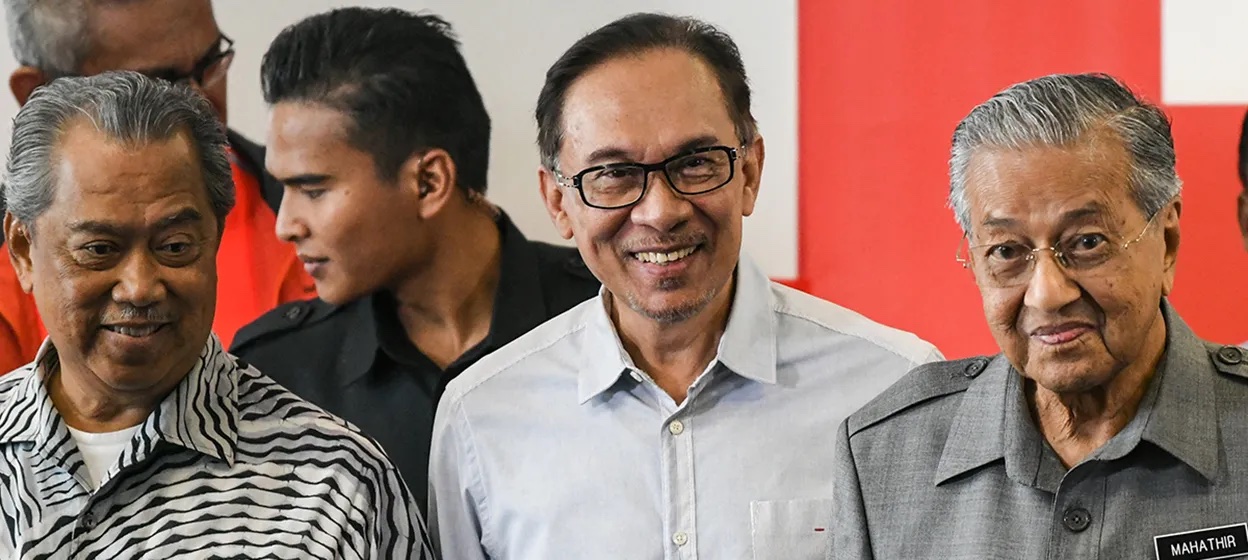
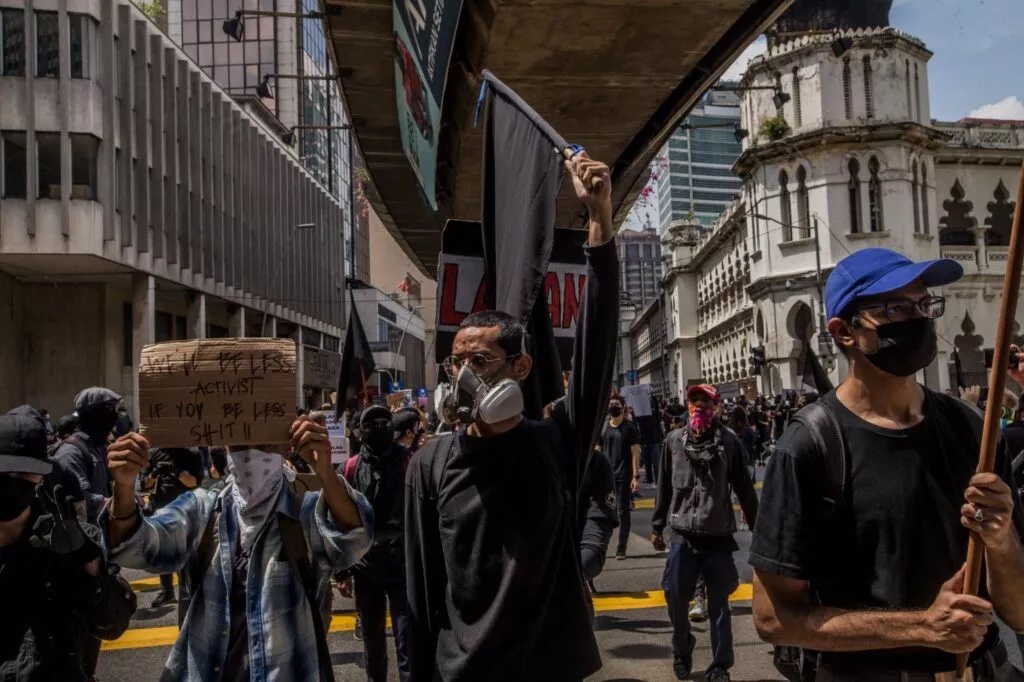






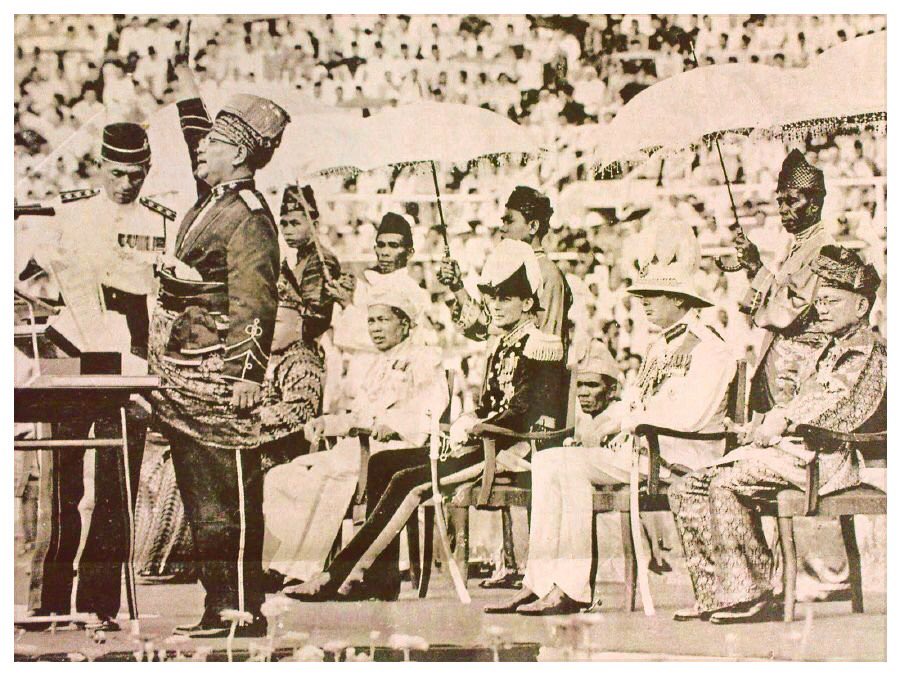

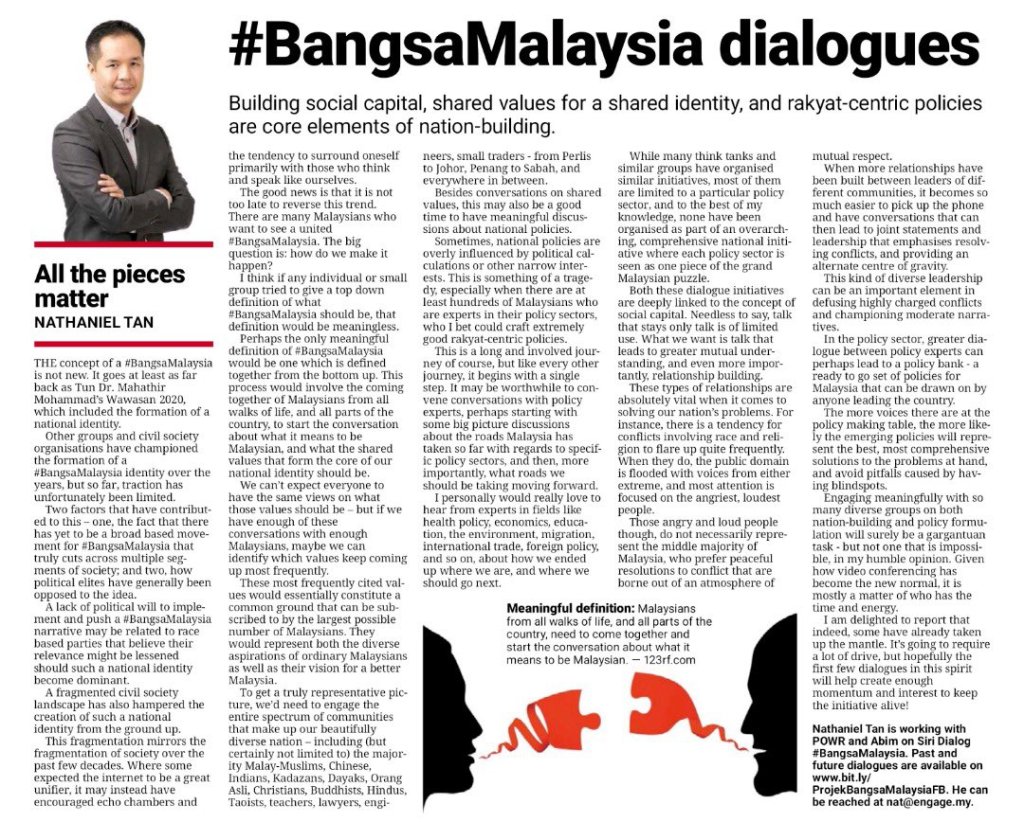
 myAsylum