So, I’m not exactly sure what law(s) the Minister of Housing and Local Government broke – other than pissing PAS off, which last I checked isn’t a crime – but I’m sure the country’s foremost political animal in religious clothing will conjur some obscurantism to justify their favorite pasttime.
As for the 69 reports filed against Hannah Yeoh, I guess it took PAS over 10 years to reach page 7 where the phrase “ambassador of God” (the book was published in 2014); I have witnessed many toddlers read faster than that, which begs the question what mental age PAS collectively has.
All told, despite the rapid industrialization these past few decades, I guess Malaysia is still an agrarian society, with all the rage farming going on. Unfortunate though that rage farming doesn’t offer any positive economic returns… because we sure have a lot of it these days.
So yeah, if anyone has ever wondered why PDRM can’t solve actual and real crimes more than they do, one of the probable reasons is they’re obligated to unnecessarily spend resources to process the multitude of police reports made over the most idiotic of reasons. Malaysians, it would seem, have forgotten the art of intelligent human engagement – you know, like normal human beings in most other parts of the world.
And then, as if the first week and a half of 2025 didn’t already have enough stupidity, we have this whole big brouhaha over the “Addendum Order” by the previous YDPA, in relation to the Pardons Board hearing to address Najib Razak’s sentence for his conviction in the SRC criminal breach of trust (CBT) and power abuse case. For which he was sentenced to 12 years in prison and a fine of RM 210 M (USD 46.6 M at current rates).
To quickly summarize (this AP report has more details): the Pardons Board on 29 January 2024 issued an order to halve Najib’s sentence, pursuant to the Board meeting on the Friday prior (26 January), chaired by the then YDPA (the current Sultan of Pahang). But not long after that Najib claims there was an Addendum Order granting him to serve the remainder of his sentence under house arrest. The Home Ministry, however, stated only the primary order was received by the Prisons Department, but not the so-called Addendum Order.
Fast forward through almost a year of political posturing and finger-pointing, participated by none other than UMNO–the primary actor, which has made the full pardon of their former president their raison d’être–and more recently Perikatan Nasional, jumping on the hot potato bandwagon, for the purpose of milking every drop of political mileage they can.
What the Court of Appeal this past Monday, 6 January 2025 ruled: that there is such an Addendum Order (or at least the Pahang palace’s affidavit that one exists), giving leave for Najib to further pursue this in the High Court. Note, however, that the actual addendum order was never submitted to the Court of Appeal, only an affidavit from the Pahang palace affirming its existence.
A tsunami’s worth of questions arise in my mind:
If there was an Addendum Order (which the Appeals Court has now ruled into being), why wasn’t it mentioned in the official order by the Pardons Board?
When was the Addendum Order issued, and to whom was it addressed to and sent?
Is the Addendum Order even legally valid?
Questions, questions, questions… well, it’s up to the High Court to decide, and some point for the actual Addendum Order to appear. We’ll just have to wait for the next episode in this ongoing political telenovela. That said, I did come across one article that discusses the constitutional and legal aspects of the Addendum Order (an article written by advocate/solicitor GK Ganesan); I leave it to you to read as a homework exercise.
The one silver lining to all this is the government, in particular PMX, has refrained from any undue interference. Many of course don’t buy this, wanting to believe that PMX is pulling strings left, right and centre, hence using him as a focal blame point for, among other things, “hiding the Addendum Order”, and even treason. But as the GK Ganesan article rightly states, there needs to be more transparency on the part of the Government.
The minutes of the Pardons Board would answer the question. We do not have it. The Government should disclose this information. This will eliminate unnecessary speculation.
It is not an ‘official secret’ (and why should it be?). It has nothing to do with national security. Nor is it related to political manoeuvring – or so we are told. In the interest of transparency, there is all the more reason that such information should come before the public.
In any case, that more or less sums the year so far.
Drama. Of Indonesian Sinetron levels, no less.
Sure there were a few other things that happened in the past nine or so days. But what I’ve shared here are the highlights. Or, if you must, lowlights.
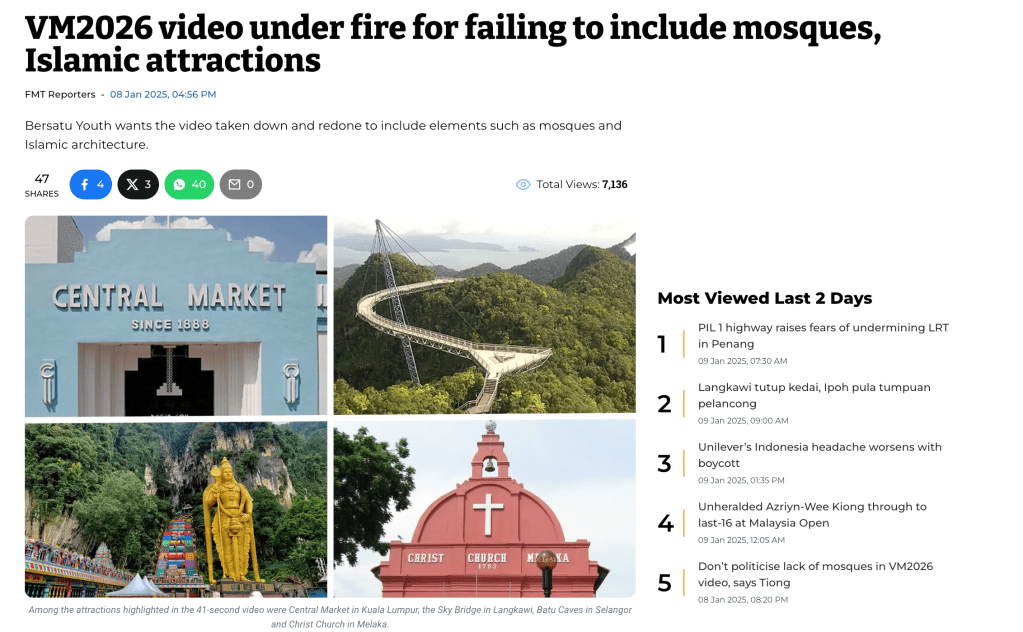
Oh, wait… an ADDENDUM: And this time it’s once again about Malaysia’s favorite agrarian activity: RAGE FARMING (click on the image to view the news report)
And that’s not even touching on the absurdities the incoming POTUS has been spewing the last few days. Which, for the sake of not making this post longer than it already is, I shall leave untouched. For now.
On a more personal note, the year’s been okay to me so far. Then again, it’s only been less than a fortnight. While 2025 doesn’t exactly fill me with much optimism, whatever the year throws at me must be met with positivity; make the best of what’s good, and mitigate the damage of what’s bad. That’s my plan.
So…
an Addendum walks into a bar. Orders a drink. And then another, and another after that… At closing time the barman asks the Addendum to settle the evening’s consumption. Addendum points to its right and says, “Put it on their tab”.
And who should be sitting there if not the people of Malaysia…
Walski’s Note: This is Part II of the third article by guest writer Mikhail Hafiz (follow him at @IMMikhailHafiz on X), a young Malaysian who writes eloquently on nationhood and his thoughts about how Malaysia can progressively move forward. Since this blog has been resuscitated from its deep slumber, I figured it would be a good idea to post more of Mikhail’s writings. This essay is part of Mikhail’s Rediscovering Malaysia series of articles, which he ultimately would like to publish in book form, sometime in the near future. This essay was originally posted as a thread on X, and is presented here with the express permission of the author, and is presented as-is, save some formatting edits.
While it is impossible for our aspiring architect leaders to prepare themselves fully for their roles, they can (and should), with the correct values, attitudes and courage, take on the responsibilities of political stewardship, despite encountering these formidable challenges:
“Old Guards vs Young Turks” Predicament
Will the older generation of leaders be willing to mentor their protégés and relinquish their positions to their successors, so that the latter are given the opportunity to hone their leadership skills?
In other words, will the Old Guards look favourably upon the challenge of incumbency mounted by the Young Turks? Or will they regard their charges sceptically, insisting that the latter are too inexperienced, too rash and too eager to change the world overnight?
As the world continues to evolve and each successive generation ushers in new regional and international political developments, these leaders should be given the opportunity to prove their worth and map out their idiosyncratic, innovative and unorthodox leadership styles, within the constraints imposed by the two pillars of our parliamentary democracy: rule of law and constitutional supremacy.
These perceived political “enfants terribles” should not be seen as a threat to their predecessors, or as disruptive forces in our country.
Perhaps the singular determinant of success or failure in this specific area of leadership is the ability to adopt an attitude of healthy confidence in governance and public engagement, as opposed to one of odious arrogance, and to not conflate the former with the latter.
Where confidence is quiet, focused and contained, arrogance is loud, brash and attention seeking.
As such, studied sprezzatura, no matter how hard it tries, will never possess the seamless stylishness, effortless nonchalance and unforced élan of its authentic, aspirational benchmark.
“Progressive vs Regressive Politics” Paradigm
Will tomorrow’s leaders be able to wean themselves – and the citizenry – from identity politics and resist the temptation to indulge in personality politics, in order to fully embrace inclusionary and reformist politics?
Will they be able to prise Malaysians who are addicted to the fear and grievances being peddled by ethnoreligious tribalists away from rampant racial and religious polarisation?
Will they also be able to free Malaysians who are caught in the clutches of a cult-like adoration of their political counterparts from unquestioning acquiescence and unconditional loyalty to the subjects of their idol and idle worship?
As I have previously opined, in my second article of this series, titled ‘O Bangsa Malaysia, Wherefore Art Thou?‘, which addresses the contentious and perplexing issue of national identity:
“[E]thnocentrism, as an ideology for modern nation building, [is incongruous with Malaysian nationalism, as it] effectively dismisses the inherent and prevailing inter-cultural hybridity and cosmopolitanism of our country … and the South East Asian region …”
In contrast, personality politics develops the conceptual link between persona and power by promoting and showcasing the political leader as a messianic figure.
This elaborate and insidious exercise in illusion is achieved through the employment of a bifurcative stratagem:
1) extolling his many virtues, in order to persuade and convince the target audience – often with additional assist from religious overtones – that this remarkable individual is (apparently) infallible and thus, an indispensable champion and protector of the people; and 2) selectively highlighting the inadequacies and ineptness of his adversaries, in order to perpetrate (and perpetuate) the narrative of an inferior challenger.
While it is ostensibly viewed as the less detrimental ideology, political cultism is as debilitating to the psychological, emotional and philosophical development of a nation, as its regressive counterpart.
As learned educator, scholar and political analyst Bridget Welsh elucidates: “Malaysians see governance by focusing on leaders, putting them on pedestals when they perform and pillorying them when they fail to meet expectations.“
“Lenses are tainted by a history of divisive politics that often forgives unforgivable acts of abuse, and excuses poor performance.“ (source: A Way Forward for Malaysia)
For far too long, Malaysians have demonstrated an overzealous fixation on political personalities and dynasties, instead of focusing on the policies their parties offer.
It is time to supplant a superficial mindset with a substantive outlook.
By clinging stubbornly to identity and personality politics, which are exclusionary and divisive in nature, and no longer serve their purposes in an ethnically plural, religiously diverse and inherently multicultural polity, Malaysia comes across, ideologically and politically, as an antiquated artefact, a relic of the past, instead of serving as an inspirational beacon of meritocracy, equality and justice for one and all, as she continues to be outpaced by, and lag behind, her regional neighbours.
“Certificate of Fairness vs Authoritarian or Mercenary Populism” Conundrum
Can our future leaders demonstrate impartiality by bringing what former Attorney General Tommy Thomas describes as a “Certificate of Fairness” to their decision making process, as former Deputy Prime Minister Tun Dr Ismail Abdul Rahman (widely regarded as “the best Prime Minister Malaysia never had”) did several decades ago?
Or will they, conversely, resort to authoritarian populism, which has saddled Malaysia with the unflattering, uncharitable and undesirable twin monikers of “competitive authoritarian system” and “guided democracy”?
There is also the distinct possibility that they may succumb to mercenary populism, which is characterised by opportunistic political skulduggery and anodyne lip service.
This disingenuous display of fawning, obsequious servitude frequently manifests itself in vacillating stances on salient and emotive issues, and crowd pleasing sound bytes, with the latter often accompanied by ingratiating expressions of appeasement and gratitude.
It is a fate that has, unfortunately yet unsurprisingly, befallen faux centrists and pseudo progressives from both sides of the political divide, in their individual pursuit of political expediency and personal gain.
Also, should any of our future leaders find themselves embroiled in political coups, controversy and corruption, will they be able to free themselves from continually spiralling down the vortex of moral depletion?
More importantly, will they possess the impetus to do so, especially if they appear to have divested themselves of their moral compasses, instead of merely misplacing these “cumbersome appliances”, which would otherwise broadcast reminders of their moral ineptitude at an alarming frequency?
This is where the prized human attribute of self awareness comes into play.
Without self awareness, there is no self reflection.
Without self reflection, there is no self examination.
Without self examination, there is no self correction.
Without self correction, there is no self development.
Coming to terms with ourselves means coming to terms with our responsibilities, our actions and their consequences.
A conscientious leader constantly examines himself, acknowledges his limitations, and continues to learn and improve.
Bennis, widely regarded as a pioneer in the contemporary field of leadership studies, cautions that “[t]he most dangerous leadership myth is that leaders are born – that there is a genetic factor to leadership”, asserting instead that “[l]eaders are made rather than born.“
It is a viewpoint that receives strong support from legendary sports coach Vince Lombardi (1913-1970): “Leaders aren’t born, they are made. And they are made just like anything else, through hard work. And that’s the price we’ll have to pay to achieve that goal, or any goal.“
Leadership is not only a challenge to be surmounted, but also a responsibility to be shouldered. The success or failure of a leader therefore depends on whether his shoulders are, metaphorically speaking, wide and sturdy enough to bear this sizeable burden.
It is only when our leaders have acquired the requisite expertise and experience that they are able to propagate the kind of statesmanship needed to propel our nation to greater heights.
To paraphrase a popular and well known idiom by one Mohandas Karamchand Gandhi (1869-1948), Malaysia’s future depends on what her leaders do today.
So, do we look to the future with guarded optimism or abject despondency?
How one views the current state of Malaysian political leadership will depend on whether one subscribes to the notion that the glass is always half full, or whether one strongly believes that the glass is perennially half empty.
Eternal optimists will attest to the existence of potential leaders in every generation by referencing statesmen who have (sadly) taken their rightful places in the scintillating constellation of dearly departed political giants, while perpetual pessimists will insist that we are slowly being submerged in the quicksand of dire straits and sinking into political obsolescence and oblivion.
It would not be unreasonable to suggest that the reality lies somewhere in the middle of these two extremes, as evidenced by a coterie of capable politicians whose vocational trajectories appear to be stymied by the lack of leadership opportunities.
Regardless of the obstacles faced by our leaders, it is increasingly infeasible to ignore the tidal wave of individual and collective voices coming from the younger demographic, who are calling for sweeping changes to our stultifying political quagmire.
Understandably, this clarion call for much needed and long awaited institutional, systemic, electoral and procedural reform carries considerable political heft, and deservedly so.
According to an announcement by the Election Commission on 14 January 2022, 1.2 million voters between the ages of 18 and 20 will be able to exercise their democratic right at the ballot box for the first time in the next general election.
This groundbreaking electoral and political development is a result of bipartisan support for the historic amendment to Article 119 of our Federal Constitution (Qualification of electors) that lowers the voting age from 21 to 18 years old.
Thomas Fann, Chairman of the Coalition for Clean and Fair Elections (Bersih 2.0), has projected that “18- to 40-year-olds would make up 12.2 million or 58 per cent of the total electorate if an election is held in the middle of next year.“
He further opines: “Young voters will be the kingmakers in the future elections. Whichever party or coalition that aspires to rule the country must appeal to this group. Ignoring them would be political suicide.“ (Source: Channelnews Asia)
Youth voters are not only clamouring for reforms, but also for a new generation of leaders to spearhead our country, in the face of mounting cynicism, anger, frustration and exasperation at the incumbent political elites due to their diabolically incompetent governance.
In an incisive and insightful article chronicling the turbulent past year in Malaysian politics, erudite political anthropologist Sophie Lemiere perceptively concludes:
“As the politicking continues and the political culture remains entrenched, recent years have shown that, more than ever, Malaysia’s political scene needs to bid farewell to its titans and allow a new generation to rise.“ (source: Center for Strategic & International Studies)
While a leader may not necessarily shoulder the responsibility of political stewardship for life, he should always be in the service of life.
As Welsh eloquently espouses: “Public service as opposed to personal servicing needs to be centre stage. Care needs to be taken to show the public that efforts are in their interests, not those of the elites.“ (source: Malaysiakini)
Her astute observation echoes the gold standard of vocational professionalism that is memorialised in the timeless words of the late P. Patto (1947-1995), Malaysia’s very own Exceptional Everyman, and one of our nation’s most distinguished statesmen: “The choice by the electorates in any election or by-election must be held in high esteem and not treated as a licence to trade one’s position as a Member of Parliament or State Assemblyman for personal gains and clarifications.“
When the time comes for the mantle of leadership to be handed over to the next generation, our future leaders must remember that they owe their leadership to those who have elected them into positions of power and authority.
They must not just promise. They must also deliver.
Our leaders must truly serve their people with vision, drive and commitment.
If we do not ascend to the peak of a mountain, we will not comprehend the highness of the heavens.
If we do not descend to the basin of a valley, we will not countenance the depths of the earth.
If we do not bear witness to the profound words handed down by the ancient wise men, we will not understand the greatness of life.
Leadership is a learning process.
The youth of today have to learn how to be exemplary leaders of tomorrow.
DEDICATION: To Kasthuri Patto (@PattoKasthuri on X): It is my personal opinion that no treatise which comprehensively examines the topic of Malaysian political leadership is complete without a reference to your late father’s uncompromising integrity, indefatigable efforts and indomitable spirit.
His words of wisdom, which I have included in this article (towards the end of Part II), resonate as clearly and unequivocally today as they did 37 years ago, when they were read and heard for the very first time.
Walski’s Note: This is the third article by guest writer Mikhail Hafiz (follow him at @IMMikhailHafiz on X), a young Malaysian who writes eloquently on nationhood and his thoughts about how Malaysia can progressively move forward. Since this blog has been resuscitated from its deep slumber, I figured it would be a good idea to post more of Mikhail’s writings. This essay is part of Mikhail’s Rediscovering Malaysia series of articles, which he ultimately would like to publish in book form, sometime in the near future. This essay was originally posted as a thread on X, and is presented here with the express permission of the author, and is presented as-is, save some formatting edits.
Leadership is the capacity to translate vision into reality.
Warren Gamaliel Bennis (1925-2014)
(Standfirst: Malaysia’s leadership crisis has come to resemble the Twilight Zone: an arid, desolate nowhere land where the modest expectation of leadership by example meets the harsh reality of leadership by absentia. The solution to this imbroglio lies in the future generation.)
[NOTE: In Part I, I delineate a holistic approach for the cultivation of advantageous and covetable leadership values, identify the five different types of leaders in the international political firmament, and argue for the necessity of architect leaders in our country.
In Part II, I develop the substantive chronological connection between youth and leadership by examining the challenges faced by the younger generation in equipping themselves with the expertise and experience to successfully shoulder the burden of political stewardship.]
A little caterpillar hatches from its eggshell and grows until it reaches its full size. It then spins itself a cocoon. In this chrysalis stage, it undergoes great changes. The metamorphosis complete, a beautiful butterfly emerges, ready to explore the world.
Similarly, a child born into this world grows and advances into the stage of youth, a period of significant development, and matures into adulthood to take his place as a leader in society.
And what better place for our future leaders to start their training than at home. If their parents and siblings, their first teachers, exemplify love, tolerance and respect towards one another, then they can also acquire these positive values.
It is, however, the years spent at school, totalling more than a decade, that are the most formative and impressionable years of their lives. In the classroom, they learn to ask questions, solve problems, come to logical conclusions and make the right decisions.
Outside the classroom, they are presented with the opportunity to develop their team-building, communicative and leadership skills through extra-curricular and sporting activities. They are, so to speak, in the chrysalis stage.
As these individuals progress from adolescence to adulthood, they continue to cultivate commendatory values and develop their leadership skills, whether they opt for tertiary education, choose to pursue a technical or vocational qualification, enrol in an apprenticeship programme, accept a position of gainful employment in a commercial enterprise or not-for-profit organisation, or explore their entrepreneurship abilities by setting up their own businesses.
Charity work and voluntary participation in political organisations also provide our prospective and fledgling leaders with the opportunity to inculcate laudatory values and habits, and master new leadership skills.
Just as it takes an entire proverbial village to raise a child, it is the “whole of society” approach that is, to a significant extent, responsible for the emergence of intelligent, empowered and virtuous leaders.
Also, just as it is the strong and resilient butterfly that survives in the polluted environment, it is the leader with unassailable rectitude who demonstrates fortitude of character to rise above moral depravity, by imbibing a multitude of noble and prized human attributes.
And what might these advantageous and covetable leadership values be?
These are the qualities I would look for in a leader.
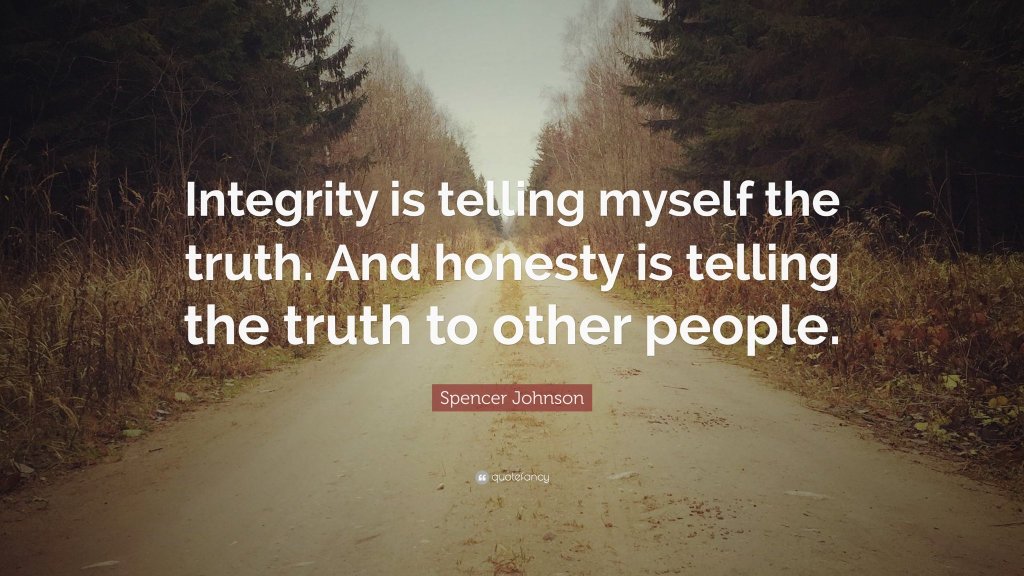
If we define “integrity” as “telling myself the truth”, and “honesty” as “telling the truth to others”, as American physician and writer Spencer Johnson (1938-2017) has done, then it is imperative that a leader not only acknowledges verifiable truths (ie, truths that are substantiated by statistical evidence and factual statements) but also communicates these truths to others, without engaging in intentional misrepresentation and premeditated manipulation.
Should he fail to do so, the erosion of trust that consequently follows, from within his own political cabal (colleagues, subordinates, coalition partners) and without (fellow legislators, citizenry, regional counterparts, international community) will inevitably lead to a respect deficit, which eventually results in a lack of cooperation and legitimacy issues.
Humility is also a great asset to a leader. It is never easy to be humble and it is even more difficult for those who lack personal foresight and worldly experience to practice humility.
We do not like to be criticised. We do not like to be told we are wrong. We do not like to have our faults pointed out. However, we must realise that constructive criticism is dispensed by those who possess clarity and insight with our best interests at heart.
After all, some of the most valuable lessons and arcane truths are derived from acknowledging our errors and examining our mistakes. It is part and parcel of what humanity has come to regard as the learning process.
Despite the substantial influence of the political elite and the indelible impact of their decisions in determining the trajectory of a nation, it is somewhat surprising to discover that there is a scarcity of academic literature devoted to the study of political leadership.
As established academic and prolific columnist Benjamin Laker notes: “Leadership literature comprises thousands of works – hundreds of which are typologies that categorize leaders in ways to explain their actions.“
“But very few examine political leadership. And given the rise of populist parties and alternative facts, advancing understanding of actions taken by politicians is crucial.“ (from Benjamin Laker’s article published at Forbes.com)
In 2020, the application of a typology developed by the Harvard Business Review to the political industry resulted in the identification of five types of leaders that populate our global political landscape: surgeon, soldier, accountant, philosopher and architect.
For purposes related to the discussion of the issues examined in this essay, a compact yet comprehensive description of each type of political leader, as articulated by Laker, follows –
Surgeon leader: decisive and incisive; focuses on delivering short term impact via targeted troubleshooting (ie, identification and prioritisation of critical stress points); transformation is temporary as the entity is heavily reliant upon the leader himself.
Soldier leader: focuses on maintaining order and increasing efficiency by trimming and tightening resources, and concentrating on the bottom line with an insatiable tenacity; fixation on operational details however drives a culture and climate of fear and uncertainty.
Accountant leader: comparatively moderate and resourceful; opposes austerity politics and operates systematically, focusing on economic growth; often described as creative financiers; economic performance usually increases during their tenure and after their departure.
Philosopher leader: a passionate debater who enjoys discussing the merits of contesting approaches; often guided by principles driven by dogma; inspiring to those who share a prevailing ideology while marginalising to detractors, thus creating an echo chamber.
What Malaysia desperately needs, in such troubled, troubling and trying times, is architect leaders: insightful and visionary individuals who “focus on redesigning and transforming to build long-term sustainable impact.”
Architect leaders possess the best attributes of the other four types of leaders. They also, according to Laker, “exemplify the concept of Servant Leadership – an interconnected series of principles coined by Robert Greenleaf in 1977 that focuses on stewardship.”
And what could be more pertinent in the representative democracy that is Malaysia than the principle of political stewardship, especially when some of our incumbent politicians have come to regard their elected positions as a birthright, legacy or entitlement?
While the tenure of an architect leader usually produces steady performance improvement, he is often vilified by those who gravitate towards immediate impact and short term gratification, precisely because of his commitment to long term sustainability.
However, it is humbly submitted that such nearsighted individuals, who tend to prioritise short term benefits over long term gains, fail to consider and appreciate the intrinsic truth encapsulated in the following words of wisdom by former American president Theodore Roosevelt Jr (1858-1919): “This country will not permanently be a good place for any of us to live in unless we make it a reasonably good place for all of us to live in.“
DEDICATION: To Kasthuri Patto (@PattoKasthuri on X): It is my personal opinion that no treatise which comprehensively examines the topic of Malaysian political leadership is complete without a reference to your late father’s uncompromising integrity, indefatigable efforts and indomitable spirit.
His words of wisdom, which I have included in this article (towards the end of Part II), resonate as clearly and unequivocally today as they did 37 years ago, when they were read and heard for the very first time.




 myAsylum