
Sadly, the overall trend in freedoms this past year has been to move backwards, not forward.
Bridget Welsh, Malaysiakini, Dec 10 2024
So, you must be wondering: who the heck is Marty and why does he need to be reformed?
For the longest time, Prime Minister Anwar Ibrahim’s rallying call has been about reform – or, in the Malay language, reformasi – from the time he got kicked out of cabinet in 1998 pretty much.
Since I trust that you, dear readers, still have analytical brain cells swimming in your noggin, you’re now fully clued in to what this post is all about. I hope.
More and more we see on social media that PH’s promised reforms have thus far – two years on – remained just that: promises. The most recent examples being Fahmi Reza getting hauled up by the police for his satirical caricature of newly appointed Sabah TYT Musa Aman; excuse me… Tun Musa Aman to us the unwashed masses; and Hadi Awang getting called in for questioning over his opinion piece about the Batu Puteh sovereignty issue.
In other words, the optics (at least) indicate that freedom of expression is being curtailed at a level similar to them BN days of yore. Some even say it’s worse than those days. Granted, correlation doesn’t imply causation, but could it be that BN being in the unity government has something to do with these recent crackdowns? And by BN I really mean UMNO, since the other component parties are pretty much inconsequential.
Also of concern are the laws that give broad powers to certain individuals and agencies, for example, the recently passed amendments to the Communications and Multimedia Act (read the concerns raised by Article 19) giving MCMC almost unbridled and unquestionable powers. And then there’s the licensing of social media platforms, imposing a “strict liability on service providers for user-generated content” (from the Article 19 posting), which will very likely incentivise platforms to remove content that they deem may be ‘problematic’ – in layperson’s terms: arbitrary censorship by the platforms, potentially. And since social media platforms are fast replacing human arbiters with AI-driven algorithms, it may lead to a situation where anything with an iota of a whiff of being problematic may be removed.
In fact, I believe this is already happening: Fahmi Reza’s TikTok account was banned while he was livestreaming a lecture session at the Universiti Malaya campus a few days ago, without any reasons given other than the generic “multiple policy violations” excuse. As of the publishing of this post, however, it’s been reported that his account has been reactivated and accessible again.
So bottom line, when it comes to individual freedom of expression, it would seem like we’re regressing. Similarly, with human rights in general, as stated in SUARAM’s 2024 Human Rights Report.
On the economic front, Malaysia seems to be on the right track. On the macro level, at least. On the ground, however, we’re still feeling the pinch when it comes to the cost of living. Important reforms to subsidies are in the works, particularly to remove blanket subsidies on fuel to a regimen that’s targeted to the lower income groups that need them the most. At present Malaysia has the lowest petrol prices in Southeast Asia.
Anwar Ibrahim maintains, however, that promised reforms are in progress and will be delivered:
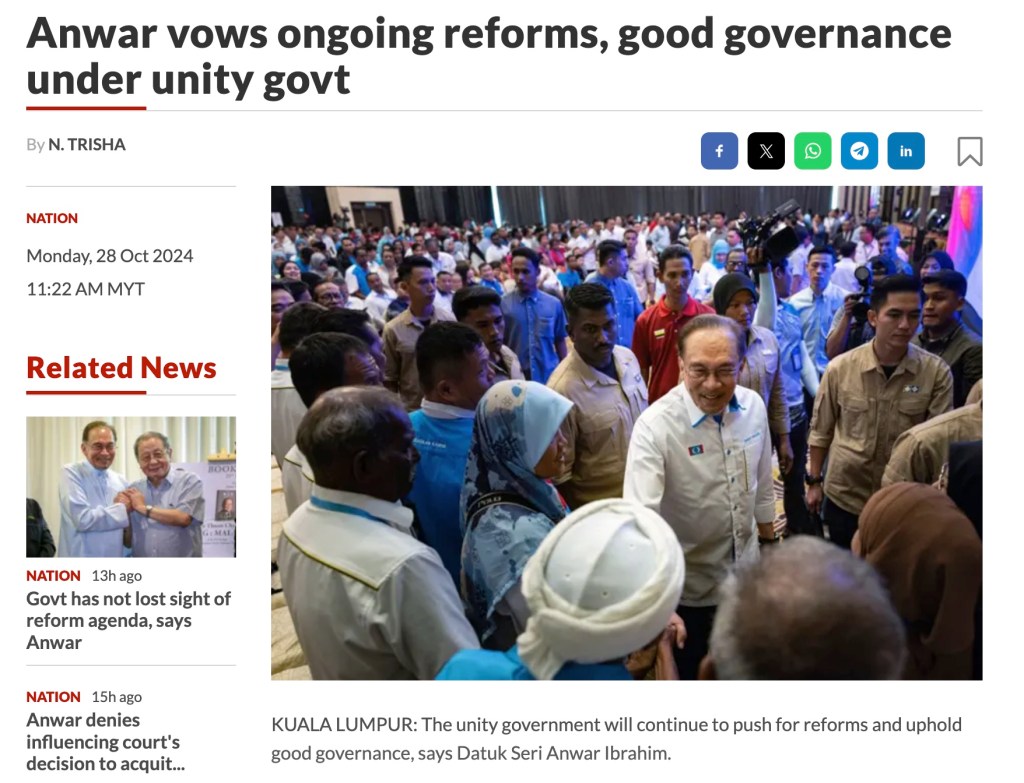
and even more recently:
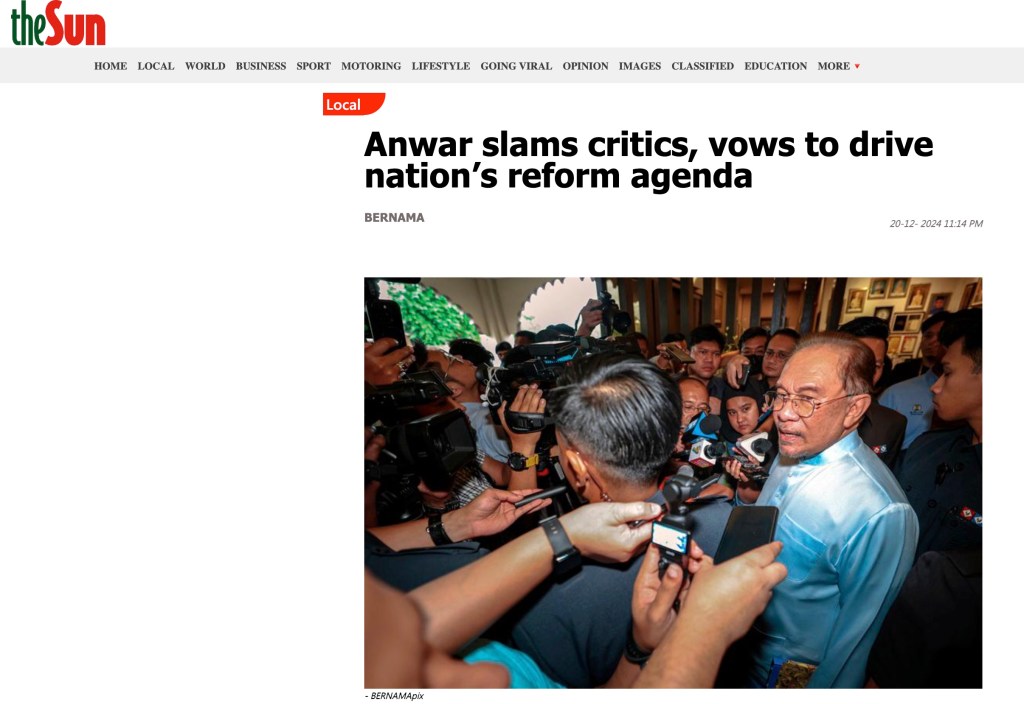
It’s true that the primary focus of perceived regression has been on human rights and freedom of expression, and almost zero focus on governance. But if my assessment of sentiments based on my observations is accurate, I would also add that not enough has been done to properly communicate these governance reform initiatives; simply because next to no one is talking about them within the online sphere.
It doesn’t help when things like the dropping of charges in the Rosmah Mansor case, and the dropping of the appeal against the dismissal of charges in the case of Zahid Hamidi happen. Even if the former is due to faulty charges, thus rightly dismissed by the presiding judge (but not so much for the Zahid Hamidi case), as long as there’s no separation of the Attorney General and Public Prosecutor roles, there will always be the lingering notion that these were done at the behest of the government, and in particular, of the PM.
Anwar has denied involvement, but the optics have nonetheless been damaging. And optics contributes greatly towards perception, which in turn colours what’s regarded as “truth“. More damaging is what I’m seeing as an erosion of PH’s support base as a result.
And if that erosion continues, PH could just find itself in the same position of the Democrats in the recent US Presidential Elections. Academic Bridget Welsh, for whom I have great respect, outlines some valuable lessons to be learnt from Trump’s triumph and second coming.
The difference with Malaysia, however, is that Perikatan Nasional (PN) falls way short in the credibility department when it comes to being an opposition block. Sure, it has loads of support, particularly for PAS, based on their religious cred (and not much else) that has great appeal for the increasingly conservative Malay demographic who somehow yearn for greater control over every minutiae of their lives and somehow have lost the ability to think for themselves. Another downside of the tongkat mentality, perhaps?
In any case, back to Marty… are the prospects of reform completely dead in Malaysia? Anwar says NO, but increasingly voices on the ground seem to think so. And with systemic reforms to the economy apparently in progress, the short-term negative effects will likely amplify those on-the-ground voices even more.
The rollback of fuel subsidies – done for diesel, to be implemented for RON95 in the near future – is bound to cause even more negative sentiments towards the PH-helmed unity government.
I have always maintained that change isn’t easy, and that often with change things get worse before they get better. Inertia, part and parcel of governmental bureaucracies, is partly to blame; as is the fact too many basic needs in our lives have been subsidized over the decades.
And why have wages been stagnant? I don’t know for sure, but I theorize it’s partly because of the desire for wages to be suppressed so that we appear more “competitive” cost-wise, to attract Foreign Direct Investments. Similarly with the undervalued Ringgit.
Reversing things like these require systemic overhauls which take time to realize – the longer policies have been in place, the longer it’ll take to overhaul them. Even then, economic policies are not instant noodles – effects aren’t immediate and sometimes takes years only to discover that the world has changed (again), and so further adjustments are required. Compounding this is the fact Malaysia doesn’t exactly have a good track record of metrics surveillance nor the agility to make timely corrections. Oh, and the habit of perpetuating and repeating mistakes but hoping for different outcomes.
So yeah, things are gonna be a lot worse before they can get better. If they get better…
All that said, personally, I think there’s still hope, although I’m not entirely optimistic looking at things through reality-tinted glasses. We’re roughly two years into Madani, with three more to go if the current government goes the full term. What transpires in 2025 will be important to watch, and God-willing, I’ll update my thoughts as we stumble along.
Reform Marty? No, I wouldn’t exactly say that. Yet. Let’s just say Marty’s gotta up his game… by leaps and bounds.
 myAsylum